

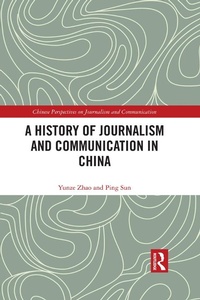
A History of Journalism and Communication in China
1st Edition
Published on 11. May 2018
182 pages
978-1-317-51931-7 (ISBN)
Description

From a modern perspective, journalism is highly relevant to modern society, along with the emergence of mass printing system and professionalisation. This book, however, expands the meaning of journalism and views it as a social process. It will not only explore the roots and development of Chinese journalism and communication, but also demonstrate how Chinese journalism and communication interact and struggle with social culture and politics.
Arranged in chronological order mainly, this book examines the initial development of Chinese journalism in ancient times in chapter 1, which from then manifested strong political attributes. After the Opium War in 1840, missionaries and businessmen from the West started to set up newspapers and periodicals in China, which brought about the birth of China's modern journalism industry. Then China's private newspapers and political party's press are studied, which are closely linked with political revolutions and have a far-reaching impact on modern Chinese society. What happened to Chinese journalism and communication after the founding of People's Republic of China in 1949? This book reviews the newspaper reforms, and studies the great negative impacts brought by "Cultural Revolution". Noteworthy news phenomena after the reform and opening-up are also covered.
This book will appeal to scholars and students in journalism, communication and Chinese studies. Readers interested in Chinese society and modern Chinese history will also be attracted by it.
Arranged in chronological order mainly, this book examines the initial development of Chinese journalism in ancient times in chapter 1, which from then manifested strong political attributes. After the Opium War in 1840, missionaries and businessmen from the West started to set up newspapers and periodicals in China, which brought about the birth of China's modern journalism industry. Then China's private newspapers and political party's press are studied, which are closely linked with political revolutions and have a far-reaching impact on modern Chinese society. What happened to Chinese journalism and communication after the founding of People's Republic of China in 1949? This book reviews the newspaper reforms, and studies the great negative impacts brought by "Cultural Revolution". Noteworthy news phenomena after the reform and opening-up are also covered.
This book will appeal to scholars and students in journalism, communication and Chinese studies. Readers interested in Chinese society and modern Chinese history will also be attracted by it.
More details
Series
Edition
1. Auflage
Language
English
Place of publication
London
United Kingdom
Publishing group
Taylor & Francis Ltd
Target group
College/higher education
Professional and scholarly
Illustrations
1 Line drawings, black and white; 3 Halftones, black and white; 4 Illustrations, black and white
ISBN-13
978-1-317-51931-7 (9781317519317)
Copyright in bibliographic data and cover images is held by Nielsen Book Services Limited or by the publishers or by their respective licensors: all rights reserved.
Schweitzer Classification
Other editions
Additional editions
Yunze Zhao | Ping Sun
A History of Journalism and Communication in China
Book
06/2020
1st Edition
Routledge
€52.07
Shipment within 15-20 days
Yunze Zhao | Ping Sun
A History of Journalism and Communication in China
Book
05/2018
1st Edition
Routledge
€238.09
Shipment within 10-20 days
Persons
Yunze Zhao is an Associate Professor and Associate Dean in School of Journalism and Communication, Renmin University of China. His research interests include history of Chinese journalism and communication, new media, etc.
Ping Sun is an Assistant Professor in the Institute of Journalism and Communication, Chinese Academy of Social Sciences. Her research focus lies in new media and history of Chinese communication.
Ping Sun is an Assistant Professor in the Institute of Journalism and Communication, Chinese Academy of Social Sciences. Her research focus lies in new media and history of Chinese communication.
Content
Introduction Chapter 1 The Ancient Communication Mechanism of Public Opinion of China Chapter 2 The Establishment of Chinese Modern Newspaper Industry Chapter 3 The Development of Chinese Private Newspapers Chapter 4 The Development of Chinese Newspapers of Political Party Chapter 5 The Development of Journalism and In-depth Reporting Chapter 6 The Development of Modern Journalism in Hong Kong, Macaw and Taiwan References
