

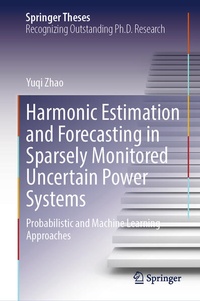
Harmonic Estimation and Forecasting in Sparsely Monitored Uncertain Power Systems
Description

This book tackles the technical challenges of integrating renewable energy sources into power grids to reduce exposure to significant financial and operational risks. It does so by introducing advanced methods for harmonic estimation and forecasting in sparsely monitored and uncertain power networks, leveraging probabilistic and machine learning techniques.
With a focus on practical applications, the book introduces a Monte-Carlo-based simulation framework to address operational randomness and uncertainties, along with the development of a Norton equivalent model of wind farms for probabilistic harmonic propagation studies. The author also presents cost-effective methods for harmonic estimation in non-radial distribution networks and proposes a sequential artificial-neural-network-based approach for probabilistic harmonic forecasting in transmission networks with limited harmonic measurements. By significantly reducing the reliance on extensive power-quality-monitoring installations, these methods provide robust, accurate, and reliable harmonic data and enable more effective and informed decision-making for future power system operations.
Targeted at academic researchers, industrial engineers, and graduate students, this book matches theoretical advance with practical application. It supports the assessment of standard compliance and benchmarking, minimizes the need for power-quality-monitoring installations, accelerates the evaluation of harmonic propagation and mitigation strategies in uncertain, power-electronics-rich networks, and advances the forecasting of potential harmonic issues in future power systems.
More details
Other editions
Additional editions
Person
Dr. Yuqi Zhao holds B.Eng., M.Sc., and Ph.D. degrees in power system engineering from the University of Manchester, UK, where she was supervised by Prof. Jovica V. Milanovic. She is an active member of the IEEE PES, IET, and CIGRE and has undertaken a visiting research position at Universidad Politécnica de Madrid. In recognition of her academic excellence, Dr. Zhao received the Best Student Paper Award at the IET APSCOM 2018 conference. She has also gained professional experience as a power system engineer with both National Grid of UK and the State Grid Corporation of China. Dr. Zhao's research contributions include multiple peer-reviewed publications in top-tier IEEE transactions journals and presentations at prestigious international conferences, such as the IEEE General Meeting, IEEE PowerTech, IEEE ICHQP, IEEE PMAPS, and CIRED. She has played an active role in multiple EU Horizon 2020 projects, including MIGRATE and CROSSBOW.
Content
Introduction.- Power System Harmonic Modelling.- Harmonic Simulation Studies.- Probabilistic Harmonic Estimation in Non-Radial Distribution Networks.- Application of Machine Learning for Harmonic Estimation in Transmission Networks.- Robustness of the Methodology for Harmonic Forecasting in Transmission Networks.- Conclusions and Future Work.- Appendices.
