

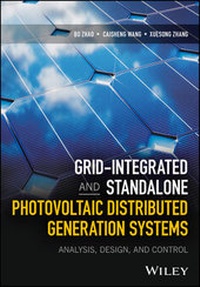
Grid-Integrated and Standalone Photovoltaic Distributed Generation Systems
Description

More details
Other editions
Additional editions
Persons
Content
Preface xiii
1 Overview 1
1.1 Current Status and Future Development Trends of Photovoltaic Generation around theWorld 1
1.1.1 USA 3
1.1.2 Japan 5
1.1.3 Germany 5
1.1.4 China 6
1.2 Current Research Status of Grid-Connected Photovoltaic Generation 8
1.2.1 Characteristics of Grid-Connected Photovoltaic Generation 8
1.2.2 Impact of High-Penetration Photovoltaic Generations on Distribution Networks 9
1.2.3 Research Needs on Massive Distributed Grid-Connected Photovoltaic Generation 11
1.3 Summary 13
References 14
2 Techniques of Distributed Photovoltaic Generation 17
2.1 Introduction to Distributed Photovoltaic Generation 17
2.1.1 Distributed Generation: Definition and Advantages 17
2.1.2 Principle and Structure of Distributed Photovoltaic Generation 18
2.2 Photovoltaic Cells 20
2.2.1 Classification of the Photovoltaic Cells 20
2.2.1.1 Classification Based on Cell Structure 20
2.2.1.2 Material-based PV Cell Classification 21
2.2.2 Development History of Solar Cells 21
2.2.3 Model of a Silicon Solar Cell 22
2.3 Inverter 26
2.3.1 Topology of Connection between Inverter and Photovoltaic Module 26
2.3.2 The Classification and Characteristics of the Inverter 28
2.3.3 Requirements of a Grid-Connected Photovoltaic Inverter 29
2.4 Maximum Power Point Tracking Control 32
2.4.1 Hill Climbing/Perturb and Observe 33
2.4.2 Incremental Conductance 34
2.4.3 Open-Circuit Voltage Method 36
2.4.4 Short-Circuit Current Method 36
2.4.5 Ripple Correlation Control 36
2.4.6 Load Current or Load Voltage MaximizationMethod 37
2.4.7 dP/dV or dP/dI Close-Loop Control 38
2.4.8 Maximum Power Point Tracking Efficiency 38
2.5 Summary 39
References 40
3 Load Characteristics in Distribution Networks with Distributed Photovoltaic Generation 43
3.1 Introduction 43
3.2 Load Characteristics of a Distribution Network 43
3.2.1 Load Types and Indices 43
3.2.2 Time-Sequence Characteristics of Typical Loads 45
3.2.3 Case Study 46
3.3 The Output Characteristics of Photovoltaic Generation 48
3.3.1 Regulations on Grid-Connected Photovoltaic Generation 48
3.3.2 Time-Sequence Characteristics of Photovoltaic Generation 49
3.3.3 Case Study 51
3.4 Characteristics of the Net Load in a Distribution Network with Distributed Photovoltaic Generation 53
3.4.1 Influence of Distributed Photovoltaic Generation on System Load Level 54
3.4.2 Influences of Distributed Photovoltaic Generation on Load Fluctuation 56
3.5 Power and Energy Analysis of Distributed Photovoltaic Generation 57
3.5.1 Effective Power and Equivalent Electricity Generation of Distributed Photovoltaic Generation 57
3.5.2 CalculationMethods of the Correction Coefficients 58
3.6 Summary 61
References 62
4 Penetration Analysis of Large-Scale Distributed Grid-Connected Photovoltaics 65
4.1 Introduction 65
4.2 Economic Analysis of Distributed Photovoltaic Systems 66
4.2.1 Cost/Benefit Analysis of Distributed Grid-Connected Photovoltaic Systems 66
4.2.1.1 Cost Composition 66
4.2.1.2 Income Composition 67
4.2.2 Grid Parity 68
4.3 Large-Scale Photovoltaic Penetration Analysis 70
4.3.1 Further Explanation of Some Concepts 70
4.3.2 Concepts and Assumptions 71
4.3.2.1 Basic Concepts 71
4.3.2.2 Basic Assumptions 73
4.3.3 Power Penetration Analysis 73
4.3.4 Photovoltaics Penetration with Different Types of Load 79
4.4 Maximum Allowable Capacity of Distributed Photovoltaics in Distribution Network 82
4.4.1 Static Characteristic Constraint Method 82
4.4.1.1 Voltage Constraint 83
4.4.1.2 Protection 83
4.4.1.3 Harmonic Limit 85
4.4.2 Constrained OptimizationMethod 86
4.4.3 Digital SimulationMethod 87
4.4.3.1 Maximum Allowable Photovoltaic Capacity in Static Simulation 87
4.4.3.2 Maximum Allowable Photovoltaic Capacity in Dynamic Simulations 87
4.5 Maximum Allowable Capacity of Distributed Photovoltaics Based on Random Scenario Method 88
4.5.1 Algorithm Introduction 88
4.5.2 Case Study 89
4.6 Photovoltaic Penetration Improvement 93
4.6.1 Full Utilization of the Reactive Power Regulation Capability of a Distributed Photovoltaic System 93
4.6.2 Distribution Network Upgrade 93
4.6.3 Demand-Side Response 93
4.6.4 Energy Storage Technologies 94
4.7 Summary 94
References 94
5 Power Flow Analysis for Distribution Networks with High Penetration of Photovoltaics 97
5.1 Introduction 97
5.2 Power Flow Calculation for Distribution Networks with Distributed Photovoltaics 97
5.2.1 Comparison between Power Flow Calculation Methods for Distribution Networks 97
5.2.2 Power Flow CalculationModel for a Distributed Photovoltaics 99
5.2.3 Power Flow CalculationMethod for Distribution Network with Distributed Photovoltaics 100
5.3 Voltage Impact Analysis of Distributed Photovoltaics on Distribution Networks 101
5.3.1 MathematicalModel 101
5.3.2 Simulation Studies 103
5.4 Loss Analysis in Distribution Network with Distributed Photovoltaics 108
5.4.1 MathematicalModel 108
5.4.2 Simulation Results 110
5.5 Real Case Studies 112
5.5.1 Patterns for Distributed Photovoltaics Interconnection 112
5.5.2 Analysis on a Feeder 114
5.5.3 Analysis on SA Substation 118
5.6 Summary 123
References 123
6 Voltage Control for Distribution Network with High Penetration of Photovoltaics 125
6.1 Introduction 125
6.2 Voltage Impact Analysis in the Distribution Network with Distributed Photovoltaics 126
6.3 Voltage Control Measures 130
6.3.1 Automatic Voltage Control System 130
6.3.2 Feeder-Level Voltage Regulation 130
6.3.3 Photovoltaic Inverter 131
6.4 Photovoltaic Inverter Control Strategies 132
6.4.1 General Control Principle 132
6.4.2 Constant Power Factor Control Strategy 132
6.4.3 Variable Power Factor Control Strategy 133
6.4.4 Voltage Adaptive Control Strategy 134
6.4.4.1 Q/V Droop Control 134
6.4.4.2 P/V Droop control 136
6.4.4.3 Inverter Parameter Optimization 136
6.5 Modeling and Simulation 137
6.5.1 Approaches 137
6.5.2 Introduction to OpenDSS 138
6.5.3 SimulationModels 138
6.5.3.1 Automatic Voltage Control System 139
6.5.3.2 Photovoltaic SystemModel 142
6.6 Simulation Analysis 144
6.6.1 Basic Data Preparation for Simulation 144
6.6.2 Analysis of Power Flow and Voltage in Extreme Scenarios with Automatic Voltage Control 147
6.6.2.1 Working Day (July 16, 2014) Scenario 147
6.6.2.2 Holiday (May 1, 2014) Scenario 149
6.6.3 Participation of Photovoltaic Inverter in Voltage Regulation 151
6.6.3.1 Working Day (July 16, 2014) Scenario 151
6.6.3.2 Holiday (May 1, 2014) Scenario 156
6.7 Summary 163
References 163
7 Short-Circuit Current Analysis of Grid-Connected Distributed Photovoltaic Generation 165
7.1 Introduction 165
7.2 Short-Circuit Characteristic Analysis of Distributed Photovoltaic Generation 165
7.2.1 Short-Circuit Characteristic Analysis of Symmetric Voltage Sag of Power Grid 166
7.2.2 Short-Circuit Characteristic Analysis of Asymmetrical Voltage Sag of Power Grid 167
7.3 Low-Voltage Ride-Through Techniques of Photovoltaic Generation 169
7.3.1 Review of Low-Voltage Ride-Through Standards 170
7.3.2 Low-Voltage Ride-Through Control Strategy for Photovoltaic Generation 171
7.4 Simulation Studies 174
7.4.1 Fault Simulations of Photovoltaic Generation without the Low-Voltage Ride-Through Function 174
7.4.2 Fault Simulation of Photovoltaic Generation with the Low-Voltage Ride-Through Function 176
7.4.2.1 Case 1: 80% Voltage Drop ofThree Phases 176
7.4.2.2 Case 2: 80% Voltage Drop of Two Phases 176
7.4.2.3 Case 3: 80% Voltage Drop of a Single Phase 177
7.5 Calculation Method for Short-Circuit Currents in Distribution Network with Distributed Photovoltaic Generation 179
7.5.1 Distribution NetworkModel 180
7.5.2 Calculation Method for Short-Circuit Currents in a Traditional Distribution Network 180
7.5.2.1 Operational Curve Law 181
7.5.2.2 IEC Standard 181
7.5.2.3 ANSI Standard 181
7.5.3 Calculation Method for Short-Circuit Currents in a Distribution Network with Distributed Photovoltaic Generation 182
7.5.3.1 Calculation Method for Symmetric Fault Short-Circuit Currents 183
7.5.3.2 Calculation Method for Asymmetric Fault Short-Circuit Currents 184
7.5.4 Fault Simulation Studies of Distribution Network with Distributed Photovoltaic Generation 186
7.6 Summary 191
References 192
8 Power Quality in Distribution Networks with Distributed Photovoltaic Generation 195
8.1 Introduction 195
8.2 Power Quality Standards and Applications 195
8.2.1 Power Quality Standards for Grid-Connected Photovoltaic Generation 196
8.2.2 Power Quality Requirements Stipulated in Standards for Grid-Connected Photovoltaic Generation 196
8.2.2.1 Voltage Deviation 197
8.2.2.2 Voltage Fluctuation and Flicker 198
8.2.2.3 Voltage Unbalance Factor 199
8.2.2.4 DC Injection 199
8.2.2.5 Current Harmonics 199
8.2.2.6 Voltage Harmonics 204
8.3 Evaluation and Analysis of Voltage Fluctuation and Flicker for Grid-Connected Photovoltaic Generation 206
8.3.1 Evaluation Process 207
8.3.1.1 First-Level Provisions 207
8.3.1.2 Second-Level Provisions 207
8.3.1.3 Third-Level Provisions 208
8.3.2 Calculation 208
8.3.2.1 The First-Level Evaluation for Photovoltaic Integration 208
8.3.2.2 The Second-Level Evaluation 208
8.4 Harmonic Analysis for Grid-Connected Photovoltaic Generation 211
8.4.1 Fundamentals of Harmonic Analysis 211
8.4.1.1 Harmonic Simulation Platform 211
8.4.1.2 Photovoltaic Harmonic Model 213
8.4.2 Harmonic Analysis of Photovoltaic Generation Connected to a Typical Feeder 218
8.4.2.1 Harmonics Analysis of Centralized Photovoltaic Connection 219
8.4.2.2 Harmonics Analysis of Photovoltaic Connection in a DistributedWay 223
8.4.3 Analysis of Practical Cases 224
8.5 Summary 225
References 225
9 Techniques for Mitigating Impacts of High-Penetration Photovoltaics 227
9.1 Introduction 227
9.2 Energy Storage Technology 227
9.2.1 Classification of Energy Storage Technologies 228
9.2.1.1 Mechanical Energy Storage 228
9.2.1.2 Electromagnetic Energy Storage 229
9.2.1.3 Phase-Change Energy Storage 229
9.2.1.4 Chemical Energy Storage 229
9.2.2 Electrochemical Energy Storage 229
9.2.2.1 Lead-Acid Battery 230
9.2.2.2 Lithium-Ion Battery 231
9.2.2.3 Flow Cell 232
9.2.3 Electrochemical Energy Storage Model 233
9.2.3.1 MathematicalModel 233
9.2.3.2 Life Model 235
9.3 Application of Energy Storage Technology in High-Penetration Distributed Photovoltaics 236
9.3.1 Siting and Sizing Methods for Energy Storage System 236
9.3.1.1 Siting of Energy Storage System 236
9.3.1.2 Sizing of the Energy Storage System 237
9.3.2 Case Simulation 238
9.4 Demand Response 242
9.4.1 Introduction 242
9.4.1.1 Price-Based Demand Response 242
9.4.1.2 Incentive-Based Demand Response 243
9.4.2 Load Characteristics of Demand Response 245
9.5 Application of Demand Response in Distribution Networks with High Penetration of Distributed Photovoltaics 247
9.5.1 Incentive-Based Demand Response OptimizationModel 247
9.5.1.1 Incentive-Based Demand Response Model 247
9.5.1.2 Constraints 249
9.5.2 Incentive-Based Demand Response Algorithm 249
9.5.3 Case Simulation 251
9.6 Cluster Partition Control 252
9.7 Application of Cluster Partition Control in Distributed Grid with High-Penetration Distributed Photovoltaics 256
9.7.1 Community-Detection-Based Optimal Network Partition 256
9.7.2 Sub-community Reactive/Active Power-Voltage Control Scheme 259
9.7.3 Case Study 261
9.8 Summary 270
References 271
10 Design and Implementation of Stand-aloneMultisource Microgrids with High-Penetration Photovoltaic Generation 273
10.1 Introduction 273
10.2 System Configurations of Microgrids with Multiple Renewable Sources 274
10.2.1 Integration Schemes 274
10.2.2 Unit Sizing and Technology Selection 277
10.3 Controls and Energy Management 278
10.3.1 Centralized Control Paradigm 278
10.3.2 Distributed Control Paradigm 279
10.3.3 Hybrid Hierarchical Control Paradigm 280
10.4 Implementation of Stand-alone Microgrids 281
10.4.1 Dongfushan Microgrid: Joint Optimization of Operation and Component Sizing 282
10.4.1.1 System Configuration 282
10.4.1.2 Operating Strategy 283
10.4.1.3 OptimizationModel 287
10.4.1.4 System Sizing Optimization 291
10.4.1.5 Optimal Configuration and Operation Practice 297
10.4.2 Plateau Microgrid: A Multiagent-System-Based Energy Management System 299
10.4.2.1 System Configuration 299
10.4.2.2 Multiagent-System-Based Energy ManagementMethod 301
10.4.2.3 Validation of the Microgrid Energy Management System 307
10.5 Summary 309
References 310
Index 315
Chapter 1
Overview
1.1 Current Status and Future Development Trends of Photovoltaic Generation around the World
With the growing `challenges in global resource depletion, global warming, and ecological deterioration, increasing attention has been given to renewable energy generation, especially to photovoltaic (PV) generation. The global market of PVs has experienced a rapid increase since 1998, with a yearly increase of 35% of the installed capacity. The total PV installed capacity was 1200 MW in 2000, and PV installations rose rapidly up to 188 GW in 2014 and is projected to be 490 GW by 2020 [1]. With the rapid development of the PV industry, the market competition is getting increasingly fierce. The investment in the PV market is being boosted in some countries and regions, like the USA, China, Japan, and Europe. By the end of 2014, the global production of PV modules was around 50 GW, in which China increased 27.2% from the previous year to 35 GW, contributing 70% of the global production [2]. The global production of PV modules is expected to reach 85 GW and maintain the momentum of rapid growth [3].
Recently, a number of countries announced their policies and plans to further promote the development of PVs [4, 5]. The US Environmental Protection Agency (EPA) published its Clean Power Plan on June 2, 2014, promising that the usage of renewable energy (including solar energy) will be doubled within 10 years. The US Department of Energy (DOE) will spend $15 million to help families, enterprises and communities develop the solar energy program [6]. The Japanese Government enacted laws, like the Renewable Energy Special Measure Law and the Renewable Portfolio Standard Law, to identify the development objectives of new energy in Japan and the responsibilities of the participating parties [7]. China has highlighted a few key and crucial demonstration projects of the PV technologies in the Outline of the National Program for Long- and Medium-Term Scientific and Technological Development (2006-2020), the National 11th Five-Year Scientific and Technological Development Plan and the Renewable Energy 12th Five-Year Plan [4-8].
It is noteworthy that the USA and Japan have both worked through the PVs "Industry Roadmap Through 2030 And Beyond." Japan expects that the future research and development pattern of PVs could be changed from creating an initial PV market based on the government's guide to creating a mature PV market based on cooperation and work sharing among academia, industry, and government, and targets to have a total PV installation capacity of 100 GW in 2030. The USA anticipates that the development pattern of the PV industry could be changed from export led to national investment oriented, promoting the industry's significant growth by devoting on the advancement of technologies and market and expansion of the domestic demand. It is projected to install 19 GW of PVs yearly in the USA, with the expectation of a total installed capacity of 200 GW by 2030. By then the cost of the PVs will decline to $0.06/kW, and PVs will make up an important part of the electricity market and become one of the main sources of electricity.
As to the development of the PV industry in China, from the viewpoint of the current status and future trend, the estimated installed capacity was for 300 MW, 1.8 GW, 10 GW, and 100 GW in 2010, 2020, 2030, and 2050 respectively in the Medium and Long Term Development Plan of Renewable Energies (2007), which is apparently lower than actual development and lags behind the trend of the PV industry. Meanwhile, China has not proposed clear goals of the method, direction, and path for developing the critical technologies and devices that has already limited the advancement of the PV industry. In terms of the grid-connected PVs, there is a lack of complete and systematic regulations and policies for operation and management, electricity price, and system maintenance. Therefore, actively promoting the research and practical applications in the Chinese PV industry to follow the main stream of the global PV industry development will be of profound significance in the future.
At present, some developed countries (such as the USA, Germany, Australia, Japan, etc.) are leading the research and development of PV technologies. For example, Australia, represented by Professor Martin A. Green from the University of New South Wales, has made a great contribution to the development of PV cells by leading the research of single crystalline silicon solar cells in the world and proposing the concept of the third-generation PV cells [9]. The USA, the UK, Germany, Spain, Japan, and so on initiated the PV industry and applications early and have experienced rapid development. Although China's PV industry started late, it has experienced exponential growth. Especially after 2004, stimulated by the large demand from the European market, China's PV industry has boomed and saw over 100% yearly growth for five years in a row. In 2007, China became the largest producer of PV cells. China's PV production exceeded 50% of global production in 2010. China has gradually formed an orbicular chain in the PV industry, from silicon material, PV cells, to PV systems and applications [10, 11]. As shown in Table 1.1, China's PV manufacturers now take a dominant role in the world's PV production. Of the world's top 10 PV manufacturers, six are from China and all the top five are from China. Among them, the number one manufacturer Trina Solar produced 3.66 GW in 2014, closely followed by Yingli Green Energy, which yielded 3.36 GW [2].
Table 1.1 World's top 10 PV manufacturers in 2014
Manufacturer Country Rank Production (GW) (%) Trina Solar China 1 3.66 14.6 Yingli Green Energy China 2 3.36 13.4 Canadian Solar China 3 3.11 12.4 Jinko Solar China 4 2.94 11.7 JA Solar China 5 2 8.0 Sharp Japan 5 2 8.0 Renesolar China 7 1.97 7.8 First Solar USA 8 1.85 7.4 Hanwha SolarOne South Korea 9 1.45 5.8 Sunpower USA 10 1.4 5.6In 2014, global PV installations increased by 17%, while the total installed capacity reached 47 GW. Figure 1.1 shows the market share of the world's top 10 PV countries in 2014. The top 10 countries were China, Japan, the USA, the UK, Germany, France, South Africa, Australia, India, and Canada with a total installed capacity of 38.3 GW, which accounted for 81.5% of the global increase [12]. As an emerging market, Asia has become the preeminent PV market in the world and took 59% of the global installation in 2014. Although China will maintain its position as the largest PVs market in the world, its development has apparently slowed down recently. Japan has continued its strong growth. The USA surpassed Europe to be the second largest PVs market and took 19.3% of installations in 2014. The European PVs market kept shrinking in 2014 and took only 16.8% of new installations. Spurred by the renewable energy laws, the UK's PVs market flourished in 2014 and exceeded Germany for the first time to be the country with the most new PVs in Europe [2].
Figure 1.1 Installation percentage of the world's top 10 PV markets in 2014.
1.1.1 USA
Way back to June 26, 1997, President Clinton announced the "Million Solar Roofs Initiative," which planned to install 1 million roof-top solar systems by 2010, including PV panels and solar thermal collectors. This initiative was driven by the trend of social development and the professionals dedicated to the research and development of PV generation. Two immediate reasons for proposing this initiative were:
- Large greenhouse gas emissions lead to global warming, which requires the reduction of the reliance on conventional energy sources. If the "Million Solar Roofs Initiative" was implemented successfully, the CO2 emissions would be reduced by more than 3 million tons by the end of 2010.
- In the USA, the technologies of PV panels and solar thermal collectors were mature and implemented in mass production.
At present, the "Million Solar Roofs Initiative" has been carried out in some regions, such as the Civano project in Tucson, AZ. Owing to the huge potential of renewable energy resources in Hawaii, solar power has become the mainstream of the local energy supply and an important part of economic development. In 2001, the California State Government proposed the world-famous "California Solar Initiative Program," planning to install 1 million PV systems in 10 years by investing $3.2 billion. In September 2004, the US Department of Energy published "Our Solar Power Future: The US Photovoltaics Industry Roadmap Through 2030 And Beyond," revealing an ambitious development plan...
