

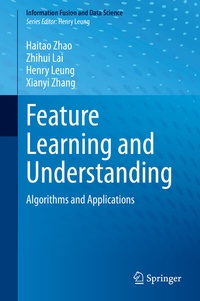
Feature Learning and Understanding
Description

This book covers the essential concepts and strategies within traditional and cutting-edge feature learning methods thru both theoretical analysis and case studies. Good features give good models and it is usually not classifiers but features that determine the effectiveness of a model. In this book, readers can find not only traditional feature learning methods, such as principal component analysis, linear discriminant analysis, and geometrical-structure-based methods, but also advanced feature learning methods, such as sparse learning, low-rank decomposition, tensor-based feature extraction, and deep-learning-based feature learning. Each feature learning method has its own dedicated chapter that explains how it is theoretically derived and shows how it is implemented for real-world applications. Detailed illustrated figures are included for better understanding. This book can be used by students, researchers, and engineers looking for a reference guide for popular methods of feature learning and machine intelligence.
More details
Other editions
Additional editions
Persons
Haitao Zhao is currently a full professor at the School of Information Science and Engineering, East China University of Science and Technology (ECUST), Shanghai, China. His research interests include feature extraction, representation learning, feature fusion, classifier design and their applications in image processing and computer vision.
Henry Leung
is a professor of the Department of Electrical and Computer Engineering of the University of Calgary. His current research interests include information fusion, machine learning, IoT, nonlinear dynamics, robotics, signal and image processing. He is a Fellow of IEEE and SPIE.
Zhihui Lai
was a Postdoctoral Fellow at the Bio-Computing Research Center, Shenzhen Graduate School, Harbin Institute of Technology (HIT) in 2011-2013. He is now a full professor at the College of Computer Science and Software Engineering, Shenzhen University.
Xianyi Zhang
is a postgraduate at the School of Information Science and Engineering, East China University of Science and Technology (ECUST), Shanghai, China. His research interests include pattern recognition, machine learning and image processing.
Content
