

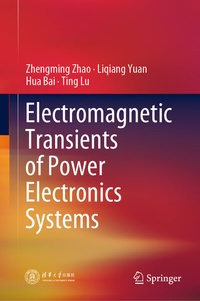
Electromagnetic Transients of Power Electronics Systems
Description

This book discusses topics related to power electronics, especially electromagnetic transient analysis and control of high-power electronics conversion. It focuses on the re-evaluation of power electronics, transient analysis and modeling, device-based system-safe operating area, and energy balance-based control methods, and presenting, for the first time, numerous experimental results for the transient process of various real-world converters.
The book systematically presents both theoretical analysis and practical applications. The first chapter discusses the structure and attributes of power electronics systems, highlighting the analysis and synthesis, while the second chapter explores the transient process and modeling for power electronics systems. The transient features of power devices at switching-on/off, transient conversion circuit with stray parameters and device-based system-safe operating area are described in the subsequent three chapters. The book also examinesthe measurement of transient processes, electromagnetic pulses and their series, as well as high-performance, closed-loop control, and expounds the basic principles and method of the energy-balanced control strategy. Lastly, it introduces the applications of transient analysis of typical power electronics systems.
The book is valuable as a textbook for college students, and as a reference resource for electrical engineers as well as anyone working in the field of high-power electronics system.
More details
Other editions
Additional editions
Persons
Professor Zhengming Zhao received bachelor's and master's degrees from Hunan University in 1982 and 1985 respectively, and a Ph.D. from Tsinghua University in 1991, all in Electrical Engineering. He pursued postdoctoral research in the USA, at the Ohio State University and the University of California Irvine in 1994-1997; and was then a senior visiting scholar and research professor at the University of British Columbia and the University of Hong Kong in 1998-1999. He is currently a professor at Tsinghua University, and Vice Director of the State Key Laboratory of Power System. He is also chair of IEEE PELS Beijing Chapter, vice president of the Power Electronics Society of the Chinese Electrotechnical Society, and vice president of the Beijing Power Electronics Society. He is an IEEE fellow and IET fellow, and serves as editor-in-chief, vice editor-in-chief, and associate editor for various leading national and international academic journals. His main research interests include high-power and high-voltage power electronic technology, grid-connected photovoltaic power generation and its applications, motors and their control, and wireless power transmission. He is the author or co-author of 8 scientific and technical books, and more than 400 technical papers. He has been granted 32 authorized national patents for inventions and 15 software copyrights. He has received more than 10 provincial science and technology achievement awards.
