

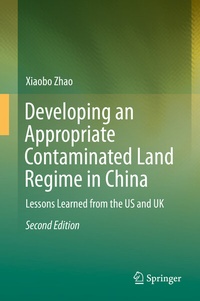
Developing an Appropriate Contaminated Land Regime in China
Description

This book explores the complex package of mechanisms used to identify, record, manage and remediate contaminated land, including the system for allocating liabilities that has been set up by China's contaminated land law and accompanying administrative decrees and environmental standards. Statutory control of soil or land contamination is a comparatively new phenomenon for Chinese lawmakers and researchers. After more than ten years of preparation, China recently adopted its first nationwide contaminated land law-the Law of the People's Republic of China on the Prevention and Control of Soil Contamination , which entered into effect in the beginning of 2019. The law deals exclusively with risk management in connection with soil contamination, and the remediation of contaminated land.
This book analyzes various facets of how China is managing the risks associated with soil contamination and remediating contaminated sites by means of legislation. Chapters 1 and 2 reveal the current extent of the soil contamination problem in China and the initial policy responses of the country's central government. In turn, Chapters 3 and 4 address the regulatory frameworks and the latest contaminated land legislation at both the local and national level. Lastly, Chapters 5 through 9 offer concrete recommendations, based on lessons learned in the US and UK, for reforming contaminated land management in China.
Overall, the book covers the past, present and future of contaminated land management in China, making it of interest to environmental policymakers, administrators, academics, lawyers and engineers engaged in soil or environmental protection. Further, it offers a source of reliable information for those who want to learn more about China's environmental legislation and contaminated land management policy.
More details
Other editions
Additional editions
Previous edition
Content
FM.- Introduction.- Status Quo of Land Contamination in China: Causes, Effects and Features.- The Regulatory Frameworks to Address Land Contamination in China.- Contamined Land Regime under the Soil Law of China 2018.- Contamined Land Liability in the US: Lessons for China?.- Contamined Land Liability Regime in the UK: General Cooncern for Developing Contamined Land Liability System in China.- Contamined Land Remediation: Legal Issues and Recommendations for China.- The Role of Environmental Liability Insurance in Contaminated Land Legislation of China: Theories and Case Study.- Financing Mechanisms for Contaminated Land Remediation and Redevelopment.- Conclusion and Recommendations: A Comparadtive Review of China´s Contaminated Land Regime.- Table of Cases.- Table of Legislation.- Appendices.- Index.
