

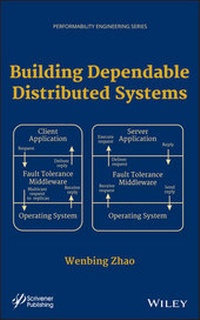
Building Dependable Distributed Systems
Description

More details
Other editions
Additional editions
Person
Content
List of Figures
1.1 An example of a chain of threats with two levels of recursion.
2.1 An example distributed system.
2.2 Consistent and inconsistent global state examples.
2.3 An example of the domino effect in recovery with uncoordinated checkpointing.
2.7 Finite state machine specification for the Chandy and Lamport distributed snapshot protocol.
2.11 An example for pessimistic logging.
2.12 Transport level (a) and application level (b) reliable messaging.
2.14 Probability density function of the logging latency.
2.15 A summary of the mean logging latency and mean end-to-end latency under various conditions.
2.16 Probability density function of the end-to-end latency.
2.17 Normal operation of the sender-based logging protocol
2.18 An example normal operation of the sender-based logging protocol
3.1 The three-tier architecture
3.3 An example runtime path of an end-user request
3.4 Component class and component instances
3.5 The chi-square cumulative distribution function for degree of freedom of 1, 2, 3, 4, 5.
3.6 The path shape of the example runtime path shown in Figure 3.3.
3.7 Component class and component instances.
3.8 Dependency templates for nodes, processes, network paths, and the neighbor sets.
3.9 A partial dependency graph for an example system.
3.13 The architecture of an Operator Undo framework [5, 6].
4.1 The replication algorithm is typically implemented in a fault tolerance middleware framework.
4.2 Active replication, without (top) and with (bottom) voting at the client.
4.5 A write-all algorithm for data replication.
4.6 The problem of the write-all-available algorithm for data replication.
4.8 An example run of the quorum consensus algorithm on a single data item.
4.9 Basic steps for optimistic data replication for an operation-transfer system.
4.10 An example run of a system with three sites that uses Lamport clocks.
4.11 An example run of a system with three sites that uses vector clocks.
4.12 An example for the determination of the new version vector value after reconciling a conflict.
4.13 An example operation propagation using vector clocks in a system with three replicas.
4.14 An example for operation propagation using timestamp matrices in a system with three replicas.
4.15 Update commit using ack vectors in a system with three replicas.
4.16 Update commit using timestamp matrices in a system with three replicas.
4.17 An illustration of the CAP theorem.
4.18 Partition mode and partition recovery.
5.1 Examples of systems that ensure uniform total ordering and nonuniform total ordering.
5.3 An example rotation sequencer based system in normal operation.
5.4 Normal operation of the membership view change protocol.
5.5 Membership change scenario: competing originators.
5.6 Membership change scenario: premature timeout.
5.7 Membership change scenario: temporary network partitioning.
5.8 A simplified finite state machine specification for Totem.
5.9 A successful run of the Totem Membership Protocol.
5.10 Membership changes due to a premature timeout by N2.
5.11 Messages sent before N1 fails in an example scenario. 181
5.12 Messages delivered during recovery for the example scenario.
5.14 Messages delivered during recovery in the two different partitions for the example scenario.
5.15 Causal ordering using vector clocks.
6.1 Normal operation of the Paxos algorithm.
6.2 A deadlock scenario with two competing proposers in the Paxos algorithm.
6.7 View change algorithm for Multi-Paxos.
6.11 Normal operation of Cheap Paxos in a system with 3 main replicas and 1 auxiliary replica
6.13 Normal operation of (Multi-) Fast Paxos in a client-server system
6.14 Collision recovery in an example system
6.15 Expansion of the membership by adding two replicas in method 1
6.16 Expansion of the membership by adding two replicas in method 2
6.17 Reduction of the membership by removing two replicas one after another
7.2 The message flow and the basic steps of the OM(1) algorithms
7.3 The message flow and the basic steps of the OM(2) algorithms
7.4 Normal operation of the PBFT algorithm
7.6 A worst case scenario for tentative execution
7.7 Normal operation of Fast Byzantine fault tolerance
7.8 Zyzzyva agreement protocol (case 1)
7.9 Zyzzyva agreement protocol (case 2)
7.10 A corner case in view change in Zyzzyva
8.3 The parallelizer and its interaction with other components.
8.4 The sequence diagram for an example WS-AT application
8.5 The sequence diagram for an example WS-BA application.
8.8 The normal operation of Byzantine fault tolerant transaction commitment and completion protocol
8.9 A classification of common types of application non-determinism
