

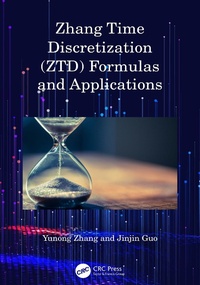
Zhang Time Discretization (ZTD) Formulas and Applications
1st Edition
Published on 7. August 2024
355 pages
978-1-040-09161-6 (ISBN)
Description

This book aims to solve the discrete implementation problems of continuous-time neural network models while improving the performance of neural networks by using various Zhang Time Discretization (ZTD) formulas.
The authors summarize and present the systematic derivations and complete research of ZTD formulas from special 3S-ZTD formulas to general NS-ZTD formulas. These finally lead to their proposed discrete-time Zhang neural network (DTZNN) algorithms, which are more efficient, accurate, and elegant. This book will open the door to scientific and engineering applications of ZTD formulas and neural networks, and will be a major inspiration for studies in neural network modeling, numerical algorithm design, prediction, and robot manipulator control.
The book will benefit engineers, senior undergraduates, graduate students, and researchers in the fields of neural networks, computer mathematics, computer science, artificial intelligence, numerical algorithms, optimization, robotics, and simulation modeling.
The authors summarize and present the systematic derivations and complete research of ZTD formulas from special 3S-ZTD formulas to general NS-ZTD formulas. These finally lead to their proposed discrete-time Zhang neural network (DTZNN) algorithms, which are more efficient, accurate, and elegant. This book will open the door to scientific and engineering applications of ZTD formulas and neural networks, and will be a major inspiration for studies in neural network modeling, numerical algorithm design, prediction, and robot manipulator control.
The book will benefit engineers, senior undergraduates, graduate students, and researchers in the fields of neural networks, computer mathematics, computer science, artificial intelligence, numerical algorithms, optimization, robotics, and simulation modeling.
Reviews / Votes
``For those interested in exploring and handling the intricacies of discrete time-dependent problems, this book may offer a comprehensive and thought-provoking journey. It perhaps deserves serious and much consideration from academics and researchers in the fields.''Professor Zibin Zheng, IEEE Fellow, Sun Yat-sen University, China
``The book is appealing for graduate students as well as academic and industrial researchers. Based on the systematic research of new effective time-discretization formulas, the book may generate curiosity and also happiness to its readers for learning more in the fields and researches.''
Professor Shuai Li, University of Oulu, Finland
More details
Edition
1. Auflage
Language
English
Place of publication
London
United Kingdom
Publishing group
Taylor & Francis Ltd
Target group
College/higher education
Professional and scholarly
Illustrations
64 Tables, black and white; 102 Line drawings, black and white; 7 Halftones, black and white; 109 Illustrations, black and white
ISBN-13
978-1-040-09161-6 (9781040091616)
Copyright in bibliographic data and cover images is held by Nielsen Book Services Limited or by the publishers or by their respective licensors: all rights reserved.
Schweitzer Classification
Other editions
Additional editions
Yunong Zhang | Jinjin Guo
Zhang Time Discretization (ZTD) Formulas and Applications
Book
approx. 06/2026
1st Edition
CRC Press
€67.00
Not yet published
Yunong Zhang | Jinjin Guo
Zhang Time Discretization (ZTD) Formulas and Applications
Book
08/2024
1st Edition
CRC Press
€206.40
Shipment within 10-20 days
Persons
Yunong Zhang, PH.D., earned his B.S. degree from Huazhong University of Science and Technology, Wuhan, China, in 1996, his M.S. degree from South China University of Technology, Guangzhou, China, in 1999, and his Ph.D. from the Chinese University of Hong Kong, Shatin, Hong Kong, China, in 2003. He is currently a professor at the School of Computer Science and Engineering, Sun Yat-sen University, Guangzhou, China. Dr. Zhang was supported by the Program for New Century Excellent Talents in Universities in 2007. He received the Best Paper Award from the International Symposium on Systems and Control in Aeronautics and Astronautics (ISSCAA) in 2008 and the Best Paper Award from the International Conference on Automation and Logistics (ICAL) in 2011. He was among the Highly Cited Scholars of China selected and published by Elsevier from 2014 to 2022.
Jinjin Guo, Ph.D., earned her B.E. degree in measurement technology and instrument from Nanchang University, Nanchang, China, in 2016, her M.E. degree in control engineering from Sun Yat-sen University, Guangzhou, China, in 2018, and her Ph.D. in computer science and technology from Sun Yat-sen University, Guangzhou, China, in 2022. She is currently a lecturer at the School of Computer Science, Guangdong Polytechnic Normal University, Guangzhou, China. Her main research interests include neural networks, numerical computation, and tracking control.
Jinjin Guo, Ph.D., earned her B.E. degree in measurement technology and instrument from Nanchang University, Nanchang, China, in 2016, her M.E. degree in control engineering from Sun Yat-sen University, Guangzhou, China, in 2018, and her Ph.D. in computer science and technology from Sun Yat-sen University, Guangzhou, China, in 2022. She is currently a lecturer at the School of Computer Science, Guangdong Polytechnic Normal University, Guangzhou, China. Her main research interests include neural networks, numerical computation, and tracking control.
Content
1 Future Matrix Right Pseudoinversion 2 Future Equality-Constrained Quadratic Programming 3 Future Matrix Inversion With Noises 4 Future Matrix Pseudoinversion 5 Future Constrained Nonlinear Optimization With O(g3) 6 Future Unconstrained Nonlinear Optimization With O(g4) 7 Future Different-Layer Inequation-Equation System Solving With O(g5) 8 Future Matrix Square Root Finding With O(g6) 9 Tracking Control of Serial and Parallel Manipulators 10 Future Matrix Inversion with Sometimes-Singular Coefficient Matrix 11 Repetitive Motion Control of Redundant Manipulators 12 Future Different-Layer Equation System Solving 13 Future Matrix Equations Solving 14 Minimum Joint Motion Control of Redundant Manipulators 15 Euler-Precision General Formula of ZTD 16 Lagrange Numerical-Differentiation Formulas
