

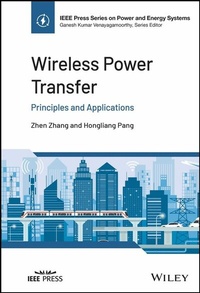
Wireless Power Transfer
Description

Presents a detailed overview of multiple-objective wireless power transfer (WPT) technologies, including the latest research developments and emerging applications
Wireless Power Transfer: Principles and Applications offers comprehensive coverage of all key aspects of wireless power transfer (WPT) technologies, including fundamental theory, intelligent control, configuration analysis, and emerging power electronics techniques. This unique resource is the first book of its kind to provide in-depth discussion of energy transmission control schemes with emphasis on omni-directional vector control, energy-encryption-based security control, demand-based optimal designs for transmitter, pickup, and self-resonance coils, multiple-objective power distribution, and maximum efficiency and power control under various conditions.
In addition, this text:
* Presents the methodologies and approaches of emerging multiple-objective WPT technologies
* Discusses various applications for wireless charging techniques, including contactless power for electric vehicles, in-flight charging for unmanned aerial vehicles, and underwater wireless charging
* Covers both intermittent and continuous impedance matching methods for different classes of coils
* Features more than 400 high-quality illustrations and numerous figures and tables throughout
Wireless Power Transfer: Principles and Applications is an invaluable technical reference for academic researchers and industry professionals in power and energy engineering, and an excellent textbook for postgraduate courses in relevant areas of industrial and electronic engineering.
More details
Other editions
Additional editions
Persons
Zhen Zhang, Ph.D., is a full professor with the School of Electrical and Information Engineering at Tianjin University. He has authored and co-authored numerous internationally referred papers as well as two books published by Wiley-IEEE Press and Cambridge University Press. Prof. Zhang is currently the Chair of IEEE Beijing Section IES Chapter (Tianjin) and an Associate Editor for the IEEE Transactions on Industrial Electronics, IEEE Transactions on Industrial Informatics and IEEE Industrial Electronics Magazine. He is the recipient of the Humboldt Research Fellowship, Carl Friedrich von Siemens Research Fellowship, Japan Society for the Promotion of Science Visiting Fellowship, 2020 Outstanding Paper Award for IEEE Transactions on Industrial Electronics, and IEEE J. David Irwin Early Career Award.
Hongliang Pang received the B.Eng. and M.Eng. degrees from Tianjin University, China in 2017 and 2020, respectively. He is currently working toward the Ph.D. degree in electrical and electronic engineering at the Department of Electrical and Electronic Engineering, the University of Hong Kong. He has published several technical papers and industrial reports in these areas. His current research interests include electric vehicle technologies, wireless power transfer and Power-electronic-based impedance matching.
Content
Part I: Introduction
Chapter 1: The Era of Wireless Power Transfer
1.1 The father of wireless power transfer - Nikola Tesla
1.2 Wireless power Transfer
1.3 About this book
Chapter 2: Inductive Power Transfer
2.1 Inductive power transfer
2.2 1-to-1 transmission
2.3 1-to-N transmission
2.4 What are differences between 1-to-1 and 1-to-N transmission
Part II: Design
Chapter 3: Design and Optimization for Coupled Coils
3.1 Introduction
3.2 Design considerations
3.3 Optimal design
3.4 Discussion
Chapter 4: Design and Optimization for Power Circuits
4.1 Impedance matching
4.2 DC/AC inverters
Part III: Control
Chapter 5: Control for Single Pickup
5.1 Review of control schemes
5.2 Maximizing efficiency control
Chapter 6: Control for Multiple Pickups
6.1 Introduction
6.2 Transmission strategy for transmitting side
6.3 Impedance matching strategy for multi-frequency transmission
6.4 Others
Chapter 7: Energy Security of Wireless Power Transfer
7.1 Introduction
7.2 Characteristic of frequency
7.3 Energy encryption
7.4 Verifications
7.5 Opportunities
Chapter 8: Omnidirectional Wireless Power Transfer
8.1 Introduction
8.2 Mathematic analysis
8.3 Design of transmitting coils for synthetic magnetic field
8.4 Design and control considerations for pickup coils
8.5 Load detection
8.6 Discussion
Part IV: Application
Chapter 9: WPT for High-Power Application - Electric Vehicles
9.1 Introduction
9.2 EV wireless charging
9.3 Electromagnetic field reduction
9.4 Key technologies
9.5 Summary
Chapter 10: WPT for Low-Power Applications
10.1 Portable consumer electronics
10.2 Implantable medical devices
10.3 Drones
10.4 Underwater wireless charging
