

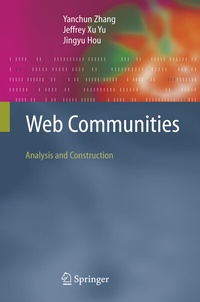
Web Communities
Description

Due to the lack of a uniform schema for Web documents and the sheer amount and dynamics of Web data, both the effectiveness and the efficiency of information management and retrieval of Web data is often unsatisfactory when using conventional data management techniques.
Web community, defined as a set of Web-based documents with its own logical structure, is a flexible and efficient approach to support information retrieval and to implement various applications. Zhang and his co-authors explain how to construct and analyse Web communities based on information like Web document contents, hyperlinks, or user access logs. Their approaches combine results from Web search algorithms, Web clustering methods, and Web usage mining. They also detail the necessary preliminaries needed to understand the algorithms presented, and they discuss several successful existing applications.
Researchers and students in information retrieval and Web search find in this all the necessary basics and methods to create and understand Web communities. Professionals developing Web applications will additionally benefit from the samples presented for their own designs and implementations.
Reviews / Votes
The book can be used by applied mathematicians, search industry professionals, and anyone who wants to learn more about how search engines work. I recommend it for any course on Web information retrieval. I firmly believe that this book and the book by Langville and Meyer are the top two books about the algorithmic aspects of modern search engines. (Yannis Manolopoulos, Aristotle University, Thessaloniki, Greece in ACM REVIEWS)
More details
Other editions
Additional editions
Persons
Dr. Yanchun Zhang is Associate Professsor and the Head of Computing Discipline in the Department of Mathematics and Computing at the University of Southern Queensland. He obtained PhD degree in Computer Science from the University of Queensland in 1991. His research areas cover databases, electronic commerce, internet/web information systems, web data management, web search and web services. He has published over 100 research papers on these topics in international journals and conference proceedings, and edited over 10 books/proceedings and journal special issues. He is a co-founder and Co-Editor-In-Chief of World Wide Web: Internet and Web Information Systems and Co-Chairman of International Web Information Systems Engineering Society.
Dr. Jeffrey Xu Yu received his B.E., M.E. and Ph.D. in computer science, from the University of Tsukuba, Japan, in 1985, 1987 and 1990, respectively. Jeffrey Xu Yu was a faculty member in the Institute of Information Sciences and Electronics, University of Tsukuba, Japan, and was a Lecturer in the Department of Computer Science, The Australian National University. Currently, he is an Associate Professor in the Department of Systems Engineering and Engineering Management, the Chinese University of Hong Kong. His research areas cover databases, data warehouse and data mining. He has published over 100 research papers on these topics in international journals and conference proceedings. Jeffrey Xu Yu is a member of ACM, and a society affiliate of IEEE Computer Society.
Dr Jingyu Hou received his BSc in Computational Mathematics from Shanghai University of Science and Technology (1985) and his PhD in Computational Mathematics from Shanghai University (1995). He is now a Lecturer in the School of Information Technology at Deakin University, Australia. He has also completed a PhD in Computer Science in the Department of Mathematics and Computing at The University of Southern Queensland, Australia. His researchinterests include Web-Based Data Management and Information Retrieval, Web Databases, Internet Computing and Electronic Commerce, and Semi-Structured Data Models. He has extensively published in the areas of Web information retrieval and Web Communities.
