Alles über E-Books | Antworten auf Fragen rund um E-Books, Kopierschutz und Dateiformate finden Sie in unserem Info- & Hilfebereich.
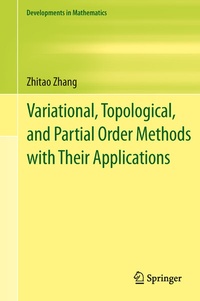
Nonlinear functional analysis is an important branch of contemporary mathematics. It's related to topology, ordinary differential equations, partial differential equations, groups, dynamical systems, differential geometry, measure theory, and more. In this book, the author presents some new and interesting results on fundamental methods in nonlinear functional analysis, namely variational, topological and partial order methods, which have been used extensively to solve existence of solutions for elliptic equations, wave equations, Schrödinger equations, Hamiltonian systems etc., and are also used to study the existence of multiple solutions and properties of solutions. This book is useful for researchers and graduate students in the field of nonlinear functional analysis.
Series
Language
Place of publication
Publishing group
Target group
Professional and scholarly
Product notice
Illustrations
File size
ISBN-13
978-3-642-30709-6 (9783642307096)
DOI
10.1007/978-3-642-30709-6
Schweitzer Classification
1 Preliminaries.- Sobolev spaces and embedding theorems.- Critical point.- Cone and partial order.- Brouwer Degree.- Compact map and Leray-Schauder Degree.- Fredholm operators.- Fixed point index.- Banach's Contract Theorem, Implicit Functions Theorem.- Krein-Rutman theorem.- Bifurcation theory.- Rearrangements of sets and functions.- Genus and Category.- Maximum principles and symmetry of solution.- Comparison theorems.- 2 Cone and Partial Order Methods.- Increasing operators.- Decreasing operators.- Mixed monotone operators.- Applications of mixed monotone operators.- Further results on cones and partial order methods.- 3 Minimax Methods.- Mountain Pass Theorem and Minimax Principle.- Linking Methods.- Local linking Methods.- 4 Bifurcation and Critical Point.- Introduction.- Main results with parameter.- Equations without the parameter.- 5 Solutions of a Class of Monge-Amp
è
re Equations.- Introduction.- Moving plane argument.- Existence and non-existence results.- Bifurcation and the equation with a parameter.- Appendix.- 6 Topological Methods and Applications.- Superlinear system of integral equations and applications.- Existence of positive solutions for a semilinear elliptic system.- 7 Dancer-Fucik Spectrum.- The spectrum of a self-adjoint operator.- Dancer-Fucik Spectrum on bounded domains.- Dancer-Fucik point spectrum on R
N
.- Dancer-Fucik spectrum and asymptotically linear elliptic problems.- 8 Sign-changing Solutions.- Sign-changing solutions for superlinear Dirichlet problems.- Sign-changing solutions for jumping nonlinear problems.- 9 Extension of Brezis-Nirenberg's Results and Quasilinear Problems.- Introduction.- W
0
1,
p
(O) versus C
0
1
(O) local minimizers.- Multiplicity results for the quasilinear problems.- Uniqueness results.- 10 Nonlocal Kirchhoff Elliptic Problems.- Introduction.- Yang index and critical groups to nonlocal problems.-Variational methods and invariant sets of descent flow.- Uniqueness of solution for a class of Kirchhoff-type equations.- 11 Free Boundary Problems, System of equations for Bose-Einstein Condensate and Competing Species.- Competing system with many species.- Optimal partition problems.- Schrödinger systems from Bose-Einstein condensate.- Bibliography.