

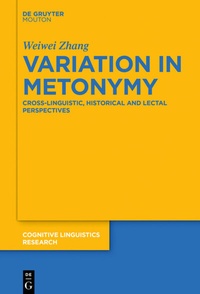
Variation in Metonymy
Description

The monograph presents new findings and perspectives in the study of variation in metonymy, both theoretical and methodological. Theoretically, it sheds light on metonymy from an onomasiological perspective, which helps to discover the different conceptual or lexical "pathways" through which a concept or a group of concepts has been designated by going back to the source concepts. In addition, it broadens the perspective of Cognitive Linguistics research on metonymy by looking into how metonymic conceptualization and usage may vary along various dimensions. Three case studies explore significant variation in metonymy across different languages, time periods, genres and social lects. Methodologically, the monograph responds to the call in Cognitive Linguistics to adopt usage-based empirical methodologies. The case studies show that quantification and statistical techniques constitute essential parts of an empirical analysis based on corpus data. The empirical findings demonstrate the essential need to extend research on metonymy in a variationist Cognitive Linguistics direction by studying metonymy's cultural, historical and social-lectal variation.
More details
Other editions
Additional editions
Person
Content
- Intro
- Contents
- Introduction
- Part One: THEORETICAL PRELIMINARY
- 1 Demarcation and variability of metonymy
- 1.1 Conceptual metonymy
- 1.1.1 Definition/demarcation of metonymy
- 1.1.2 Internal typology of metonymy
- 1.1.3 The conventionalization of metonymy
- 1.2 Metonymy: A variationist CL view
- 1.2.1 The cross-linguistic dimension
- 1.2.2 The historical dimension
- 1.2.3 The lectal dimension
- 1.3 Metonymy: Semasiology and onomasiology
- 1.3.1 The semasiological perspective
- 1.3.2 The onomasiological perspective
- 1.4 The methodological state of the art in metonymy research
- 1.4.1 Why CL research needs an empirical approach
- 1.4.2 Overview of methods in CL metonymy research
- 1.5 Summary: Research gaps
- 2 Metonymy in expressions
- 2.1 Models for analyzing figurative composite expressions
- 2.1.1 Compositionality and analyzability
- 2.1.2 Fauconnier and Turner's blending model
- 2.1.3 Benczes's analysis of noun-noun compounds
- 2.1.4 Geeraerts's prismatic model
- 2.2 Metonymic mappings in Chinese expressions
- 2.2.1 Bringing the prismatic model to Chinese metonymic expressions
- 2.2.2 Various paths of metonymy in Chinese expressions
- 2.3 Some criteria for classification
- 2.3.1 Global metonymy versus parallel local metonymies
- 2.3.2 Internal metonymy versus external metonymy
- 2.3.3 Differentiation between alternative prismatic structures
- 2.4 Summary
- Part Two: CASE STUDIES
- 3 The cross-linguistic perspective: Metonymies for PERSON
- 3.1 Methodology
- 3.1.1 The Chinese data resources
- 3.1.2 The English data resource
- 3.1.3 Summary of the methodology
- 3.2 Results
- 3.2.1 Variation in metonymic patterns for PERSON in general
- 3.2.2 Variation in metonymic patterns for different kinds of person
- 3.2.3 Variation in metonymic sources of a particular pattern
- 3.3 Discussion
- 3.3.1 Paragons in Chinese culture
- 3.3.2 The carriage-clothing system in Chinese culture
- 3.3.3 The residence system in Chinese culture
- 3.3.4 Culture-bound conceptualizations of body parts
- 3.3.5 Collectivism versus individualism
- 3.3.6 Section summary
- 3.4 Summary
- 4 The diachronic perspective: Metonymies for WOMAN
- 4.1 Methodology
- 4.1.1 The Corpus of Historical Chinese
- 4.1.2 Metonymy identification
- 4.1.3 Metonymy quantification and analysis
- 4.2 Diachronic variation in metonymic patterns
- 4.2.1 Exploring and visualizing the data
- 4.2.2 Targets with relatively stable diachronic variation
- 4.2.3 Targets with a dominant trend in diachronic variation
- 4.2.4 Targets with highly fluctuating diachronic variation
- 4.2.5 Section summary
- 4.3 Interactions with stylistic variation
- 4.3.1 Stylistic variation in metonymic patterns
- 4.3.2 Introduction of new metonymic items
- 4.3.3 Section summary
- 4.4 Summary
- 5 The lectal perspective: Metonymies for GOVERNMENT
- 5.1 Methodology
- 5.1.1 Data collection
- 5.1.2 The variables
- 5.1.3 The mixed-effects logistic regression model
- 5.2 The general regression model for GOVERNMENT
- 5.2.1 General impact of the predictors
- 5.2.2 Specific influence of fixed effects
- 5.2.3 The random-effect variable of verbs
- 5.3 The separate regression model for MAINLAND CHINESE GOVERNMENT
- 5.3.1 The separate mixed-effects model
- 5.3.2 The lectal variation between Mainland and Taiwan Chinese
- 5.4 Summary
- Conclusion
- Main findings and contributions
- Limitations and further directions
- References
- Appendix
- A. Chinese/English metonymic mapping datasets
- B. Distributions of main patterns for specific targets
- C. Distributions of sources under a particular pattern for specific targets
- D. References for meaning identification in the corpus
- E. Classification of source/target concepts in Case 2
- F. Contributions of patterns for interpreting the MDS dimensions
- Index

