

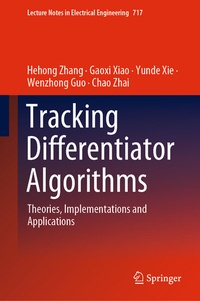
Tracking Differentiator Algorithms
Theories, Implementations and Applications
1st Edition
Published on 27. October 2020
XIII, 105 pages
978-981-15-9384-0 (ISBN)
Description

This book highlights designs, implementations and applications of tracking differentiator (TD) algorithms. The real-time differentiation estimation of a given signal is of high importance in control science and engineering. A good differentiator shall have i) robustness against input noises and ii) exactness with a small phase delay. The book has three focuses:
Designing practical, accurate and efficient TD based on discrete-time optimal control (DTOC).Presenting full convergence analysis on DTOC-TDs.
Implementing the DTOC-TDs in state estimations in power systems and signal processing, as well as feedback control in maglev train.
The proposed TD solution and its successful real-life applications shall stimulate wide interests in different areas including power systems, railway transportations and aerospace industry, etc.
More details
Series
Language
English
Place of publication
Singapore
Singapore
Publishing group
Springer Singapore
Target group
Professional and scholarly
Product notice
Reflowable
Illustrations
XIII, 105 p. 59 illus., 55 illus. in color.
File size
4,48 MB
ISBN-13
978-981-15-9384-0 (9789811593840)
DOI
10.1007/978-981-15-9384-0
Schweitzer Classification
Other editions
Additional editions
Hehong Zhang | Gaoxi Xiao | Yunde Xie
Tracking Differentiator Algorithms
Theories, Implementations and Applications
Book
10/2020
Springer
€139.09
Shipment within 3-4 weeks
Persons
Hehong Zhang received his Ph. D. degree in smart control and data analysis from the Interdisciplinary Graduate School, Nanyang Technological University, Singapore. He is now an Associate Professor in the College of Mathematics and Computer Science/College of Software, Fuzhou University, Fuzhou, China. His research interests include data processing, smart control and nonlinear control theory, particularly time optimal control-based tracking differentiator.
Gaoxi Xiao received his Ph.D. degree in computing from the Hong Kong Polytechnic University. He joined the School of Electrical and Electronic Engineering, Nanyang Technological University, Singapore, in 2001, where he is now an Associate Professor. His research interests include complex systems and complex networks, communication networks, smart grids, and system resilience and risk management. Dr. Xiao serves/served as an Associate Editor or Guest Editor for IEEE Transactions on Network Science and Engineering, PLOS ONE and Advances in Complex Systems, etc., and a TPC member for numerous conferences including IEEE ICC and IEEE GLOBECOM.
Yunde Xie received his Ph. D. degree in control science and control engineering from National University of Defense Technology in 1998. He became an Associate Professor in National University of Defense Technology, China, in 2004. From 2005 until now, he has worked as a Senior Engineer at Beijing Rail Transit Technology Institute, Beijing, China. His research interests include nonlinear control theory and application and maglev control techniques.
Wenzhong Guo received his Ph.D. degree in communication and information systems from Fuzhou University, Fuzhou, China. He is now a Full Professor in the College of Mathematics and Computer Science/College of Software, Fuzhou University, Fuzhou, China. He leads the Network Computing and Intelligent Information Processing Laboratory, which is a Key Lab of Fujian Province, China. His research interests include intelligent information processing, network computing and network content analysis.
Chao Zhai received his Ph. D. degree in complex systems and control from the Institute of Systems Science, Chinese Academy of Sciences, Beijing, China. He is now a Full Professor in the School of Automation, China University of Geosciences, Wuhan, China. His research interests include cooperative control, power system stability and control, and social motor coordination.
Gaoxi Xiao received his Ph.D. degree in computing from the Hong Kong Polytechnic University. He joined the School of Electrical and Electronic Engineering, Nanyang Technological University, Singapore, in 2001, where he is now an Associate Professor. His research interests include complex systems and complex networks, communication networks, smart grids, and system resilience and risk management. Dr. Xiao serves/served as an Associate Editor or Guest Editor for IEEE Transactions on Network Science and Engineering, PLOS ONE and Advances in Complex Systems, etc., and a TPC member for numerous conferences including IEEE ICC and IEEE GLOBECOM.
Yunde Xie received his Ph. D. degree in control science and control engineering from National University of Defense Technology in 1998. He became an Associate Professor in National University of Defense Technology, China, in 2004. From 2005 until now, he has worked as a Senior Engineer at Beijing Rail Transit Technology Institute, Beijing, China. His research interests include nonlinear control theory and application and maglev control techniques.
Wenzhong Guo received his Ph.D. degree in communication and information systems from Fuzhou University, Fuzhou, China. He is now a Full Professor in the College of Mathematics and Computer Science/College of Software, Fuzhou University, Fuzhou, China. He leads the Network Computing and Intelligent Information Processing Laboratory, which is a Key Lab of Fujian Province, China. His research interests include intelligent information processing, network computing and network content analysis.
Chao Zhai received his Ph. D. degree in complex systems and control from the Institute of Systems Science, Chinese Academy of Sciences, Beijing, China. He is now a Full Professor in the School of Automation, China University of Geosciences, Wuhan, China. His research interests include cooperative control, power system stability and control, and social motor coordination.
Content
Introduction.- Literature Review.- Discrete Time Optimal Control Algorithm.- Simple and E?cient Tracking Di?erentiator.- On Convergence Performance of DTOC based Tracking Di?erentiator.- Time-Optimal Control Based Tracking Di?erentiator with Phase Delay Alleviation.- Tracking Di?erentiators in real-life engineering.- Summary.
