

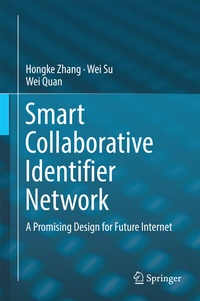
Smart Collaborative Identifier Network
Description

This book introduces a promising design for future Internet, the Smart Collaborative Identifier NETwork (SINET). By examining cutting-edge research from around the world, it is the first book to provide a comprehensive survey of SINET, including its basic theories and principles, a broad range of architectures, protocols, standards, and future research directions. For further investigation, the book also provides readers an experimental analysis of SINET to promote further, independent research. The second part of the book presents in detail key technologies in SINET such as scalable routing, efficient mapping systems, mobility management and security issues. In turn, the last part presents various implementations of SINET, assessing its merits. The authors believe SINET will greatly benefit researchers involved in designing future Internet thanks to its high degree of flexibility, security, manageability, mobility support and efficient resource utilization.
More details
Other editions
Additional editions
Persons
Prof. Hongke Zhang received his M.S. and Ph.D. degrees from the University of Electronic Science and Technology of China (UESTC) in 1988 and 1992 respectively. He is currently a professor at the School of Electronic and Information Engineering, Beijing Jiaotong University (BJTU) and director of a National Engineering Lab on Next Generation Internet in China. His research has resulted in many papers, books, patents, systems and equipment in the areas of communications and computer networks. He is the Chief Scientist of a National Basic Research Program of China (973 Program) and has also served on the editorial board of several international journals.
Prof. Wei Su received his Ph.D. degree in Communication and Information Systems from Beijing Jiaotong University (BJTU) in 2008. He is currently a professor at the School of Electronics and Information Engineering, BJTU, where his work focuses on the theories and technologies of the next generation Internet.He has published more than 50 papers, and has taken part in many national projects such as the National Basic Research Program ("973 Program") and initiatives of the State High Technology Research and National Natural Science Foundation of China (NSFC).
Dr. Wei Quan received his Ph.D. degree in Communication and Information Systems from Beijing University of Posts and Telecommunications (BUPT) in October 2014. He is currently an instructor at the School of Electronics and Information Engineering, Beijing Jiaotong University. His research interests include next generation Internet technologies, vehicular networks, Internet of Things (IoT), future Internet architectures and Internet of Energy (IoE). He has published more than 20 research papers in international journals and conferences, and also serves as a technical reviewer for several journals.
