

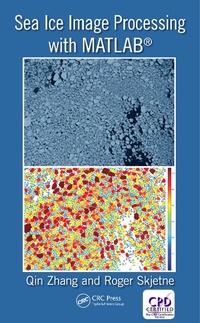
Sea Ice Image Processing with MATLAB (R)
1st Edition
Published on 13. February 2018
272 pages
978-1-351-06919-9 (ISBN)
Description

Sea Ice Image Processing with MATLAB addresses the topic of image processing for the extraction of key sea ice characteristics from digital photography, which is of great relevance for Artic remote sensing and marine operations. This valuable guide provides tools for quantifying the ice environment that needs to be identified and reproduced for such testing. This includes fit-for-purpose studies of existing vessels, new-build conceptual design and detailed engineering design studies for new developments, and studies of demanding marine operations involving multiple vessels and operational scenarios in sea ice. A major contribution of this work is the development of automated computer algorithms for efficient image analysis. These are used to process individual sea-ice images and video streams of images to extract parameters such as ice floe size distribution, and ice types. Readers are supplied with Matlab source codes of the algorithms for the image processing methods discussed in the book made available as online material.
Features
Presents the first systematic work using image processing techniques to identify ice floe size distribution from aerial images
Helps identify individual ice floe and obtain floe size distributions for Arctic offshore operations and transportation
Explains specific algorithms that can be combined to solve various problems during polar sea ice investigations
Includes MATLAB (R) codes useful not only for academics, but for ice engineers and scientists to develop tools applicable in different areas such as sustainable arctic marine and coastal technology research
Provides image processing techniques applicable to other fields like biomedicine, material science, etc
Features
Presents the first systematic work using image processing techniques to identify ice floe size distribution from aerial images
Helps identify individual ice floe and obtain floe size distributions for Arctic offshore operations and transportation
Explains specific algorithms that can be combined to solve various problems during polar sea ice investigations
Includes MATLAB (R) codes useful not only for academics, but for ice engineers and scientists to develop tools applicable in different areas such as sustainable arctic marine and coastal technology research
Provides image processing techniques applicable to other fields like biomedicine, material science, etc
Reviews / Votes
"Sea Ice Image Processing with MATLAB (R) is a large and important step forward in the creation of the necessary tools for the planning and execution of Arctic maritime operations. The ability to predict what kind of ice that one will encounter is of critical importance for safety, as you need to know what you are going to run into. This book provides an important insight to the cutting edge of technology being developed for sustainable operations in the polar regions."-Ake Rohlen, Arctic Marine Solutions AB, Sweden
"This is a really elaborate book for the image processing to extract ice information. To my knowledge, this is the first work that describes the methods to obtain ice floe size distribution in a systematic and sophisticated way. It is still a big issue to predict the sea ice behavior in the numerical sea ice model due to the lack of our knowledge about the sub-grid scale information of sea ice, especially floe size distribution. This book aims at solving this problem and has achieved it to some extent. This work certainly contributes to this issue and sheds light on collecting observational data on an operational basis. Therefore, I sincerely hope the algorithm developed by the authors will be used by many people to improve our understanding of sea ice properties."
- Takenobu Toyota, Hokkaido University, Sapporo, Japan
More details
Series
Edition
1. Auflage
Language
English
Place of publication
London
United Kingdom
Publishing group
Taylor & Francis Ltd
Target group
Professional and scholarly
College/higher education
Illustrations
12 farbige Abbildungen, 142 s/w Abbildungen
12 Illustrations, color; 142 Illustrations, black and white
File size
25,30 MB
ISBN-13
978-1-351-06919-9 (9781351069199)
Copyright in bibliographic data and cover images is held by Nielsen Book Services Limited or by the publishers or by their respective licensors: all rights reserved.
Schweitzer Classification
Other editions
Additional editions
Qin Zhang | Roger Skjetne
Sea Ice Image Processing with MATLAB (R)
Book
06/2020
1st Edition
CRC Press
€60.65
Shipment within 15-20 days
Qin Zhang | Roger Skjetne
Sea Ice Image Processing with MATLAB (R)
Book
02/2018
1st Edition
CRC Press
€274.84
Shipment within 10-20 days
Persons
Qin Zhang received her Ph.D. degree in 2015 at the Norwegian University of Science and Technology (NTNU), Trondheim, Norway. She became a researcher in 2015 at the Center for Research-based Innovation (CRI) Sustainable Arctic Marine and Coastal Technology (SAMCoT), NTNU. Her research interests include remote sensing, image and sensory data processing.
Prof. Roger Skjetne received his MSc degree in 2000 in control engineering at the University of California at Santa Barbara, and his PhD degree in 2005 at the Norwegian University of Science and Technology (NTNU), for which his thesis was awarded the Exxon Mobil prize for best PhD thesis in applied research. Prior to his studies, he worked as an electrician for Aker Elektro AS on numerous oil installations for the North Sea. In 2004-2009 he was employed in Marine Cybernetics AS, working on Hardware-In-the-Loop (HIL) simulation for testing safety-critical marine control systems. From August 2009 he has held the position of Professor in Marine Control Engineering at the Department of Marine Technology at NTNU, where he presently is the leader of the research group on Marine Structures. His research interests are within Arctic stationkeeping operations and Ice Management systems for ships and rigs, environmentally robust control of shipboard electric power systems, and nonlinear control theory for motion control of single and groups of marine vessels. Roger Skjetne is leader of the ice management work package in the CRI Sustainable Arctic Marine and Coastal Technology (SAMCoT), associated researcher in the CoE Centre for Ships and Ocean Structures (CeSOS) and CoE Autonomous Marine Operations and Systems (AMOS), principal researcher in the CRI on Marine Operations (MOVE), and he was project manager for the KMB Arctic DP research project. He is also co-founder of the two companies BluEye Robotics and ArcISo.
Prof. Roger Skjetne received his MSc degree in 2000 in control engineering at the University of California at Santa Barbara, and his PhD degree in 2005 at the Norwegian University of Science and Technology (NTNU), for which his thesis was awarded the Exxon Mobil prize for best PhD thesis in applied research. Prior to his studies, he worked as an electrician for Aker Elektro AS on numerous oil installations for the North Sea. In 2004-2009 he was employed in Marine Cybernetics AS, working on Hardware-In-the-Loop (HIL) simulation for testing safety-critical marine control systems. From August 2009 he has held the position of Professor in Marine Control Engineering at the Department of Marine Technology at NTNU, where he presently is the leader of the research group on Marine Structures. His research interests are within Arctic stationkeeping operations and Ice Management systems for ships and rigs, environmentally robust control of shipboard electric power systems, and nonlinear control theory for motion control of single and groups of marine vessels. Roger Skjetne is leader of the ice management work package in the CRI Sustainable Arctic Marine and Coastal Technology (SAMCoT), associated researcher in the CoE Centre for Ships and Ocean Structures (CeSOS) and CoE Autonomous Marine Operations and Systems (AMOS), principal researcher in the CRI on Marine Operations (MOVE), and he was project manager for the KMB Arctic DP research project. He is also co-founder of the two companies BluEye Robotics and ArcISo.
Content
Introduction; Digital Image Processing Preliminaries; Ice Pixel Detection; Ice Edge Detection; Watershed-Based Ice Floe Segmentation; GVF Snake-Based Ice Floe Boundary Identification and Ice Image Segmentation; Sea Ice Type Identification; Sea Ice Image Processing Applications; Model Sea Ice Image Processing Applications; Appendix A Geometric Calibration; Appendix B Ice Image Data Structure.
