

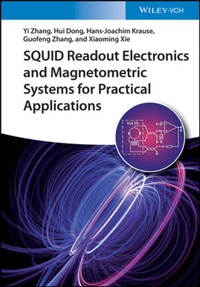
SQUID Readout Electronics and Magnetometric Systems for Practical Applications
1st Edition
Published on 12. May 2020
XII, 230 pages
978-3-527-81650-7 (ISBN)
Description

SQUIDs, short for superconducting quantum interference devices, are very sensitive magnetometers used to measure extremely subtle magnetic fields, based on superconducting loops containing Josephson junctions. SQUIDs are developing more and more into an enabling technology for many applications such as biomagnetic imaging and geophysical prospecting.
This book builds a bridge for scientists and engineers to fill potential know-how gaps for all working on SQUID systems and their practical applications. Key words such as readout electronics, flux quantization, Josephson effects or noise contributions will be no obstacle for the design and application of simple and robust SQUID systems.
This book builds a bridge for scientists and engineers to fill potential know-how gaps for all working on SQUID systems and their practical applications. Key words such as readout electronics, flux quantization, Josephson effects or noise contributions will be no obstacle for the design and application of simple and robust SQUID systems.
More details
Other editions
Additional editions
Yi Zhang | Hui Dong | Hans-Joachim Krause
SQUID Readout Electronics and Magnetometric Systems for Practical Applications
Book
07/2020
1st Edition
Wiley-VCH
€93.90
Article exhausted; check different version
Persons
Xiaoming Xie, Executive Director of the Center for Excellence in Superconducting Electronics, Chinese Academy of Sciences, received his Ph.D in 1990 from Shanghai Institute of Microsystem and Information Technology (SIMIT). He worked as a Postdoc at ESPCI, France, on high-temperature superconductivity followed by research on electronics manufacturing and reliability. He switched back to superconductivity research with a focus on superconducting electronics in 2005. He is the author of ca. 200 scientific publications with about 2000 citations and is the holder of 50 patents.
Yi Zhang received his Ph.D. in 1990 from the University of Gießen, Germany. His research at the Forschungszentrum Jülich is dedicated to the fabrication and application of SQUIDs. He has been awarded various Professor titles at the University of Peking, Shanghai Jiao Tong University, Tongji University and SIMIT CAS, and from Jilin University. In 2001, he worked at the University of California, Berkeley, in Prof. John Clarke's group, and was a co-author of the "SQUID Handbook", edited by John Clarke and Alex. I. Braginski (WILEY-VCH). He has contributed to more than 150 publications with about 2000 citations, and is one of the leading scientists for SQUID research worldwide. Several of his papers were cited in the book "100 Years of Superconductivity", edited by Horst Rogalla and Peter H. Kes (CRC Press).
Hui Dong received her Ph.D. in 2011 from SIMIT CAS. 2008 - 2010 she was a visiting student at Forschungszentrum Jülich, Germany, and a visiting scholar at the University of California, Berkeley. She is currently Associate Professor at SIMIT CAS. Her research interests include SQUID system optimization and applications of ultra-low field magnetic resonance imaging (ULF MRI). She has authored and co-authored about 30 scientific publications, and she holds 8 patents.
Guofeng Zhang received his Ph.D. in microelectronics and solid state electronics from SIMIT CAS in 2012. From 2009 - 2011 he was a visiting Ph.D. student at the Forschungszentrum Jülich, before becoming Assistant and in 2015 Associate Professor at SIMIT CAS. His research interests include SQUID design and fabrication, and SQUID applications in biomagnetism, geophysics and related areas. He has authored and co-authored about 20 scientific publications, and he holds 5 patents.
Hans-Joachim Krause received his Ph.D. in Physics from RWTH Aachen, Germany in 1993. He initiated the Non-destructive Evaluation Group at Forschungszentrum Jülich, working on projects with industrial partners for the development of SQUID systems for the magnetic testing of aircraft parts, pre-stressed concrete bridges and other structures. In summer 2011, he was a Visiting Professor at Université Pierre et Marie Curie, Paris, France. Currently, he leads the Magnetic Sensing Group in Jülich, focusing on SQUID sensors, magnetic biosensing, low field nuclear magnetic resonance, magnetic immunoassays and magnetic nanoparticle actuation. In 2017, he was appointed Professor of Physics at the University of Applied Sciences, Aachen, Germany. He has co-authored more than 150 scientific publications with over 1500 citations.
Yi Zhang received his Ph.D. in 1990 from the University of Gießen, Germany. His research at the Forschungszentrum Jülich is dedicated to the fabrication and application of SQUIDs. He has been awarded various Professor titles at the University of Peking, Shanghai Jiao Tong University, Tongji University and SIMIT CAS, and from Jilin University. In 2001, he worked at the University of California, Berkeley, in Prof. John Clarke's group, and was a co-author of the "SQUID Handbook", edited by John Clarke and Alex. I. Braginski (WILEY-VCH). He has contributed to more than 150 publications with about 2000 citations, and is one of the leading scientists for SQUID research worldwide. Several of his papers were cited in the book "100 Years of Superconductivity", edited by Horst Rogalla and Peter H. Kes (CRC Press).
Hui Dong received her Ph.D. in 2011 from SIMIT CAS. 2008 - 2010 she was a visiting student at Forschungszentrum Jülich, Germany, and a visiting scholar at the University of California, Berkeley. She is currently Associate Professor at SIMIT CAS. Her research interests include SQUID system optimization and applications of ultra-low field magnetic resonance imaging (ULF MRI). She has authored and co-authored about 30 scientific publications, and she holds 8 patents.
Guofeng Zhang received his Ph.D. in microelectronics and solid state electronics from SIMIT CAS in 2012. From 2009 - 2011 he was a visiting Ph.D. student at the Forschungszentrum Jülich, before becoming Assistant and in 2015 Associate Professor at SIMIT CAS. His research interests include SQUID design and fabrication, and SQUID applications in biomagnetism, geophysics and related areas. He has authored and co-authored about 20 scientific publications, and he holds 5 patents.
Hans-Joachim Krause received his Ph.D. in Physics from RWTH Aachen, Germany in 1993. He initiated the Non-destructive Evaluation Group at Forschungszentrum Jülich, working on projects with industrial partners for the development of SQUID systems for the magnetic testing of aircraft parts, pre-stressed concrete bridges and other structures. In summer 2011, he was a Visiting Professor at Université Pierre et Marie Curie, Paris, France. Currently, he leads the Magnetic Sensing Group in Jülich, focusing on SQUID sensors, magnetic biosensing, low field nuclear magnetic resonance, magnetic immunoassays and magnetic nanoparticle actuation. In 2017, he was appointed Professor of Physics at the University of Applied Sciences, Aachen, Germany. He has co-authored more than 150 scientific publications with over 1500 citations.
Content
1 INTRODUCTION
1.1 Motivation
1.2 Contents of the chapters
2 JOSEPHSON JUNCTIONS
2.1 Josephson equations
2.2 RCSJ model
3 DC SQUID'S I-V CHARACTERISTICS AND ITS BIAS MODES
3.1 SQUID's I-V characteristics
3.2 An ideal current source
3.3 A practical voltage source
4 FUNCTIONS OF THE SQUID'S READOUT ELECTRONICS
4.1 Selection of the SQUID's bias mode
4.2 Flux locked loop (FLL)
4.2.1 Principle of the FLL
4.2.2 Electronic circuit of the FLL and the selection of the working point
4.2.3 "Locked" and "unlocked" cases in the FLL
4.2.4 Slew rate of the SQUID system
4.3 Suppressing the noise contribution from the preamplifier
4.4 Two models of a dc SQUID
5 DIRECT READOUT SCHEME (DRS)
5.1 Introduction
5.2 Readout electronics noise in DRS
5.2.1 Noise characteristics of two types of preamplifiers
5.2.2 Noise contribution of a preamplifier with different source resistors
5.3 Chain rule and flux noise contribution of a preamplifier
5.3.1 Test circuit using the same preamplifier in both bias modes
5.3.2 Noise measurements in both bias modes
5.4 Summary of the DRS
6 SQUID MAGNETOMETRY SYSTEM AND SQUID PARAMETERS
6.1 Field-to-flux transformer circuit (converter)
6.2 Three dimensionless characteristic parameters, beta-c, Gamma, and beta-L, in SQUID operation
6.2.1 SQUID's nominal Stewart-McCumber characteristic parameter beta-c
6.2.2 SQUID's nominal thermal noise parameter Gamma
6.2.3 SQUID's screening parameter beta-L
6.2.4 Discussion on the three characteristic parameters
7 FLUX MODULATION SCHEME (FMS)
7.1 Mixed bias modes
7.2 Conventional explanation of the FMS
7.2.1 Schematic diagram of the FMS
7.2.2 Time domain and flux domain
7.2.3 Flux modulation
7.2.4 Five additional notes
7.3 FMS revisited
7.3.1 Bias mode in FMS
7.3.2 Basic consideration of synchronous measurements of Is and Vs
7.3.3 Experimentally synchronous measurements of Delta i and VRs
7.3.4 Transfer characteristics of the step-up transformer
7.3.5 V(Phi) comparison obtained by DRS and FMS
7.4 Conclusion
8 FLUX FEEDBACK CONCEPTS AND PARALLEL FEEDBACK CIRCUIT
8.1 Flux Feedback Concepts and its History
8.2 SQUID's apparent parameters
8.3 Parallel Feedback Circuit (PFC)
8.3.1 Working Principle of the PFC in Current Bias Mode
8.3.2 Working Principle of PFC in Voltage Bias Mode
8.3.3 Brief Summary of Qualitative Analyses of PFC
8.4 Quantitative analyses and experimental verification of the PFC in voltage bias mode
8.4.1 The equivalent circuit with the PFC in voltage bias mode
8.4.2 Introduction of Two Dimensionless Parameters r and ¿
8.4.3 Numerical calculations
8.4.4 Experimental Results
8.4.5 Noise Comparison and Interpretation
8.4.6 Two practical designs for PFC
8.5 Main achievements of PFC quantitative analysis
8.6 Comparison with the noise behaviors of two preamplifiers
9 ANALYSES OF THE "SERIES FEEDBACK COIL (CIRCUIT)" (SFC)
9.1 SFC in current bias mode
9.1.1 Working principle of the SFC in current bias mode
9.1.2 Noise measurements of a weakly damped SQUID (magnetometer) system with the SFC
9.2 The SFC in voltage bias mode
9.3 Summary of the PFC and SFC
9.4 Combination of the PFC and SFC (PSFC)
9.4.1 PSFC analysis under independence conditions
9.4.2 PSFC experiments and results
9.4.3 Conclusion of the PSFC
10 WEAKLY DAMPED SQUID
10.1 Basic consideration of weakly damped SQUID
10.2 SQUID system noise measurements with different ßc values
10.3 Statistics of SQUID properties
10.4 Single chip readout electronics (SCRE)
10.4.1 Principle of SCRE and its performance
10.4.2 Equivalent circuit of SCRE
10.4.3 Differences between the conventional version of readout electronics with an integrator and SCRE
10.4.4 Two applications of SCRE
10.5 Suggestions for the DRS
11 TWO-STAGE AND DOUBLE RELAXATION OSCILLATION READOUT SCHEMES
11.1 Two-stage scheme
11.2 ROS and DROS
11.3 Some comments on D-ROS and two-stage scheme
12 RADIO-FREQUENCY (RF) SQUID
12.1 Fundamentals of an rf SQUID
12.2 Conventional rf SQUID system
12.2.1 Block diagram of rf SQUID readout electronics (the 30 MHz version)
1.1 Motivation
1.2 Contents of the chapters
2 JOSEPHSON JUNCTIONS
2.1 Josephson equations
2.2 RCSJ model
3 DC SQUID'S I-V CHARACTERISTICS AND ITS BIAS MODES
3.1 SQUID's I-V characteristics
3.2 An ideal current source
3.3 A practical voltage source
4 FUNCTIONS OF THE SQUID'S READOUT ELECTRONICS
4.1 Selection of the SQUID's bias mode
4.2 Flux locked loop (FLL)
4.2.1 Principle of the FLL
4.2.2 Electronic circuit of the FLL and the selection of the working point
4.2.3 "Locked" and "unlocked" cases in the FLL
4.2.4 Slew rate of the SQUID system
4.3 Suppressing the noise contribution from the preamplifier
4.4 Two models of a dc SQUID
5 DIRECT READOUT SCHEME (DRS)
5.1 Introduction
5.2 Readout electronics noise in DRS
5.2.1 Noise characteristics of two types of preamplifiers
5.2.2 Noise contribution of a preamplifier with different source resistors
5.3 Chain rule and flux noise contribution of a preamplifier
5.3.1 Test circuit using the same preamplifier in both bias modes
5.3.2 Noise measurements in both bias modes
5.4 Summary of the DRS
6 SQUID MAGNETOMETRY SYSTEM AND SQUID PARAMETERS
6.1 Field-to-flux transformer circuit (converter)
6.2 Three dimensionless characteristic parameters, beta-c, Gamma, and beta-L, in SQUID operation
6.2.1 SQUID's nominal Stewart-McCumber characteristic parameter beta-c
6.2.2 SQUID's nominal thermal noise parameter Gamma
6.2.3 SQUID's screening parameter beta-L
6.2.4 Discussion on the three characteristic parameters
7 FLUX MODULATION SCHEME (FMS)
7.1 Mixed bias modes
7.2 Conventional explanation of the FMS
7.2.1 Schematic diagram of the FMS
7.2.2 Time domain and flux domain
7.2.3 Flux modulation
7.2.4 Five additional notes
7.3 FMS revisited
7.3.1 Bias mode in FMS
7.3.2 Basic consideration of synchronous measurements of Is and Vs
7.3.3 Experimentally synchronous measurements of Delta i and VRs
7.3.4 Transfer characteristics of the step-up transformer
7.3.5 V(Phi) comparison obtained by DRS and FMS
7.4 Conclusion
8 FLUX FEEDBACK CONCEPTS AND PARALLEL FEEDBACK CIRCUIT
8.1 Flux Feedback Concepts and its History
8.2 SQUID's apparent parameters
8.3 Parallel Feedback Circuit (PFC)
8.3.1 Working Principle of the PFC in Current Bias Mode
8.3.2 Working Principle of PFC in Voltage Bias Mode
8.3.3 Brief Summary of Qualitative Analyses of PFC
8.4 Quantitative analyses and experimental verification of the PFC in voltage bias mode
8.4.1 The equivalent circuit with the PFC in voltage bias mode
8.4.2 Introduction of Two Dimensionless Parameters r and ¿
8.4.3 Numerical calculations
8.4.4 Experimental Results
8.4.5 Noise Comparison and Interpretation
8.4.6 Two practical designs for PFC
8.5 Main achievements of PFC quantitative analysis
8.6 Comparison with the noise behaviors of two preamplifiers
9 ANALYSES OF THE "SERIES FEEDBACK COIL (CIRCUIT)" (SFC)
9.1 SFC in current bias mode
9.1.1 Working principle of the SFC in current bias mode
9.1.2 Noise measurements of a weakly damped SQUID (magnetometer) system with the SFC
9.2 The SFC in voltage bias mode
9.3 Summary of the PFC and SFC
9.4 Combination of the PFC and SFC (PSFC)
9.4.1 PSFC analysis under independence conditions
9.4.2 PSFC experiments and results
9.4.3 Conclusion of the PSFC
10 WEAKLY DAMPED SQUID
10.1 Basic consideration of weakly damped SQUID
10.2 SQUID system noise measurements with different ßc values
10.3 Statistics of SQUID properties
10.4 Single chip readout electronics (SCRE)
10.4.1 Principle of SCRE and its performance
10.4.2 Equivalent circuit of SCRE
10.4.3 Differences between the conventional version of readout electronics with an integrator and SCRE
10.4.4 Two applications of SCRE
10.5 Suggestions for the DRS
11 TWO-STAGE AND DOUBLE RELAXATION OSCILLATION READOUT SCHEMES
11.1 Two-stage scheme
11.2 ROS and DROS
11.3 Some comments on D-ROS and two-stage scheme
12 RADIO-FREQUENCY (RF) SQUID
12.1 Fundamentals of an rf SQUID
12.2 Conventional rf SQUID system
12.2.1 Block diagram of rf SQUID readout electronics (the 30 MHz version)
