

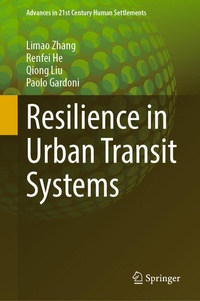
Resilience in Urban Transit Systems
Description

This book provides an integrated and up-to-date overview of resilience thinking applied to urban transit systems, with a clear structure reflecting the logical progression from understanding vulnerabilities to implementing enhancement strategies. This book reveals the hidden complexities and interdependencies within urban transit systems that affect their resilience performance; presents analytical models, evaluation methods, and practical planning strategies for assessing and strengthening transit resilience; showcases real-world applications and evidence-based practices to demonstrate how resilience can be embedded in transit operations and management; promotes a deeper understanding of current advancements and inspires further research and implementation of resilience-oriented solutions in urban transit systems.
More details
Other editions
Additional editions
Persons
Dr. Limao Zhang is currently a Professor at the School of Civil and Hydraulic Engineering, Huazhong University of Science and Technology, China. Prior to his appointment at HUST, he served as an Assistant Professor at the School of Civil and Environmental Engineering, Nanyang Technological University, Singapore. He serves as Editor-in-Chief of Journal of Building Desing and Environment and Editorial Board Member of Automation in Construction. His research focuses on construction informatics, urban resilience, and intelligent control.
Dr. Renfei He is currently a postdoctoral research fellow at the School of Civil and Environmental Engineering, Nanyang Technological University, Singapore. He obtained his Doctoral degree from Nanyang Technological University, Singapore. His principal research interests include urban resilience, emergency management, and metro flood management.
Ms. Qiong Liu is currently a Ph.D. candidate at the Department of Architecture and Civil Engineering, City University of Hong Kong. She received her Master's degree from Huazhong University of Science and Technology China. She has published and contributed to topics including emergency response optimization, network vulnerability analysis, resilience enhancement for urban rail transit systems.
Dr. Paolo Gardoni holds the Alfredo H. Ang Family Professorship in Civil and Environmental Engineering at the University of Illinois Urbana-Champaign (Grainger College of Engineering). He also holds joint/courtesy appointments in Industrial Engineering, Carle Illinois College of Medicine, and Gies College of Business, along with positions at international institutions including Loughborough University and Tsinghua University. He is Editor-in-Chief of Reliability Engineering & System Safety and founded Sustainable & Resilient Infrastructure. He serves on numerous journal boards and has held leadership roles in major societies like ASCE's Engineering Mechanics Institute and CERRA. His research focuses on risk, reliability, and resilience analysis; probabilistic mechanics; sustainable infrastructure; natural hazard modeling/mitigation; climate change impacts; and engineering ethics.
Content
Introduction to urban resilience.- Part one.- System vulnerability modelling.- Disaster chains modelling.- Cascading failure modelling.- Evolutionary dynamics modelling.- Part two.- System vulnerability evaluation.- Flood hazard analysis.- Fire hazard analysis.- Escape panic analysis.- Part three.- System resilience enhancement.- Facility operation planning.- Emergence rescue planning.- Passenger evacuation planning.- System repair planning.- Conclusions.
