

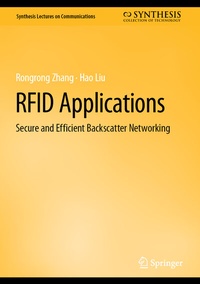
RFID Applications
Description

This book introduces current efficient and secure backscatter networking schemes for RFID. The authors integrate these schemes with a concrete example, namely RFID-based missing item detection. The book presents a large palette of tools indispensable in the RFID-based passive IoT (such as compute complexity analysis, approximate algorithm design, the probabilistic data structure, and the protocol stack in COTS and software-defined RFID tags) and how these tools can be carefully tuned and adapted to be practically applied in RFID systems. The book elaborates the state-of-the-art research bringing the conventional data structure and traffic engineering technology in the core network into the emerging IoT applications of RFID. This does not only boost the performance for RFID systems, but also inspires new research directions. The authors believe that this book will interest researchers, professionals, and graduates working in RFID system design and engineering, low-power IoT as well as other related fields.
More details
Other editions
Additional editions
Persons
Rongrong ZHANG received the B.E and M.E degree in communication and information systems from Chongqing University of Posts and Telecommunications, Chongqing, China, in 2010 and 2013, respectively, and Ph.D degree in Computer Science at the University of Paris Descartes, France, in 2017. She was a research fellow from 2017 in the School of Electrical Engineering and Computer Science, University of Ottawa, Ontario, Canada. She is currently an Associate Professor with the College of Information Engineering, Capital Normal University, Beijing, China. Her research interests focus on Wireless Area Body Networks for e-health applications, and Internet of Things. She has published over 30 papers on top-tier journals and conferences, such as IEEE TMC\JSAC\TCOM\TWC, NSDI, ACM MobiSys, and IEEE INFOCOM\ICC\GLOBECOM. She received the Best Paper Awards at IEEE GLOBECOM'20 and IEEE/CIC ICCC'20, and the Best Paper Runner-up at ACM MobiSys'23.
Hao Liu received the B.E degree and Ph.D degree in information engineering from Beijing Institute of Technology, Beijing, China, in 2014 and 2022. He is currently an assistant professor at Communication University of China. His research interest focuses on RFID technology.
Content
Introduction.- Efficient grouping scheme for large-scale RFID systems.- Secure group-wise downlink communication scheme.- Compact filter-based scheduled access protocol.- Fast scheduled access protocol with joint communication-computation optimization.- Practical hashing-free scheduling access implementation.- Perspective.- Conclusion.
