

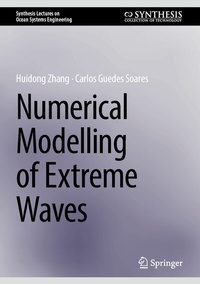
Numerical Modelling of Extreme Waves
Description

This book describes some approaches for developing the numerical models to efficiently predict the formation of extreme waves which can pose a threat to the safety of marine structures. The numerical algorithms for solving different governing equations and the theoretical probability models for extreme wave predictions are explained in detail. These models can help engineers in the design of marine structures that can withstand extreme waves.
With more frequent extreme weather due to climate change, extreme waves have become more common. Extreme waves are an interesting phenomenon, but because of their enormous destructive power, understanding their formation mechanism, properties, and impact, is necessary for the design and safe operation of ships and offshore structures.
More details
Other editions
Additional editions
Persons
Huidong Zhang is an Associate Professor of Ocean Engineering at the Department of Ocean Engineering, Ocean University of China since 2017. He received his Ph.D. in naval architecture and ocean engineering from the University of Lisbon in 2016. Dr. Zhang's research is focused on the statistical analysis and numerical modelling of extreme waves as well as their effects on various marine structures.
Carlos Guedes Soares is a Distinguished Professor at the University of Lisbon. He is the Scientific Coordinator of the Centre for Marine Technology and Ocean Engineering (CENTEC). He received the Ph.D. degree from the Norwegian Institute of Technology of the University of Trondheim, in 1984, and a Doctor of Science degree from the Technical University of Lisbon, Portugal, in 1991. He has supervised more than 75 PhD students, has co-authored more than 700 journal papers and has more than 32,000 citations in Web of Science (45,000 in SCOPUS).
He is one of the 5 Founding Members of the European Safety and Reliability Association (ESRA), and has served as General Secretary, Vice-Chairman and Chairman of ESRA. He has been the Chairman of the International Maritime Association of the Mediterranean (IMAM) and of the Ship and Offshore Structures Congress (ISSC). He has been the Editor and Editor-in-Chief of the Reliability Engineering and System Safety Journal (Elsevier) since 1992, is Co-Editor in Chief of the Journal for Marine Science and Application (Springer), and serves on the Editorial Board of more than 15 Journals.
Content
Introduction.- Laboratory Experiments of Extreme Waves.- Modeling Extreme Waves with 2D NLS Equation.- Modeling Extreme Waves with 2D Dysthe Equation.- Modeling .-xtreme Waves with 3D Dysthe Equation.- Modeling Extreme Waves with High-Order Spectral Method.- Modeling Extreme Waves with Fully Nonlinear CS Model.- Effect of Initial Condition on the Formation of Extreme Wave.- References.
