

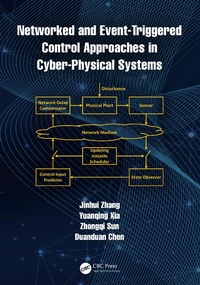
Networked and Event-Triggered Control Approaches in Cyber-Physical Systems
1st Edition
Published on 27. January 2022
220 pages
978-1-000-53428-3 (ISBN)
Description

The insertion of communication networks in feedback control loops complicates analysis and synthesis of cyber-physical systems (CPSs), and network-induced uncertainties may degrade system control performance. Thus, this book researches networked delay compensation and event-triggered control approaches for a series of CPSs subject to network-induced uncertainties.
The authors begin with an introduction to the concepts and challenges of CPSs, followed by an overview of networked control approaches and event-triggered control strategies in CPSs. Then, networked delay compensation and event-triggered control approaches are proposed for CPSs with network communication delay, data dropout, signal quantization, and event-triggered communication. More specifically, networked delay compensation approaches are proposed for linear/nonlinear networked controlled plants with time-varying and random network communication delays and data dropouts. To reduce computational burden and network communication loads in CPSs, event-triggered control, self-triggered control, co-design of event-triggered control and quantized control techniques, and event-triggered disturbance rejection control approaches are also presented.
This book is an essential text for researchers and engineers interested in cybersecurity, networked control, and CPSs. It would also prove useful for graduate students in the fields of science, engineering, and computer science.
The authors begin with an introduction to the concepts and challenges of CPSs, followed by an overview of networked control approaches and event-triggered control strategies in CPSs. Then, networked delay compensation and event-triggered control approaches are proposed for CPSs with network communication delay, data dropout, signal quantization, and event-triggered communication. More specifically, networked delay compensation approaches are proposed for linear/nonlinear networked controlled plants with time-varying and random network communication delays and data dropouts. To reduce computational burden and network communication loads in CPSs, event-triggered control, self-triggered control, co-design of event-triggered control and quantized control techniques, and event-triggered disturbance rejection control approaches are also presented.
This book is an essential text for researchers and engineers interested in cybersecurity, networked control, and CPSs. It would also prove useful for graduate students in the fields of science, engineering, and computer science.
More details
Edition
1. Auflage
Language
English
Place of publication
London
United Kingdom
Publishing group
Taylor & Francis Ltd
Target group
College/higher education
Professional and scholarly
Illustrations
6 Tables, black and white; 43 Line drawings, black and white; 2 Halftones, black and white; 45 Illustrations, black and white
ISBN-13
978-1-000-53428-3 (9781000534283)
Copyright in bibliographic data and cover images is held by Nielsen Book Services Limited or by the publishers or by their respective licensors: all rights reserved.
Schweitzer Classification
Other editions
Additional editions
Jinhui Zhang | Yuanqing Xia | Zhongqi Sun
Networked and Event-Triggered Control Approaches in Cyber-Physical Systems
Book
01/2024
1st Edition
CRC Press
€71.50
Shipment within 10-20 days
Jinhui Zhang | Yuanqing Xia | Zhongqi Sun
Networked and Event-Triggered Control Approaches in Cyber-Physical Systems
Book
01/2022
1st Edition
CRC Press
€119.90
Shipment within 10-20 days
Persons
Jinhui Zhang is currently a Professor at Beijing Institute of Technology, China. His research interests include networked control systems, composite disturbance rejection control, and biomedical engineering.
Yuanqing Xia is currently a Professor at Beijing Institute of Technology, China. His research interests are in the fields of networked control systems, robust control and signal processing, and active disturbance rejection control.
Zhongqi Sun is currently an Assistant Professor at Beijing Institute of Technology, China. His research interests include multi-agent systems, model predictive control, machine learning, and robotic systems.
Duanduan Chen is currently a Professor at Beijing Institute of Technology, China. Her research focuses on biomechanics, computer simulation, and complex system analysis and control.
Yuanqing Xia is currently a Professor at Beijing Institute of Technology, China. His research interests are in the fields of networked control systems, robust control and signal processing, and active disturbance rejection control.
Zhongqi Sun is currently an Assistant Professor at Beijing Institute of Technology, China. His research interests include multi-agent systems, model predictive control, machine learning, and robotic systems.
Duanduan Chen is currently a Professor at Beijing Institute of Technology, China. Her research focuses on biomechanics, computer simulation, and complex system analysis and control.
Content
Chapter 1 Introduction
Section 1 Networked Control Approaches in CPSs
Chapter 2 Stochastic Stability and Stabilization of CPSs with Random Delay
Chapter 3 Observer-Based Output Feedback Stabilization for CPSs with Quantized Inputs
Chapter 4 State Feedback Networked Delay Compensation Control for CPSs with Time-Varying Delay
Chapter 5 Output Feedback Networked Delay Compensation Control for CPSs with Random Delay
Chapter 6 Fuzzy Networked Delay Compensation Control for Nonlinear CPSs
Chapter 7 Networked Output Tracking Control of CPSs with Delay Compensation
Section 2 Event-Triggered Control Approaches in CPSs
Chapter 8 Observer-Based Event-Triggered Control for CPSs
Chapter 9 Observer-Based Self-Triggered Control for CPSs
Chapter 10 Event-Triggered Dynamic Output Feedback Control for CPSs
Chapter 11 Co-Design of Event-Triggered Control and Quantized Control for CPSs
Chapter 12 Event-Triggered Disturbance Rejection Control for CPSs
Section 1 Networked Control Approaches in CPSs
Chapter 2 Stochastic Stability and Stabilization of CPSs with Random Delay
Chapter 3 Observer-Based Output Feedback Stabilization for CPSs with Quantized Inputs
Chapter 4 State Feedback Networked Delay Compensation Control for CPSs with Time-Varying Delay
Chapter 5 Output Feedback Networked Delay Compensation Control for CPSs with Random Delay
Chapter 6 Fuzzy Networked Delay Compensation Control for Nonlinear CPSs
Chapter 7 Networked Output Tracking Control of CPSs with Delay Compensation
Section 2 Event-Triggered Control Approaches in CPSs
Chapter 8 Observer-Based Event-Triggered Control for CPSs
Chapter 9 Observer-Based Self-Triggered Control for CPSs
Chapter 10 Event-Triggered Dynamic Output Feedback Control for CPSs
Chapter 11 Co-Design of Event-Triggered Control and Quantized Control for CPSs
Chapter 12 Event-Triggered Disturbance Rejection Control for CPSs
