

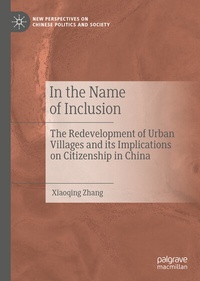
In the Name of Inclusion
Description

This book follows the citizenship-based approach and interrogates the policies on urban village redevelopment from a perspective of social exclusion and inclusion. It focuses on two questions: how policy makers and urban villagers understand social inclusion differently, and what makes a difference in enhancing social inclusion. Firstly, an examination of citizenship conceptions, as reflected in the Chinese traditional discourses, provides the basis for questioning the political rhetoric of social inclusion in China. Secondly, a comparison between policy makers' and villages' interpretations on urban citizenship helps explore the different understandings of citizenship between them. Finally, by studying six redeveloped urban villages in the city of Xi'an, the book identifies what villagers strive for, and discusses how their strivings make a difference in achieving social inclusion during urban village redevelopment.
More details
Other editions
Additional editions
Person
Xiaoqing Zhang is Lecturer in Public Administration at the Zhejiang Sci-tech University, China. She graduated from University College London with a PhD in Planning Studies. Her research interests include urban regeneration in relation to welfare regimes, and community governance sitting within a broader understanding of local political resources.
