

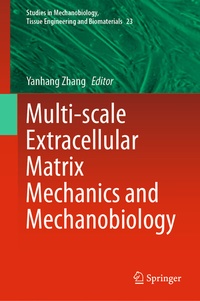
Multi-scale Extracellular Matrix Mechanics and Mechanobiology
Description

This book describes the current state of knowledge in the field of multi-scale ECM mechanics and mechanobiology with a focus on experimental and modelling studies in biomechanical characterization, advanced optical microscopy and imaging, as well as computational modeling. This book also discusses the scale dependency of ECM mechanics, translation of mechanical forces from tissue to cellular level, and advances and challenges in improving our understanding of cellular mechanotransduction in the context of living tissues and organisms.
More details
Other editions
Additional editions
Person
Dr. Yanhang (Katherine) Zhang is a Professor at Boston University's Departments of Mechanical and Biomedical Engineering, and Division of Materials Science and Engineering. She received her double major B.S. degrees in Engineering Mechanics and Economics and Management from Tsinghua University, China, in 1998; and her M.S. and Ph.D. degrees in Mechanical Engineering from the University of Colorado at Boulder, in 2000 and 2003 respectively, and was also a postdoc there for two years. In 2006, Dr. Zhang became an Assistant Professor at Boston University, where she established the Multi-Scale Tissue Biomechanics Laboratory. Her research focuses on vascular biomechanics and the multi-scale mechanics and mechanobiology of the extracellular matrix. Her research has been funded the by National Institute of Health (NIH), National Science Foundation (NSF), and the Defense Advanced Research Projects Agency (DARPA). Dr. Zhang was awarded the Clare Boothe Luce Assistant Professorship from 2006-2011, and received the Young Faculty Award from DARPA in 2007, and Faculty Early Career Development (CAREER) Award from the NSF in 2010. Dr. Zhang was elected a Fellow of the American Society of Mechanical Engineers (ASME) in 2018.
Content
Contributions of extracellular (ECM) constituents to the mechanical function of soft biological tissue.- Structure-based constitutive modeling of ECM mechanics.- Advanced optical imaging of ECM structures in biological systems -fundamental research and clinical applications.- Discrete fiber network modeling of ECM networks.- Microstructural mechanisms and contributions of elastin and collagen to the elastic and viscoelastic behavior of soft biological tissues.- Scale-dependency of multi-scale ECM mechanics and measurements.- Bridging scales - multi-scale mechanics of engineered and native tissue.- Mechanical and biological interactions between cells and ECM.- Multi-physics modeling of ECM mechanics.
