

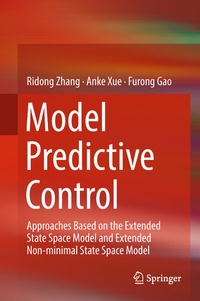
Model Predictive Control
Description

This monograph introduces the authors' work on model predictive control system design using extended state space and extended non-minimal state space approaches. It systematically describes model predictive control design for chemical processes, including the basic control algorithms, the extension to predictive functional control, constrained control, closed-loop system analysis, model predictive control optimization-based PID control, genetic algorithm optimization-based model predictive control, and industrial applications. Providing important insights, useful methods and practical algorithms that can be used in chemical process control and optimization, it offers a valuable resource for researchers, scientists and engineers in the field of process system engineering and control engineering.
More details
Other editions
Additional editions
Persons
Ridong Zhang received his Ph.D. in control science and engineering from Zhejiang University, Hangzhou, China, in 2007. From 2007 to 2015, he was a full professor at the Institute of Information and Control, Hangzhou Dianzi University, Hangzhou, and since 2015 he has been a visiting professor at the Chemical and Biomolecular Engineering Department, Hong Kong University of Science and Technology, Hong Kong. He has published more than 40 journal papers in the fields of process modeling and control. His research interests include process modeling, model predictive control and nonlinear systems.
Anke Xue received his Ph.D. in control science and engineering from Zhejiang University, Hangzhou, China, in 1997. He is currently a full professor at the Institute of Information and Control, Hangzhou Dianzi University, Hangzhou and the president of Hangzhou Dianzi University. He has published more than 50 journal papers in the fields of robust controland complex systems. His research interests include control theory and applications.
Furong Gao received his B.Eng. degree in automation from China University of Petroleum, China, in 1985 and his M.Eng. and Ph.D. degrees in chemical engineering from McGill University, Montreal, Canada in 1989 and 1993, respectively. He was a senior research engineer at Moldflow International Company Ltd. Since 1995, he has worked at Hong Kong University of Science and Technology, where he is currently a chair professor at the Department of Chemical and Biomolecular Engineering. His research interests include process monitoring and control, as well as polymer processing.
Content
Introduction.- Model Predictive Control Based on Extended State Space Model.- Predictive Functional Control Based on Extended State Space Model.- Model Predictive Control Based on Extended Non-Minimal State Space Model.- Predictive Functional Control Based on Extended Non-minimal State Space Model.- Model Predictive Control Under Constraints.- PID Control Using Extended Non-minimal State Space Model Optimization.- Closed-loop System Performance Analysis.- Model Predictive Control Performance Optimized by Genetic Algorithm.- Industrial Application.- Further Ideas on MPC and PFC Using Relaxed Constrained Optimization.
