

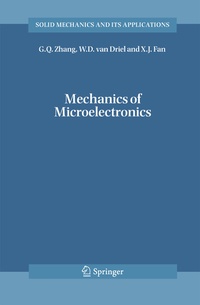
Mechanics of Microelectronics
Description

From a mechanical engineering point of view, Microelectronics and Microsystems are multi-scale in both geometric and time domains, multi-process, multi-functionality, multi-disciplinary, multi-material/interface, multi-damage and multi-failure mode. Their responses in manufacturing, assembling, qualification tests and application conditions are strongly nonlinear and stochastic. Mechanics of Microelectronics is extremely important and challenging, in terms of both industrial applications and academic research.
Written by the leading experts with both profound knowledge and rich practical experience in advanced mechanics and microelectronics industry, this book aims to provide the cutting edge knowledge and solutions for various mechanical related problems, in a systematic way. It contains essential and detailed information about the state-of-the-art theories, methodologies, the way of working and real case studies.
Reviews / Votes
From the reviews:
"This is an introductory treatise on the mechanism of microelectronics that has penetrated into every aspects of human life for the past half of a century. . The treatise should be of interest to both the academia and industry, and it can be used as a 'basic source for teaching' in a graduate course. . In sum, the authors have done a valuable service in presenting the title topic to researchers, engineers and students interested in the mechanics of microelectronics." (M. Cengiz Dökmeci, Zentralblatt MATH, Vol. 1105 (7), 2007)
"The editors of Mechanics of Microelectronics present this book, as their obligation, to graduate students in universities, researchers, engineers and managers in industries. . The book chapters are written by the worldwide leading experts with both profound theoretical achievement and rich industrial experience . . The book will be eagerly sought after by microelectronics and microsystems design engineers; process/product development engineers; reliability engineers; thermal, mechanical and multi-physics analysts; researchers, graduates and PhD students and their guides." (Current Engineering Practice, 2007)
More details
Other editions
Additional editions
Content
Chapter 7
CHARACTERIZATION AND MODELLING OF SOLDER JOINT RELIABILITY (p. 378)
R. Dudek
Fraunhofer Institute Zuverlassigkeit und Mikrointegration, Gustav-Meyer-A - llee 25, 13355
Berlin, Germany
Abstract: This chapter addresses finite-element analyses (FEA) of solder fatigue phenomena caused by low-cycle thermo-mechanical loading. To begin with, an introduction to board level solder joint fatigue, characteristic thermal loading situations, the effects of thermal mismatch and analytical lifetime estimates is provided. Subsequently, challenges to the FE-based methodologies are discussed, which are particularly related to the non-linear mechanical properties of soft solders. Material constitutive models and the implementation of time and temperature dependent behaviours of leaded and lead-free solders are described. d Fatigue-life prediction modelling focuses on the strength of materials approaches, i.e., creep strain-based relations or energy-based relations. An overview on several fatigue-life prediction models from the literature is additionally provided. The FE-based methodology is applied to board-level solder joint reliability assessments for several components. Its wide applicability is illustrated by the choice of different types of components ranging from large t ceramic surface mount to small flip-chip assemblies on different types of substrates. For some of the application cases, results of parametric studies are presented and comparisons between failure prediction and testing results are made.
Key words: Solder fatigue, Finite Element simulations, solder plasticity, solder creep, primary and secondary creep, reliability predictions, coffin manson, board level test validation.
1. INTRODUCTION
The computational design of reliable microsystems, electronic packages as well as their interconnects can minimize expensive prototype development and testing. Accordingly, finite element (FE-) modelling is widely used to perform parametric studies on the thermo-mechanical behaviour of components like e.g., silicon microstructures, plastic packages, chip size/wafer level packages, or flip chip assemblies.
From a mechanical point of view all these structures include constituents, which are subjected to different loading conditions. The theoretical analysis of stresses within these constituents induced by environmental conditions requires the characterization of loads and material properties, respectively, as well as the knowledge of the appropriate failure criteria. Figure 1 provides an overview on the characteristic tasks to be performed for those thermomechanical finite element analyses (FEA).
