

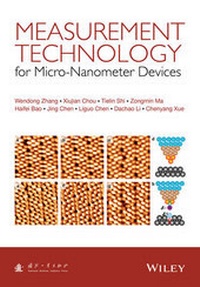
Measurement Technology for Micro-Nanometer Devices
Description

More details
Other editions
Additional editions

Persons
WENDONG ZHANG, North University of China, China
XIUJIAN CHOU, North University of China, China
TIELIN SHI, Huazhong University of Science and Technology, China
ZONGMIN MA, North University of China, China
HAIFEI BAO, Shanghai Institute of Microsystem and Information Technology, Chinese Academy of Sciences, China
JING CHEN, Peking University, China
LIGUO CHEN, Soochow University, China
DACHAO LI, Tianjin University, China
CHENYANG XUE, Key Laboratory of Instrument Science and Dynamic Measurement, Ministry of Education, China
Content
About the Authors ix
Preface xi
1 Introduction 1
1.1 Micro/Nanotechnology 1
1.1.1 Development of MEMS 1
1.1.2 Development of NEMS 3
1.2 Development of Micro/Nanoscale Measurements 5
1.2.1 Significance 5
1.2.2 Types of Micro/Nanoscale Measurements 6
1.2.3 Conclusion and Outlook 7
References 9
2 Geometry Measurements at the Micro/Nanoscale 11
2.1 Microvision Measurement 11
2.1.1 Micro/Nanoscale Plane Geometry Parameter Tests 11
2.1.2 Integrality Tests and Analysis of Micro/Nanometer Structures 12
2.1.3 Micro/Nanoscale Plane Dynamic Characteristic Tests 13
2.2 3D Morphology Measurements in Contact Mode 15
2.2.1 Scanning Probe Microscopy 15
2.2.2 Near-Field Scan Optics Microscopy (NSOM) 21
2.2.3 Scanning Electron Microscopy 26
2.2.4 Transmission Electron Microscopy 31
2.3 3D Morphology Optics Measurements with Non-Contact Modes 36
2.3.1 Laser Scanning Microscopy 37
2.3.2 White Light Interferometry Morphology Measurements 40
2.4 Micro/Nanoscale Tricoordinate Measurements 63
2.4.1 Basics 64
2.4.2 Experimental Techniques 67
2.5 Measurement of Film Thickness 71
References 77
3 Dynamic Measurements at the Micro/Nanoscale 79
3.1 Stroboscopic Dynamic Vision Imaging 79
3.1.1 Principles of Plane Dynamic Measurements 80
3.1.2 Equipment 81
3.1.3 Block Matching and Phase Correlation Methods 84
3.1.4 Optical Flow Field Measurement Method 86
3.2 Stroboscopic Microscopy Interference Measurements 90
3.2.1 Principles 90
3.2.2 Equipment 92
3.2.3 System 93
3.3 Laser Doppler Microscope Vibration Measurements 94
3.3.1 Differential Doppler Vibration Measurements 98
3.3.2 Laser Torsional Vibration Measurements 99
3.3.3 Laser Doppler Vibration Measurements of Single Torsional Vibrations and Single Bend Vibrations 100
3.3.4 Laser Doppler Flutter Measurements 103
3.4 Conclusion 104
3.4.1 Mechanical Processes in AFM 104
3.4.2 Measurement Theory and Methods of Micro/Nanometer Mechanics in AFM 106
3.4.3 Micro/Nano Measurement System and Reference Cantilever Measurement Method in AFM 112
3.4.4 Measurement of Spring Constant of Cantilever and System Verification 115
3.4.5 Application of AFM to Nanometrology 117
References 119
4 Mechanical Characteristics Measurements 121
4.1 Residual Stress Measurements of Microstructures 122
4.1.1 Residual Stress 122
4.1.2 Measurements 122
4.2 Axial Tensile Measurement 131
4.2.1 Traditional Tensile Method 131
4.2.2 Conversion Tensile Method 136
4.2.3 Integrated Tensile Method 137
4.2.4 Displacement Measurement of Uniaxial Tension 138
4.3 Nano-Indentation Measurements Using Contact Dode 140
4.3.1 Basic Principles of Nano-Indentation Technology 140
4.3.2 Nano-Indentation Measurements 148
4.3.3 Features of Nano-Indentation Technology 150
4.4 Bend Method 151
4.4.1 Principles 151
4.4.2 Micro/Nanobeams 154
4.4.3 Advantages and Disadvantages of the Bend Method 157
4.5 Resonance Method 157
4.5.1 Resonance Frequency 158
4.5.2 Intrinsic Resonance Frequency 159
4.6 Stress Measurements Based on Raman Spectroscopy 160
4.6.1 Raman Scattering 160
4.6.2 Theory 161
4.6.3 Experimental Techniques 162
4.6.4 System 164
4.6.5 Experiments 172
4.6.6 Conclusion and Prospects 173
4.7 Bonding Strength Measurements 174
4.7.1 Principles 174
4.7.2 Crack Spread Method 183
References 189
5 SPM for MEMS/NEMS Measurements 191
5.1 Introduction 191
5.2 Atomic Force Measurement 192
5.2.1 Atomic Force Measurement Methods 192
5.3 Instruments 199
5.3.1 Schematic of the AFM Unit 199
5.3.2 Fiber and Sample Approach Stages 200
5.3.3 Tube Scanner 202
5.3.4 Vibration Isolation System 204
5.4 Interferometer Detection Method 205
5.4.1 Optical Interference Theory 205
5.4.2 Interferometer Detection 207
5.5 Cantilever and Tip 209
5.6 SPM System 211
5.7 Applications of SFM in Micro/Nano Measurements 212
5.7.1 Three-Dimensional (3D) Imaging 212
5.7.2 Micro/Nanoelectronics 215
5.7.3 Metrology 217
5.7.4 Manipulation and Spectroscopy 218
5.8 Conclusion 222
References 222
6 MEMS Online Measurements 227
6.1 Bulk Silicon Micromachining 228
6.1.1 Principles 228
6.1.2 Location Platform 229
6.2 Surface Micromachining 235
6.2.1 Surface Sacrificial Layer Microfabrication Process 236
6.2.2 Thermal Conductivity Measurements of Polysilicon Thin Films 239
6.3 Polymer Materials Processing 245
6.3.1 Principles 245
6.3.2 Photosensitive Polyimide (PSPI) Microvalve 247
6.4 Conclusion 252
References 253
7 Typical Micro/Nanoscale Device Measurements 255
7.1 MEMS Pressure Transducer Measurements 255
7.1.1 Introduction 255
7.1.2 Principles of MEMS Pressure Transducers 255
7.1.3 Electrical Property Measurements 261
7.1.4 Static Testing of MEMS Pressure Sensors 267
7.1.5 Dynamic Measurements 271
7.1.6 Impact Factors of Pressure Sensor Testing 272
7.1.7 Reliability Measurements 273
7.2 MEMS Accelerator Measurements 276
7.2.1 Introduction 276
7.2.2 Low- and Medium-Range Accelerator Measurements 277
7.2.3 High-g MEMS Accelerator Measurements 284
7.3 RF MEMS Testing Technology 296
7.4 Micro/Nanoscale Devices for Infrared Measurement 304
7.4.1 Infrared Imaging System 305
7.4.2 Infrared Imaging Measurement 307
7.5 Typical NEMS Device Measurement 311
7.5.1 NEMS Accelerometer Measurements 312
7.5.2 Working Principles of a NEMS Acoustic Sensor 318
References 325
Index 327
1
Introduction
Over the past 30 years, with the proposal of various micro-electromechanical systems (MEMS) and nano-electromechanical systems (NEMS), micro/nanoscale measurement techniques have rapidly become powerful, and as a result, have become an invaluable tool for investigating micro/nanoscale devices and their properties. In this chapter, we will first present the basic concepts and current state of micro/nanoscale science and technology and related measurement techniques. Subsequently, we will introduce the specific micro/nanoscale measuring techniques that lie at the core of this book and will highlight examples of important achievements in the field. We will conclude with a brief comment on the future prospects of micro/nanoscale measurement techniques.
1.1 Micro/Nanotechnology
In this book, we focus on two important issues in micro/nanotechnology: MEMS and NEMS. First, we will briefly explain how materials, mechanisms, data, sensing, and systems are integrated in micro/nanotechnology. We will also highlight how important features of micro/nanotechnology increasingly rely on the multidisciplinary advances in science and technology, and how they help to drive these advances.
1.1.1 Development of MEMS
In 1994, the Federal Ministry of Education and Research (BMBF) in Germany defined MEMS as a technology that combines computers with tiny mechanical devices such as sensors, valves, gears, mirrors, and actuators embedded in semiconductor chips. A MEMS device contains microcircuitry on a tiny silicon chip into which some mechanical device such as a mirror or a sensor has been manufactured. Such chips can be built in large quantities at low cost, making them cost-effective for many applications. They consist of sophisticated but compact sensors and actuator systems, in addition to related processing circuits, which measure and electronically process parameters such as acceleration, pressure, distance, temperature, light, and chemical concentrations. As a result, these devices have the capacity for detection, computation, and actuation. Manufacturing and processing these devices requires a combination of various cutting-edge microfabrication technologies.
A typical MEMS device comprises a sensor, an actuator, a signal processing system, a control system, and a power supply. MEMS devices can transform energy, produce building blocks and signal substances for the body, generate and conduct electrical signals, and communicate with neighboring devices and more distant partners. They are also capable of repairing themselves and multiplying. MEMS devices can serve as microsensors, actuators, micromechanical optical devices, vacuum microelectronic devices, and power electronic devices. As a result, MEMS have a very broad range of potential applications in fields such as aviation, motoring, environmental monitoring, and biomedicine. Thus, the design and production of MEMS has grown into a huge industry. MEMS is believed to provide profound technological advantages to society, such as improving temperature transducers, humidity transducers, automation intelligence, and the reliability of integrated systems with built-in attitude regulation, similar to how microelectronics and computer science have brought great advantages to humans over the past few decades. MEMS technology has made electronic systems compact, more flexible, and smarter, thereby stimulating progress in the field of micro/nanotechnology.
Various types of MEMS devices, including pressure sensors, accelerators, micromachined gyroscopes, ink nozzles, and hard drive disks, are commercially available. Most industry observers predict that the global sales of MEMS devices will increase in the next five years, with an average annual increase in sales of approximately 18% (MEMS Industry Group, MIG, 2013). This will lead to opportunities as well as challenges, particularly in the fields of mechanical and electronics engineering, precision machinery and equipment, and semiconductors. The following highlights some of the expected trends in the development of the science and technology of MEMS:
- Research scope diversification:
MEMS-related research fields include microaccelerometers and microgyroscopes, atomic force microscope (AFM), data storage, three-dimensional microstructures, microvalves, pumps and nozzles, microflow devices, micro-optics, actuators, performance simulation of micro-electromechanical devices, fabrication processes, packaging and bonding, medical devices, device characterization and analysis of experimental results, pressure sensors, microphones, and acoustic devices. All these 16 fields have potential military and civil applications.
- Process technology diversification:
Various processing technologies for fabricating MEMS devices have been developed over the last twenty years. These include conventional silicon bulk processing; surface sacrifice layer processing; dissolved silicon processing; deep groove etching and bond combination processing; lithography, electroforming, injection molding processing; processing of metal sacrificial layers; metal-air MOSFET; and silicon-bulk-processing-combined surface sacrificial layer processing.
- Development of monolithic integration for MEMS devices:
Because of the very weak (current or voltage) output signals of MEMS sensors, useful information can be completely drowned out by stray capacitance and resistance if they are connected to external circuits. Therefore, in order to obtain a high signal-to-noise ratio (SNR) for MEMS devices, the sensors and processing circuits must be integrated on a chip. For example, ADI, an American company, used monolithic integration to integrate a sensor and circuits on a single chip to produce an integrated accelerator.
- General considerations for the fabrication and packaging of a MEMS device:
The major difference between a MEMS device and an integrated circuit chip is that a MEMS device usually has fragile, moveable components that can get damaged during transfer of the device before packaging. Therefore, fabrication and packaging must be considered simultaneously when MEMS devices are designed. Packaging techniques are indeed one of the most important MEMS research areas and are covered in every international conference and symposium on MEMS.
- Coexistence of commercial devices and devices for specific applications (such as for aviation, space flight, or military use):
Depending on the context of their use, different devices might have very different demands. For example, for accelerators used in airbags in automobiles, a sensitivity of 0.5 g is required, whereas in aerospace and other high-tech fields, accelerometers with high resolutions and sensitivities of below 10-8 g are used.
Based on the miniaturization, intelligence, and integration features of MEMS devices, we predict that the development of MEMS will bring about a technological revolution within the society, and profoundly influence science and technology, production methods, and production qualities throughout the twenty-first century. Furthermore, we expect MEMS to accelerate the development of national science, security, and economic prosperity in China.
1.1.2 Development of NEMS
NEMS are devices that integrate electrical and mechanical functionality on the nanoscale (0.1-100 nm); they are the next logical miniaturization step after MEMS devices. Typically, NEMS integrate transistor-like nanoelectronics with mechanical actuators, pumps, or motors, and may form physical, biological, and chemical sensors. Their typical device dimensions (in nanometers) lead to low mass, high mechanical resonance frequencies, potentially large quantum mechanical effects such as zero point motion, and high surface-to-volume ratios, which are useful for surface-based sensing mechanisms. NEMS devices have been used as accelerometers or detectors of airborne chemical substances.
NEMS are expected to significantly impact many areas of technology and science, and eventually replace MEMS because of the scale on which they can function. As noted by Richard Feynman in his famous talk in 1959, "There's Plenty of Room at the Bottom," there are many potential applications of machines at smaller and smaller sizes; technology benefits by building and controlling devices at smaller scales. The expected benefits include greater efficiencies and reduced size, decreased power consumption, and lower costs of production in electromechanical systems. In 2000, the first very-large-scale integration NEMS device was demonstrated by researchers from IBM. Its premise was an array of AFM tips that can heat/sense a deformable substrate in order to function as a memory device. In 2007, the International Technical Roadmap for Semiconductors (ITRS) contained NEMS memory as a new entry in the Emerging Research Devices section (text taken from Wikipedia, the free encyclopedia, https://en.wikipedia.org/wiki/Nanoelectromechanical-systems).
Two complementary approaches for the fabrication of NEMS can be found. The top-down approach uses traditional microfabrication methods, that is, optical and electron beam lithography, to manufacture devices. Although limited by the resolution of these methods, this approach allows a large degree of control over the resulting structures. Typically, devices are fabricated from metallic thin films or etched semiconductor...
