


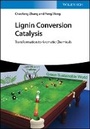
Lignin Conversion Catalysis
Transformation to Aromatic Chemicals
1st Edition
Published on 19. August 2022
464 pages
978-3-527-83502-7 (ISBN)
Description

This book focuses on the research development of lignin conversion to aromatic compounds. It provides systematic results for the study of lignin conversion by giving details of lignin depolymerization and mechanisms.
More details
Other editions
Additional editions
Software
09/2022
Wiley-VCH
€223.42
No shipping information available
Book
09/2022
1st Edition
Wiley-VCH
€165.00
Shipment within 5-7 days
Persons
Dr. Chaofeng Zhang received his Ph.D. degree in Physical Chemistry from Dalian Institute of Chemical Physics (DICP), Chinese Academy of Sciences, under the supervision of Professor Feng Wang in 2017. Then he joined in the DICP as an assistant professor. His research interests include catalytic transformation of biomass resource to valuable chemicals and fuels; synthesis of nanostructured heterogeneous catalysts; organic synthesis with photoelectrocatalytic methods.
Professor Feng Wang received his Ph.D. degree in Physical Chemistry from Dalian Institute of Chemical Physics (DICP), Chinese Academy of Sciences, in 2005, and he joined DICP and was promoted to full professor in 2011. He did postdoctoral research on heterogeneous catalysis at University of California at Berkeley and Catalysis Research Center of Hokkaido University. Currently, he is the director of the Biomass and Bio-energy Division of the Dalian National Laboratory for Clean Energy (DNL). His research interests include: Heterogeneous C-O band transformation catalysis; synthesis of nanostructured metal and metal oxide catalyst; in situ characterization technique for liquid phase reaction; catalytic biomass conversion to valuable chemicals.
Professor Feng Wang received his Ph.D. degree in Physical Chemistry from Dalian Institute of Chemical Physics (DICP), Chinese Academy of Sciences, in 2005, and he joined DICP and was promoted to full professor in 2011. He did postdoctoral research on heterogeneous catalysis at University of California at Berkeley and Catalysis Research Center of Hokkaido University. Currently, he is the director of the Biomass and Bio-energy Division of the Dalian National Laboratory for Clean Energy (DNL). His research interests include: Heterogeneous C-O band transformation catalysis; synthesis of nanostructured metal and metal oxide catalyst; in situ characterization technique for liquid phase reaction; catalytic biomass conversion to valuable chemicals.
Content
Part I Book Introduction1
1. Background and Overview
Part II Lignin Introduction
2. Lignin Biosynthesis, and Lignin Structure
3. Lignin Isolation, Physicochemistry Properties, and Chemical Properties
Part III Lignin Depolymerization: Scientific Questions, Challenges, and Current Progress
4. Scientific Questions for Lignin Conversion and Brief Summary of Methods for Lignin Depolymerization
Part IVReview on Lignin Linkages Cleavage Strategies and Mechanisms via an IDA Method
5. The Inverse Disassembly Analysis Method for Classifying Lignin Conversion Strategies
6. Direct Lignin C-OAr, ArO-Ar or C-Ar Bonds Cleavage without First Activation of the Adjacent Chemical Bonds
7. Lignin C-C/C-O Bonds Cleavage via First Phenolic Hydroxyl Group Dehydrogenation or First Aromatic Rings Activation
8. Lignin Linkages Cleavage Beginning with C alphaO-H/ArO-H or C alpha-OH Bond Heterolysis
9. Lignin Linkages Cleavage Beginning with Calpha-H, C alpha-OH, or C alphaO-H Bond Non-ionized Activation
10. Lignin Linkages Cleavage Beginning with C beta-H, C gamma-H, or C gammaO-H Direct Activation
11. Lignin Linkages Cleavage Considering Fragments Condensation
Part V Outcome and Outlook
12. Summary on Lignin Utilization and Perspectives on Aromatic Chemicals Preparation
A AC Activated carbon ACT 4-Acetamido-TEMPO AFEX Ammonia fiber explosion AFGM Adjacent functional group modification B BDE Bond dissociation enthalpy BNL Brauns native lignin BTX Benzene-toluene-xylenes C C3H Coumarate 3-hydroxylase C4H Cinnamic acid 4-hydroxylase CAD Cinnamyl alcohol dehydrogenase. CB Conduction band CCoAOTM Caffeoyl-CoA O-methyltransferase CCR Cinnamoyl-CoA reductase CCTC Contact charge transfer complex CDE CO2 explosion CEL Cellulolytic Enzyme Lignins 4CL 4-coumarate CoA ligase CoA Coenzyme A COMT CoA O-methyltransferase CP/MAS It is a combination of cross-polarization sequence (CP) and magic angle transformation technology (MAS). D DAIB Diacetoxyiodobenzene DBAD Diisopropyl azodiformate DDQ 2,3-Dichloro-5,6-dicyano-1,4-benzoquinone DEPT Distortionless enhancement by polarization transfer DES Deep eutectic solvent DFRC Derivatization followed by reductive cleavage DFT Density functional theory DIPEA N,N-diisopropylethylamine DL Dioxane (acidolysis) lignins DMSO Dimethyl sulfoxide DSPEC Dye-sensitized photoelectrochemical cell E E-4-P Erythrose-4-phosphate EMAL Enzymatic mild acidolysis lignin ESR Electron spin resonance absorption EXAFS Extended X-ray absorption fine structure F F5H Ferulate 5-hydroxylase FA Formic acid FTIR Fourier transform infrared spectroscopy infrared absorption spectroscopy G GFC Gel-filtration chromatography GH Glucosylhydrolases GPC Gel-permeation chromatography GS Glutathione GT Glucosyl transferases G-unit Coniferyl alcohol, or lignin phenylpropanoid unit with one -OMe connecting with the aromatic ring H HAADF-STEM High angle annular dark-field scanning transmission electron microscopy HAT Hydrogen atom transfer HBS High-boiling-point solvent HCT Hydroxycinnamoyltransferase HMBC Heteronuclear multiple bond correlation HMQC Heteronuclear multiple-quantum correlation HPAs Heteropoly acids HPSEC High-performance size-exclusion chromatography HTC Hydrotalcite H-unit p-Coumaric alcohol, or lignin phenylpropanoid unit without -OMe connecting with the aromatic ring I IDA Inverse disassembly analysis ILs Ionic liquids INADEQUATE Incredible natural abundance double quantum transfer experiment L LA Lewis acid LAR Lignin isolation from lignocellulose with lignin as the residue LBD Lignin isolation from lignocellulose by first lignin dissolution LC Lignocellulose LCC Lignin-carbohydrate complex LDH Layered-double hydroxide catalyst LDP Lignin depolymerization LMCT Ligand-to-metal charge-transfer LS Lignocellulose M MALDI-TOF Matrix-assisted laser desorption/ionization time-of-flight mass spectrometry mCPBA m-Chloroperbenzoic acid MDO Methyldioxorheniu MOF Metal-organic framework MTO Methyltrioxorhenium MWD Molecular weight distribution MWL Milled-wood lignin N NCS N-chlorosuccinimide NE Nucleus exchange NHC N-heterocyclic carbene NHPI N-hydroxyphthalimide NMR Nuclear magnetic resonance spectroscopy NPs Nanoparticles (noble metal) O OAT Oxygen atom transfer ... OMS Open metal sites
1. Background and Overview
Part II Lignin Introduction
2. Lignin Biosynthesis, and Lignin Structure
3. Lignin Isolation, Physicochemistry Properties, and Chemical Properties
Part III Lignin Depolymerization: Scientific Questions, Challenges, and Current Progress
4. Scientific Questions for Lignin Conversion and Brief Summary of Methods for Lignin Depolymerization
Part IVReview on Lignin Linkages Cleavage Strategies and Mechanisms via an IDA Method
5. The Inverse Disassembly Analysis Method for Classifying Lignin Conversion Strategies
6. Direct Lignin C-OAr, ArO-Ar or C-Ar Bonds Cleavage without First Activation of the Adjacent Chemical Bonds
7. Lignin C-C/C-O Bonds Cleavage via First Phenolic Hydroxyl Group Dehydrogenation or First Aromatic Rings Activation
8. Lignin Linkages Cleavage Beginning with C alphaO-H/ArO-H or C alpha-OH Bond Heterolysis
9. Lignin Linkages Cleavage Beginning with Calpha-H, C alpha-OH, or C alphaO-H Bond Non-ionized Activation
10. Lignin Linkages Cleavage Beginning with C beta-H, C gamma-H, or C gammaO-H Direct Activation
11. Lignin Linkages Cleavage Considering Fragments Condensation
Part V Outcome and Outlook
12. Summary on Lignin Utilization and Perspectives on Aromatic Chemicals Preparation
List of Abbreviations
A AC Activated carbon ACT 4-Acetamido-TEMPO AFEX Ammonia fiber explosion AFGM Adjacent functional group modification B BDE Bond dissociation enthalpy BNL Brauns native lignin BTX Benzene-toluene-xylenes C C3H Coumarate 3-hydroxylase C4H Cinnamic acid 4-hydroxylase CAD Cinnamyl alcohol dehydrogenase. CB Conduction band CCoAOTM Caffeoyl-CoA O-methyltransferase CCR Cinnamoyl-CoA reductase CCTC Contact charge transfer complex CDE CO2 explosion CEL Cellulolytic Enzyme Lignins 4CL 4-coumarate CoA ligase CoA Coenzyme A COMT CoA O-methyltransferase CP/MAS It is a combination of cross-polarization sequence (CP) and magic angle transformation technology (MAS). D DAIB Diacetoxyiodobenzene DBAD Diisopropyl azodiformate DDQ 2,3-Dichloro-5,6-dicyano-1,4-benzoquinone DEPT Distortionless enhancement by polarization transfer DES Deep eutectic solvent DFRC Derivatization followed by reductive cleavage DFT Density functional theory DIPEA N,N-diisopropylethylamine DL Dioxane (acidolysis) lignins DMSO Dimethyl sulfoxide DSPEC Dye-sensitized photoelectrochemical cell E E-4-P Erythrose-4-phosphate EMAL Enzymatic mild acidolysis lignin ESR Electron spin resonance absorption EXAFS Extended X-ray absorption fine structure F F5H Ferulate 5-hydroxylase FA Formic acid FTIR Fourier transform infrared spectroscopy infrared absorption spectroscopy G GFC Gel-filtration chromatography GH Glucosylhydrolases GPC Gel-permeation chromatography GS Glutathione GT Glucosyl transferases G-unit Coniferyl alcohol, or lignin phenylpropanoid unit with one -OMe connecting with the aromatic ring H HAADF-STEM High angle annular dark-field scanning transmission electron microscopy HAT Hydrogen atom transfer HBS High-boiling-point solvent HCT Hydroxycinnamoyltransferase HMBC Heteronuclear multiple bond correlation HMQC Heteronuclear multiple-quantum correlation HPAs Heteropoly acids HPSEC High-performance size-exclusion chromatography HTC Hydrotalcite H-unit p-Coumaric alcohol, or lignin phenylpropanoid unit without -OMe connecting with the aromatic ring I IDA Inverse disassembly analysis ILs Ionic liquids INADEQUATE Incredible natural abundance double quantum transfer experiment L LA Lewis acid LAR Lignin isolation from lignocellulose with lignin as the residue LBD Lignin isolation from lignocellulose by first lignin dissolution LC Lignocellulose LCC Lignin-carbohydrate complex LDH Layered-double hydroxide catalyst LDP Lignin depolymerization LMCT Ligand-to-metal charge-transfer LS Lignocellulose M MALDI-TOF Matrix-assisted laser desorption/ionization time-of-flight mass spectrometry mCPBA m-Chloroperbenzoic acid MDO Methyldioxorheniu MOF Metal-organic framework MTO Methyltrioxorhenium MWD Molecular weight distribution MWL Milled-wood lignin N NCS N-chlorosuccinimide NE Nucleus exchange NHC N-heterocyclic carbene NHPI N-hydroxyphthalimide NMR Nuclear magnetic resonance spectroscopy NPs Nanoparticles (noble metal) O OAT Oxygen atom transfer ... OMS Open metal sites
