

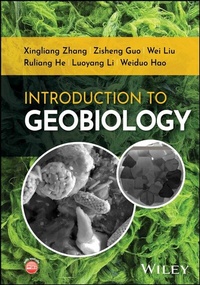
Introduction to Geobiology
Description

An introduction to how life has colonized and shaped the Earth, turning it into the habitable planet of today
Exploring the geological basis for life on Earth, Introduction to Geobiology systematically examines the interaction between the geosphere and the biosphere, including its evolutionary history.
In this didactically written text, readers will learn about the various modes of interaction between living and inorganic environments, emphasizing the geological significance of metabolism and the basis of life in extreme environments, the geobiological role and geological record of microbial ecosystems, and the material and energy cycles between the geosphere and the biosphere. The book also explores geological imprint of biological processes such as biomineralization, biosedimentation, and biological weathering of minerals and rocks, as well as the co-evolution process between organisms and the environment.
Based on a highly successful course taught by the authors for more than 20 years, Introduction to Geobiology includes information on:
- Domains and kingdoms of cellular life, classification of organisms according to their metabolism
- Ecological and metabolic diversity in marine and terrestrial environments, including extreme environments
- Using microbial ecosystems as a model for exploring life beyond earth
- Oxygen, carbon, nitrogen, sulfur, phosphorus, and iron cycles
- Biosedimentation investgating biological processes in making rocks
- Bioerosion, macroborers and microborers, biological and lichen weathering, and soil development
Introduction to Geobiology is an excellent textbook for senior undergraduate and graduate students in geology or microbiology seeking to learn about geobiology and the origin of life on Earth. It also provides a strong foundation for the study of astrobiology: the conditions under which life on other planets may develop.
More details
Other editions
Additional editions
Persons
Xingliang Zhang, Department of Geology, Northwest University, Xi'an, China.
Zisheng Guo, College of Life Sciences, Northwest University, Xi'an, China.
Wei Liu, Northwest University Museum, Northwest University, Xi'an, China.
Ruliang He, Department of Geology, Northwest University, Xi'an, China.
Luoyang Li, College of Marine Geosciences, Ocean University of China, Qingdao, China.
Weiduo Hao, Department of Geology, Northwest University, Xi'an, China.
Content
Preface xv
About the Companion Website xvii
1 Biological Diversity: A Geobiological Perspective 1
Zisheng Guo and Xingliang Zhang
1.1 Introduction 1
1.2 Classification of Biological Entities 2
1.2.1 Acellular Life 2
1.2.2 Domains of Cellular Life 4
1.2.2.1 The LUCA 5
1.2.2.2 The FECA and LECA 7
1.2.3 Kingdoms of Cellular Life 8
1.3 Diversity of Biological Metabolism 9
1.3.1 Metabolic Classification of Organisms 10
1.3.2 Photosynthesis 11
1.3.2.1 Pigments, Reactions, and Photosystems 11
1.3.2.2 Oxygenic Photosynthesis 11
1.3.2.3 Anoxygenic Photosynthesis 13
1.3.3 Nitrogen Fixation 15
1.3.4 Chemolithotrophy: Energy from Oxidation of Inorganics 16
1.3.4.1 Hydrogen-Oxidation: Using the Chemical Energy in H2 to Fix Carbon 17
1.3.4.2 Methanogenesis and Acetogenesis from CO2 Reduction 17
1.3.4.3 Oxidation of Reduced Sulfur Compounds 19
1.3.4.4 Iron Oxidation 21
1.3.4.5 Manganese Oxidation 22
1.3.4.6 Ammonia and Nitrite Oxidation: Nitrification 23
1.3.4.7 Anammox 25
1.3.5 Catabolism 26
1.3.5.1 Glycolysis and Fermentation 26
1.3.5.2 Aerobic Respiration 27
1.3.5.3 Nitrate Reduction and Denitrification 28
1.3.5.4 Microbial Manganese Reduction 29
1.3.5.5 Ferric Iron Reduction 30
1.3.5.6 Sulfate Reduction 32
1.3.5.7 Other Electron Acceptors 35
1.3.5.8 Methanogenesis 35
1.3.5.9 Methanotrophs and Methylotrophs 38
References 39
2 Life in Extreme Environments 43
Zisheng Guo and Xingliang Zhang
2.1 Introduction 43
2.2 Diversity of Extreme Environments and Extremophiles 44
2.2.1 Extreme Environments 44
2.2.1.1 Extreme Ecosystems 44
2.2.1.2 Extreme Environmental Parameters 46
2.2.2 Phylogenic Diversity of Extremophiles 46
2.2.2.1 Extremophilic Prokaryotes 46
2.2.2.2 Extremophilic Eukaryotes 54
2.2.2.3 Extremophilic Viruses 55
2.3 Thermophiles 57
2.3.1 Phylogenic Diversity 57
2.3.2 Adaptive Strategies 58
2.4 Psychrophiles 59
2.4.1 Phylogenic Diversity 59
2.4.2 Adaptive Strategies 60
2.5 Acidophiles 62
2.5.1 Phylogenic Diversity 62
2.5.2 Adaptive Strategies 63
2.6 Alkaliphiles 63
2.6.1 Phylogenic Diversity 63
2.6.2 Adaptive Strategies 64
2.7 Halophiles 65
2.7.1 Phylogenic Diversity 66
2.7.1.1 Halophilic Archaea 66
2.7.1.2 Halophilic Bacteria 66
2.7.1.3 Halophilic Eukaryotes 66
2.7.2 Adaptive Strategies 67
2.7.2.1 Salt-in and -out Strategies 67
2.7.2.2 Other Strategies 68
2.8 Xerophiles 68
2.8.1 Low Water Activity Stress 68
2.8.2 Low Water Activity Habitats 69
2.8.3 Adaptive Strategies 69
2.9 Radiodurans 70
2.9.1 Discovery 70
2.9.2 Radiotolerant Organisms 70
2.9.3 Radiotolerant Mechanisms 71
2.10 Barophiles 72
2.10.1 Phylogenic Diversity 72
2.10.1.1 Barophilic Prokaryotes 72
2.10.1.2 Barophilic Eukaryotes 73
2.10.2 Adaptive Strategies 73
2.11 Tardigrades as a Model Animal for Astrobiology 74
2.11.1 Survival Strategies 74
2.11.2 Adaptations to Anhydrobiosis 76
2.11.3 Adaptations to Cryobiosis 77
2.11.4 Molecular Mechanisms of Radiation and ROS Tolerance 77
2.11.4.1 ROS Scavenging Mechanisms 78
2.11.4.2 DNA Repair Mechanisms 78
2.11.5 Tardigrades in Space 78
References 79
3 Microbial Ecosystems 87
Wei Liu and Xingliang Zhang
3.1 Introduction 87
3.1.1 From Cell to Microbial Communities 87
3.1.2 Extracellular Polymeric Substances (EPS) 88
3.1.3 Preservation Potential 90
3.2 Biofilms and Microbial Mats 91
3.2.1 Biofilms 91
3.2.1.1 What Are Biofilms? 91
3.2.1.2 Why Learn About Biofilms? 92
3.2.1.3 Types of Biofilms 94
3.2.1.4 Development of Biofilms 94
3.2.1.5 Factors that Affect Biofilm Attachment and Growth 97
3.2.1.6 Fully Functioning Biofilm: Cooperate, Grow, and Spread 97
3.2.1.7 Biofilm Architecture 98
3.2.1.8 Biochemistry of Biofilm Bacteria 99
3.2.2 Microbial Mats 100
3.2.2.1 Structure of Microbial Mats 102
3.2.2.2 Morphology and Physical Behaviors 104
3.2.2.3 Microenvironment Within the Microbial Mats 104
3.2.2.4 Biogeochemistry of Microbial Mats 106
3.3 Microbial Ecosystems on Earth 107
3.3.1 Microbial Ecosystems in Marine Settings 107
3.3.1.1 Basaltic Ocean Crust Ecosystems 107
3.3.1.2 Hydrothermal Vent Ecosystems 109
3.3.1.3 Cold Seep Ecosystems 113
3.3.2 Microbial Ecosystems in Terrestrial Settings 114
3.3.2.1 Glacier and Frozen Soil Systems 114
3.3.2.2 Desert System 116
3.3.2.3 Soil System 119
3.3.2.4 Karst Cave System 121
3.3.3 Microbial Ecosystems in Other Extreme Settings 123
3.3.3.1 Extremely Acidic System 123
3.3.3.2 High Saline-alkaline System 125
3.3.3.3 Deep Subsurface System 126
3.4 Microbial Ecosystem as a Model for Exploring Life Beyond 129
References 129
4 Earth as a System and Biogeochemical Cycles 135
Weiduo Hao and Xingliang Zhang
4.1 Introduction 135
4.2 Earth System: An Overview 135
4.2.1 A System Approach 135
4.2.2 Energy Flows of the Earth System 136
4.2.2.1 Law of Thermodynamics 136
4.2.2.2 Earth's Energy Budget 136
4.2.2.3 Human Use of Energy Flows 137
4.2.3 Three Key Traits of the Earth System 138
4.2.3.1 Openness 138
4.2.3.2 Integration 139
4.2.3.3 Complexity 139
4.3 Biogeochemical Cycles 139
4.3.1 Concept 139
4.3.1.1 Biomass Production 139
4.3.1.2 Energy Source 140
4.3.1.3 Terminal Electron Acceptors 140
4.3.2 Element Abundance 140
4.3.3 Carbon Cycle 141
4.3.3.1 Carbon Reservoirs 141
4.3.3.2 Flux: Withdrawal 142
4.3.3.3 Flux: Addition 143
4.3.3.4 Isotope Fractionation 144
4.3.4 Oxygen Cycle 146
4.3.4.1 O2 Reservoirs 147
4.3.4.2 O2 Flux: Production 148
4.3.4.3 O2 Flux: Consumption 149
4.3.5 Nitrogen Cycle 151
4.3.5.1 Reservoirs 152
4.3.5.2 Flux 152
4.3.5.3 Key Processes 152
4.3.5.4 Isotope Fractionation 154
4.3.6 Sulfur Cycle 154
4.3.6.1 Reservoirs 155
4.3.6.2 Flux 156
4.3.6.3 Key Processes 157
4.3.6.4 Organic Sulfur Compounds 158
4.3.6.5 Isotope Fractionation 159
4.3.7 Phosphorus Cycle 162
4.3.7.1 Reservoirs 162
4.3.7.2 Flux 162
4.3.7.3 Bioavailability in Ecosystems 164
4.3.7.4 P Supply and Sink 164
4.3.7.5 Tectonic Controls on Global Phosphorus Cycle 166
4.3.7.6 Human Impact on Global Phosphorus Cycle 166
4.3.8 Iron Cycle 167
4.3.8.1 Flux 168
4.3.8.2 Key Processes 169
4.4 Major Features of Biogeochemical Cycles 170
4.4.1 Diversity of Pathways 171
4.4.2 Variable Rates of Cycling 171
4.4.3 The Effects of Human Activity 172
References 173
5 Biomineralization and Its Origin 177
Luoyang Li and Xingliang Zhang
5.1 Introduction 177
5.2 Biominerals and Organominerals 179
5.2.1 Concept and Unique Characteristics 179
5.2.2 Major Groups of Biominerals 181
5.2.2.1 Carbonate Biominerals 182
5.2.2.2 Phosphate Biominerals 184
5.2.2.3 Silica Biominerals 185
5.2.2.4 Sulfate Biominerals 186
5.2.2.5 Sulfide Biominerals 186
5.2.2.6 Oxide and Hydroxide Biominerals 187
5.2.2.7 Organominerals 189
5.3 Classification of Biomineralization 189
5.3.1 Biologically Influenced Mineralization (BFM) 190
5.3.2 Biologically Induced Mineralization (BIM) 191
5.3.3 Biologically Controlled Mineralization (BCM) 192
5.3.3.1 Weakly vs. Strictly Biological-Controlled Mineralization 192
5.3.3.2 Biologically Controlled Extracellular Mineralization 193
5.3.3.3 Biologically Controlled Intercellular Mineralization 193
5.3.3.4 Biologically Controlled Intracellular Mineralization 194
5.4 Principle of Biomineralization 195
5.4.1 Supersaturation and Nucleation 195
5.4.2 Amorphous Phase and Solidification 196
5.4.3 Hierarchical Organization 198
5.4.4 Genetic and Molecular Systems 199
5.4.5 Benefits and Costs 199
5.4.6 Prokaryotic vs. Eukaryotic Biomineralization 200
5.5 Origin and Evolution of Biomineralization 201
5.5.1 History of Biomineralization Pathways 201
5.5.2 On the Origin of Animal Skeletons 202
5.5.3 Controls on the Onset of Biomineralization 204
5.5.3.1 Co-option of Ancestral Biomineralization Toolkit 204
5.5.3.2 Oxygen and Marine Redox 205
5.5.3.3 Biomineralization as a Detoxification Mechanism 205
5.5.3.4 Mineralogical Stability and Changing Seawater Chemistry 206
5.5.3.5 The Rise of Biological Arm-Race 208
5.5.4 Cambrian Animal Skeletonization: Insights from Molluscs 208
5.5.4.1 Genetic Co-option Underpinning Shell Diversity 209
5.5.4.2 Fossils and Oldest Molluscan Shells 209
5.5.4.3 Mineralogy and Seawater Chemistry 210
5.5.4.4 Microbial Attacks and Defensive Strategy 212
5.6 Releasing Biomineralization Signatures from Fossils 214
5.6.1 Diagenesis, Permineralization, and Phosphatization 215
5.6.2 Recognizing Primary Biomineral Structures 215
5.6.2.1 Identification of the Original Mineralogy 215
5.6.2.2 Preservation of Skeletal Organic Matrix 217
5.6.2.3 Primary Structures and Diagenetic Growths 217
5.6.3 Biomineralization in Phylogenetic Systematics 218
5.6.4 Skeletal Sediments and Paleoenvironmental Reconstruction 219
References 220
6 Biosedimentation 227
Wei Liu and Xingliang Zhang
6.1 Introduction 227
6.2 Biogenic Sediments 228
6.2.1 Carbonates 229
6.2.1.1 Limestones are Biological Sediments 230
6.2.1.2 Microbialites 235
6.2.1.3 Methane-Seep Carbonates 238
6.2.1.4 "Dolomite Problem" and Microbial Dolomite Models 241
6.2.2 Siliceous Sediments 243
6.2.2.1 Primary Sediments 243
6.2.2.2 Formation of Chert 245
6.2.3 Phosphatic Sediments 247
6.2.3.1 Phosphorus Source 248
6.2.3.2 Phosphorus Uptake 248
6.2.3.3 Phosphorus Concentration 249
6.2.3.4 Apatite Precipitation 249
6.2.3.5 Microbial Structures in Phosphatic Rocks 249
6.2.3.6 Grains and Groundmasses 251
6.2.4 Iron Sediments 251
6.2.4.1 Sedimentary Pyrite 252
6.2.4.2 Banded Iron Formations 253
6.3 Biological Diagenesis 257
6.3.1 Biogeochemical Zonation of Sediment Column 258
6.3.2 Diagenetic Mineralization 261
6.3.2.1 Diagenetic Carbonate Minerals 261
6.3.2.2 Diagenetic Phosphate Minerals 262
6.3.2.3 Amorphous Silica 262
6.4 Microbially Induced Sedimentary Structures 262
6.4.1 Definition 262
6.4.2 Classification 263
6.4.3 Biological Processes in MISS Formation 263
6.4.3.1 Growth 263
6.4.3.2 Biostabilization 268
6.4.3.3 Baffling and Trapping 269
6.4.3.4 Binding 269
6.4.3.5 Interference of Microbial Activities Interacting with Physical Environments 269
6.4.4 Distribution and Preservation 270
6.4.4.1 Temporal and Spatial Distribution 270
6.4.4.2 Preservation and Recognition 271
6.5 Astrobiological Implications 272
References 273
7 Bioerosion and Biological Weathering 279
Ruliang He and Xingliang Zhang
7.1 Introduction 279
7.2 Bioerosion 280
7.2.1 Macroborers 282
7.2.1.1 Macroboring Groups 282
7.2.1.2 Insight into Boring Sponges 285
7.2.1.3 Insight into Boring Bivalves 287
7.2.2 External Grazers and Scrapers (Raspers) 289
7.2.3 Microborers 292
7.2.3.1 Microbial Endolithic Groups 292
7.2.3.2 Diverse Endolithic Habitats 292
7.2.3.3 Geological Evolution of Microborings 293
7.2.3.4 Geological and Astrobiological Implications 294
7.3 Biological Weathering 295
7.3.1 Biological Mechanisms That Enhance Rock Weathering 295
7.3.1.1 Plant Roots 295
7.3.1.2 Animals 295
7.3.1.3 Microbial Communities 296
7.3.2 Biological Weathering of Silicate Minerals and Rocks 297
7.3.2.1 Feldspar 298
7.3.2.2 Silica 299
7.3.2.3 Mafic Rocks and Minerals 299
7.3.3 Carbonate Weathering 300
7.3.4 Sulfide Mineral Oxidation 301
7.3.5 Insight into Lichen Weathering 302
7.3.5.1 Physical Processes 303
7.3.5.2 Biochemical Processes 303
7.3.5.3 A Zone Model 303
7.4 Soil as a Classic System of Biological Weathering 304
7.4.1 Soil Development 305
7.4.2 Horizons of Soil Profile 306
7.4.3 Humus in Soils 307
References 307
8 Co-evolution of Life and Environment 311
Xingliang Zhang
8.1 Introduction 311
8.2 Earth's Earliest Records and Habitability 313
8.2.1 Hadean (~4.567 to 4.031 Ga) 313
8.2.1.1 Hadean Zircons and Implications 313
8.2.1.2 Hadean Environment 314
8.2.2 Archean (~4.031 to 2.5 Ga) 315
8.2.2.1 Geological Record of Eoarchean (~4.031-3.6 Ga) 316
8.2.2.2 Geological Record of Paleoarchean (3.6-3.2 Ga) 318
8.2.2.3 Geological Record of Mesoarchean (3.2-2.8 Ga) 320
8.2.2.4 Geological Record of Neoarchean (2.8-2.5 Ga) 321
8.2.2.5 Archean Environment-Habitable for Prokaryotes 322
8.3 Evolution of Atmosphere 323
8.3.1 The Prebiotic Atmosphere 324
8.3.2 The Atmosphere at the Time of Life Origin 325
8.3.3 Atmospheric Greenhouse Gases and Long-term Climate Change 325
8.3.3.1 The Faint Young Sun Paradox 326
8.3.3.2 Atmospheric CO2 Concentrations in the Precambrian 327
8.3.3.3 Methane-rich Atmosphere in the Precambrian 329
8.3.3.4 Phanerozoic CO2 Concentrations 330
8.3.4 The Rise of Atmospheric O2 332
8.3.4.1 Net Accumulation of O2 in Atmosphere 333
8.3.4.2 Constraints on Precambrian Atmospheric O2 Levels 333
8.3.4.3 Evidence for the Paleoproterozoic Rise of Atmospheric O2 335
8.3.4.4 Second Rise of Atmospheric O2 337
8.3.4.5 Phanerozoic Variations of Atmospheric O2 337
8.4 Evolution of the Ocean 339
8.4.1 Origin of the Oceans 340
8.4.2 Cooling of the Surface Ocean Temperature 340
8.4.3 Salinity History of Ocean 342
8.4.3.1 Total Salinity 343
8.4.3.2 Secular Variations of SO42-, Ca2+, and Mg2+ Concentrations 345
8.4.3.3 Bioavailability of Phosphorus and Nitrogen 349
8.4.3.4 Bio-essential Trace Metals 350
8.4.4 Evolution of Ocean Oxygenation 351
8.5 Evolution of Biosphere 353
8.5.1 The Origin of Life 353
8.5.2 The Timing of Life Origin 355
8.5.3 The Framework of Life History 357
8.5.3.1 Prokaryotes Dominated the Biosphere for 2.0 Billion Years 357
8.5.3.2 Eukaryotic Life Emerged Early and Diverged Late 358
8.5.3.3 Multicellularity Across Lineages of the Life Tree 360
8.5.3.4 The Cambrian Explosion of Animals 361
8.5.3.5 The Development of Life on Land 362
8.5.3.6 Phanerozoic Events 364
8.5.4 Evolution of Metabolism 367
8.6 A Summary: Four Billion Years Co-evolution to One Intelligent Species 369
References 373
9 Exploring Extraterrestrial Life 381
Ruliang He and Xingliang Zhang
9.1 Introduction 381
9.2 Habitability and Habitable Zone 381
9.2.1 Key Requirements for Habitability 382
9.2.1.1 A Solvent 382
9.2.1.2 Elements and Nutrients 382
9.2.1.3 Energy 383
9.2.1.4 Clement Physical and Chemical Conditions 383
9.2.2 The Habitable Zone 384
9.3 Potentially Habitable Worlds Beyond Earth 385
9.3.1 Venus 385
9.3.2 Mars 386
9.3.2.1 A Brief Introduction to Mars 386
9.3.2.2 Water on Mars 387
9.3.2.3 Habitability of Mars 392
9.3.2.4 Search for Extant Life in Subsurface of Mars 392
9.3.3 Europa 393
9.3.4 Enceladus 395
9.3.5 Titan 397
9.4 Detecting Life Beyond Earth 399
9.4.1 Life Detection 399
9.4.2 Biosignatures 400
9.4.2.1 Physical Signals 400
9.4.2.2 Chemical Signals 400
9.4.3 Case Studies 401
9.4.3.1 Viking Biological Investigation 401
9.4.3.2 ALH84001 Martian Meteorite 401
9.5 Lessons from Explorations 402
References 403
Glossary 405
Index 415
1
Biological Diversity: A Geobiological Perspective
Zisheng Guo and Xingliang Zhang
1.1 Introduction
Life can be understood as a living form, either cellular or acellular form, and is composed of interconnected components that are organized in a complex hierarchical structure. This hierarchy ranges from the smallest units-atoms and molecules-to cells, tissues, organs, and ultimately whole organisms. Together with its environment, life forms the biosphere, an intricate and interactive hierarchy consisting of species, populations, communities, and ecosystems (Figure 1.1). Each level in this biological hierarchy, from cells to the biosphere, operates as a self-sustaining and adaptive system that has been constantly co-evolving with physical environment since its origin. Life pervades our planet and potentially extends beyond it. Living organisms thrive in an astonishing variety of environments, from the icy poles to the scorching equator and from the depths of the oceans to several kilometers above the Earth's surface. They can be found in extreme conditions, such as freezing waters, dry valleys, undersea thermal vents, and even deep within the Earth's crust.
Over the past ~4.0 billion years, life on Earth has diversified and adapted to a myriad of environments. Despite this incredible diversity, all living organisms share common traits: they grow, adapt, reproduce, and interact with their surroundings. From microscopic organisms to expansive ecosystems, life takes many forms but is united by these shared characteristics. Every living being has the ability to replicate, driven by DNA as the molecular basis of replication. Moreover, all organisms possess mechanisms to translate the genetic information in DNA into functional products like proteins, fats, and carbohydrates, which are essential for building and maintaining cellular machinery.
Virtually every month, new discoveries are made about surprising occurrences and modes of life forms on Earth, ranging from proteorhodopsin-based phototrophy in the open ocean to methanogenesis driven by geochemical reactions in Earth's interior. Niches once considered to be uninhabitable (such as those with pH of 0 in extremely rich metal solutions) have been found to harbor thriving microbial communities; compounds once thought to be refractory (such as kerogen, or long-chain alkanes under anaerobic conditions) are now known to serve as microbial growth substrates; organisms previously believed to be unculturable (such as anaerobic benzene oxidizers or soil bacteria that produce medically relevant natural products) have been brought into culture and/or their genetic content has been expressed in recombinant strains; and enigmatic geochemical transformations (such as the anaerobic oxidation of methane [AOM] or ammonium) are now attributed to the activity of consortia of bacteria and archaea. The importance and extent of biological diversity have captured the attention of life scientists, and now the community of geosciences is helping to define and explore interesting biogeochemical problems.
Figure 1.1 Biological hierarchy ranging from the smallest units-atoms and molecules-to cells, tissues, organs, whole organisms, and ultimately the biosphere.
Up until now, we have been familiar with organisms that can be said to have a "conventional" metabolism. These are organisms that use organic compounds as energy sources, primarily via aerobic (respiratory) metabolism. In this chapter, we aim to explore the vast biological diversity, especially focusing on microbial metabolisms with geological consequences. To address gaps in biological knowledge for geology students, we begin with the current classification of acellular and cellular life forms. This is followed by an examination of metabolic diversity from a geobiological perspective, which is essential for comprehending geobiological processes.
1.2 Classification of Biological Entities
1.2.1 Acellular Life
Cellular and acellular life represent two fundamental categories of biological entities. Cellular life forms, encompassing prokaryotes and eukaryotes, are living organisms that are composed of one or more cells. These organisms are characterized by the presence of a cell membrane enclosing cytoplasm and genetic material (DNA or RNA), along with their ability to metabolize, grow, reproduce, and respond to stimuli. In contrast, acellular life forms are biological entities that lack cellular structure and are generally not considered fully alive in a traditional sense. Acellular life forms include viruses that consist of genetic material (DNA or RNA) encased in a protein coat, viroids that are small RNA molecules infecting plants, and prions that are misfolded proteins causing diseases in animals and humans (Figure 1.2). Unlike cellular life forms that are autonomous and self-sustaining, acellular entities rely on other organisms to replicate and function. They display biological activity and functions only within living host cells, while existing as inert chemical particles in external environments, which are replicated only within a host organism (parasitic nature) and do not exhibit independent metabolism or growth.
Viruses and their allies may have influenced Earth's geology by infecting bacterial, archaeal, and eukaryotic hosts and altering their physiology. Given that bacteria and archaea have dominated Earth's biosphere for billions of years, these simple, non-self-sustaining, acellular entities-particularly viruses-may be involved in geobiological processes since the Archean Eon in multiple ways. Firstly, viruses contribute to nutrient cycling in marine environments by infecting and lysing microbial cells, such as bacteria and phytoplankton. This process releases organic matter and nutrients into the surroundings, thereby impacting sediment composition over geological time. Secondly, viruses drive microbial evolution through horizontal gene transfer (HGT), also known as lateral gene transfer, the process by which genetic material is transferred between organisms, bypassing traditional parent-to-offspring inheritance, which plays a major role in the evolution of bacteria and archaea (Figure 1.3). HGT can reshape microbial communities and influence the breakdown or formation of mineral deposits by microorganisms. Thirdly, virus-like particles have been discovered in ancient sediments and rocks, offering valuable insights into Earth's early ecosystems and the evolutionary history of life. Lastly, viral activity in oceans affects phytoplankton populations, which play a role in carbon sequestration and regulate atmospheric CO2 levels, indirectly connecting viruses to geological climate processes (Feng 2020; Wang 2022).
Figure 1.2 Microphotographs of acellular biological entities and cellular organisms.
Source: parvovirus B19 (ssDNA viruses), Lee et al. (2024) / Springer Nature / CC BY-NC-ND 4.0; adenovirus (dsDNA viruses), Besson et al. (2020) / MDPI / CC BY 4.0; potato spindle tuber viroid (viroids), from International Committee on Taxonomy of Viruses, https://ictv.global/report_9th/subviral/Viroids; extra small virus (satellite virus), Krupovic et al. (2016) / Springer Nature; prions, Terry et al. (2019) / Springer Nature / CC BY-NC-ND 4.0; rotavirus (dsRNA viruses), Farkas et al. (2013) / Springer Science Business Media New York; influenza virus (-ssRNA viruses), Noda and Kawaoka (2010) / John Wiley & Sons; Aichi virus (+ssRNA viruses), from International Committee on Taxonomy of Viruses, https://ictv.global/report/chapter/picornaviridae/picornaviridae; HTLV-1 (reverse-transcribing viruses), Grigsby et al. (2010) / Springer Nature / CC BY 2.0; cyanobacteria (bacteria), reprinted with permission from Schneider et al. (2025) Schneider et al.; halobacteria (archaea), reprinted with permission from Cui and Dyall-Smith (2021) © 2021, Ocean University of China; tardigrade (eukaryotes), Hashimoto et al. (2016) / Springer Nature / CC BY-NC-SA 4.0.
Figure 1.3 Mechanisms of horizontal gene transfer as a driving force of evolution. Transformation: direct uptake of genetic material from the environment; transduction: transfer mediated by viruses; conjugation: exchange through direct cell-to-cell contact.
Source: Arnold et al. (2022) / with permission of Springer Nature.
1.2.2 Domains of Cellular Life
The two-kingdom system of organisms, the Animalia and the Plantae, proposed by Carl Linnaeus in the 18th century, laid the groundwork for the systematic study of organisms, creating a structured approach to naming and classifying living forms. In the latter half of the 20th century, evidence began to accumulate that these were insufficient to express the diversity of life, and various schemes were proposed with three, four, or more kingdoms. This coexisted with a scheme dividing life into two main divisions: the prokaryota (bacteria, etc.) and the eukaryota (animals, plants, fungi, and protists).
However, with the advent of molecular taxonomy and phylogeny (sequence comparison of genes coding for 16S ribosomal RNA), our view of life on Earth changed radically. What were once called "prokaryotes" are far more diverse...
