

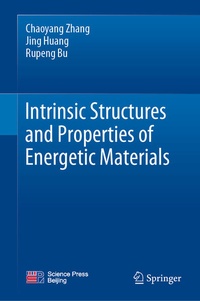
Intrinsic Structures and Properties of Energetic Materials
Description

This book highlights the intrinsic structures of all kinds of energetic compounds and some structure-property relationships therein. Energetic materials are a class of energy materials that can transiently release a large amount of gases and heat by self-redox after stimulated and usually refer to explosives, propellants and pyrotechnics. Nowadays, in combination with various theories and simulation-aided material design technologies, many new kinds of energetic materials like energetic extended solids, energetic ionic salts, energetic metal organic frames, energetic co-crystals and energetic perovskites have been created, in addition to traditional energetic molecular crystals. It is somewhat dazzling, and an issue of how we can understand these new types of energetic materials is raised. In the past about 20 years, we were immersed in the computational energetic materials. By means of defining a concept of intrinsic structures of energetic materials, which refers to the crystal packing structure of energetic materials, as well as molecule for molecular solid specially, the microscopic structures have been mostly clarified, and related with many macroscopic properties and performances, with molecular simulations. This book presents our understanding about it. Thereby, a simply and new way to readily understand energetic materials is expected to be paved, based on this book.
It contains energetic molecular crystals, energetic ionic crystals, energetic atomic crystals, energetic metallic crystals and energetic mixed-type crystals and the substructures closest to crystal packing. Meanwhile, the common intermolecular interactions in energetic crystals will be introduced. In addition, theoretical and simulation methods for treating the intrinsic structures will be briefed, as they are the main tools to reveal the molecules and crystals. Besides, the polymorphism as a level of intrinsic structures will be briefly discussed. In the final of this book, we introduce the crystal engineering of energetic materials. This book features the first proposal of intrinsic structure and crystal engineering of energetic materials and the understanding of the properties and performances of energetic materials by maintaining a concept that structure determines property. It helps to promote the rationality in creating new energetic materials, rather than increase experience.
More details
Other editions
Additional editions
Persons
Chaoyang Zhang is a professor at the Institute of Chemical Materials, China Academy of Engineering Physics. He received his Ph.D. in physical chemistry from Fudan University, China. He is also an adjunct professor at Beijing Computation Science Research Centre, the University of Science and Technology of China, Chongqing University and Southwest University of Science and Technology, China. His research focuses on computational energetic materials. He was awarded Yu-Min Mathematical Prize and Deng-Jiaxian Youth Science and Technology Prize for his research on energetic materials.
Dr. Jing Huang is a research associate in the Institute of Chemical Materials, China Academy of Engineering Physics. She received her Ph.D. in theoretical and computational chemistry from Nanjing University, China in 2021. She is interested in the research on the machine learning for energetic materials, high-accuracy potential energy surface and molecular spectroscopy.
Dr. Rupeng Bu receivedhis Ph.D. in materials science & engineering from China Academy of Engineering Physics in 2022, supervised by Prof. Chaoyang Zhang. His main research interest is crystal engineering of energetic materials.
Content
Introduction.- Classification of Energetic Crystals.- Application of molecular simulation methods in treating intrinsic structures of energetic materials.- Energetic molecules & single-component energetic molecular crystals.- Polymorphism and polymorphic transition in energetic molecular crystals.- Energetic ionic crystals.- Energetic cocrstals.- Energetic atomic crystals, energetic metallic crystals & energetic mixed-type crystals.- Hydrogen bonding, hydrogen transfer and halogen bonding.- p-stacking in energetic crystals.- Crystal engineering for creating low sensitive and highly energetic materials.
