

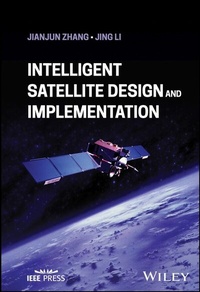
Intelligent Satellite Design and Implementation
Description

Integrate cutting-edge technology into spacecraft design with this groundbreaking work
Artificial intelligence and machine learning have revolutionized virtually every area of computing and complex engineering, and the design of satellite spacecraft is no exception. Intelligent satellites are increasingly capable of human-like perception, decision-making, and operations, and their problem-solving capacities are still expanding. As AI and machine learning continue to advance, their integration into satellite manufacture will only deepen.
Intelligent Satellite Design and Implementation seeks to understand the foundations of this integration and its likely directions in the coming years. Beginning from the basic principles of interaction between artificial intelligence and satellite design and mission planning, the book analyzes a series of current or potential areas of technological advancement to create a comprehensive overview of the subject.
Intelligent Satellite Design and Implementation readers will also find:
* Background information on the introduction and development of artificial intelligence
* Detailed discussion of topics including autonomous satellite operation, remote sensing satellites, and many more
* Over 100 illustrations and tables to reinforce key concepts
Intelligent Satellite Design and Implementation is ideal for graduate students and advanced undergraduates in engineering, computing, and spacecraft design programs, as well as researchers in these and related fields.
More details
Other editions
Additional editions
Persons
Jianjun Zhang, PhD, is Professor of the Beijing Institute of Spacecraft System Engineering, China Academy of Space Technology, China. He is Chairman of the Space Information Technology Professional Committee of the China Electronics Society, among other professional memberships, and has published widely on satellite navigation system design and related subjects.
Jing Li, PhD, is Associate Professor in the School of Automation, Beijing Institute of Technology, China. She is an expert member of the Space Information Technology Youth Committee of the China Electronics Society and has published widely on artificial intelligence and automation.
Content
Preface
Chapter 1 - Development of Artificial Intelligence
Chapter 2 - Artificial Intelligence in the Satellite Field
Chapter 3 - Development status of AI technology in satellites
Chapter 4 - Basic Knowledge of AI Technology
Chapter 5 - AI Requirements for Satellite System
Chapter 6 - Intelligent Remote Sensing Satellite System
Chapter 7 - Intelligent Communication Satellite System
Chapter 8 - Intelligent Navigation Satellite System
Chapter 9 - Application of AI in Aerospace Loads
Chapter 10 - Future Development of Intelligent Satellite
Index
2
Artificial Intelligence in the Satellite Field
2.1 The Concept and Connotation of Intelligent Satellite
2.1.1 The Concept of Intelligent Satellite
Satellite system is an engineering system composed of on-orbit operating satellites, application service systems, etc., and completes specific space missions. It is a typical complex large system [1-3].
2.1.1.1 Artificial Intelligence in Satellite Field
Artificial intelligence in satellite field refers to the "special artificial intelligence" that integrates the relevant theories, technologies and methods of artificial intelligence at all levels of physical laws, technologies, and knowledge in satellite field and with the whole cycle of satellite design, development, production, and application. The scope of artificial intelligence in satellite field is very broad, mainly including two aspects. The first is the intelligence of satellites, and the second is the intelligence of satellite design, manufacturing, testing, and satellite data application. We believe that the former has its own characteristics, while the latter has little difference from artificial intelligence in other fields. In the book, we focus on the analysis of satellite artificial intelligence.
The scope of artificial intelligence in the satellite field is very broad, and the content involved at present generally belongs to "+AI," including computational intelligence, multidisciplinary design of space missions, multi-objective optimization of space applications, resource allocation and solutions, intelligent search, and optimization methods in aerospace applications, emerging artificial intelligence technology and group intelligence, intelligent chips, intelligent operating systems, space and in-satellite integrated network, high-performance on-board computer, intelligent algorithm for fault identification, diagnosis and maintenance, multi-agent system and bionic solution for system design and control, machine learning progress of space applications, human-computer interaction intelligent interface, knowledge discovery, data mining and representation of large data sets, etc., that is, traditional industries or currently mature industries actively introduce AI technology to optimize their own business, improve efficiency and user experience, and reduce risks and costs. "+AI" is more about thinking about what technology can do. It is mainly used to transform and optimize the current inherent process, which is normal technology iteration and upgrading [4-6].
In the future, the core of AI to realize intelligence is to learn human's flexible thinking. In the field of satellite, AI will be driven by "AI+" technology as the core and will be launched by satellite systems to redesign products, programs, or work modes with the goal of exploring diversified scene applications. "AI+" tends to think about what technology can do, which may or may not exist at present. Therefore, the logic of "AI+" is more likely to produce "new inventions," which will disrupt the industry.
2.1.1.2 Intelligent Satellite
For the future, intelligent satellite refers to the architecture model simulating the human brain's natural intelligence "information perception, memory thinking, learning adaptation, and action drive," forming a space vehicle with seven self-capabilities of "self-perception, self-memory, self-thinking, self-learning, self-adaptation, self-action, and self-evolution."
At present, there is no consensus on the concept of satellite artificial intelligence. Satellites, including satellites, deep space probes, manned spaceflight, etc., are essentially typical unmanned systems and automatic control machines. Their development is based on the behavioral school theory with cybernetics as the core and develops along the route of automation, autonomy, and high autonomy. Therefore, it can be considered that satellites are essentially unmanned systems with AI attributes and have been a typical representative of AI development for quite a long time. However, in the new wave of AI development, due to the limitations of satellite's own computing resources and data resources, neural networks, deep learning, and other technologies have not been integrated with satellite development, and the development lags behind.
In view of the above discussion, the current main concerns of satellite AI are:
- Vigorously promote the current deep integration of AI technology represented by big data, machine learning, and high-performance computing with aerospace, and on the basis of automation, enable satellites to have environmental awareness and understanding, autonomous decision-making and planning, self-learning and evolution, autonomous health management, and other functions.
- In combination with the characteristics of aerospace development, develop the artificial intelligence algorithm theory with aerospace characteristics. Through environmental cognition, decision-making planning, and collaborative action, generate intelligent behaviors with a plan and purpose to adapt to the environment and change the status quo, imitate human intelligence and behavior, and actively perform tasks in complex and changeable unknown environments.
2.1.1.3 Group Intelligence
Group intelligence is the development direction. Intelligent networking satellites can continuously cooperate with many satellites to form an intelligent agent with its own characteristics on the whole, from a lonely intelligent satellite to a distributed intelligent satellite combination [7-10].
Group intelligence originates from the research on the group behavior of social insects represented by bee colonies, ant colonies, etc. (including the information transmitted, the way of information transmission, and how to reach an agreement and take action, that is, decision-making). There is nonsynchronous information exchange between groups. Groups are self-organized, with division of labor and collaborative work. The results of group behavior are neither random nor deterministic; the collective intelligent behavior of a system composed of nonintelligent agents through interaction with each other or with the environment.
In the field of satellites, group intelligence can be expressed as individual aircraft interact with each other in a relatively simple local self-organization manner, and display intelligent characteristics such as distributed, adaptive, and robust in the environment, making the system emerge at the overall level an intelligent level that cannot be achieved by a single aircraft.
2.1.1.4 Understanding of Intelligence and Autonomy
Autonomy and intelligence are two different categories of concepts. Autonomy expresses the way of behavior, and it is called autonomy to complete a certain behavior with its own decision; intelligence refers to the ability to complete the behavior process, that is, whether the methods and strategies used conform to the natural laws or the behavior rules of people (or groups). It is intelligent to find a reasonable "path" to complete a task in an ever-changing environment. Obviously, intelligence is hierarchical.
The relationship between autonomy and intelligence should be: autonomy comes first and intelligence comes second, which should complement each other; autonomy is not necessarily intelligent, but autonomy hopes to be intelligent; intelligence depends on autonomy. The level of intelligence depends on the level of autonomy. Intelligence is the combination of autonomy and knowledge and its use of knowledge. The general process of intelligence generation should be: under the premise of autonomy, comprehensively use the abilities of authority, initiative, love and obsession, perception and other aspects to feel information, extract information, accumulate knowledge, summarize knowledge, summarize the characteristics and refine, improve and perfect the knowledge structure, and integrate the knowledge to achieve the goal of conforming to the laws of nature as much as possible.
Autonomous control refers to the control process of a system to achieve its objectives without human or other system intervention and can adapt to changes in the environment and objects. Classical automatic control methods such as PID, robust, and adaptive control are designed based on analytical models. They are not strong in adaptability to sudden events, unknown environments, and other changes, and their task ability is limited. They belong to a lower level of autonomous control. Intelligent autonomous control refers to autonomous control with human behavior attributes such as perception, learning, reasoning, cognition, execution, and evolution and is the advanced stage of autonomous control.
The intelligence level of satellites is one of the key factors that determine the autonomous capability of satellites. The introduction of artificial intelligence technology improves the intelligence level of space vehicles and enhances the ability of satellites to perform tasks independently. Therefore, intelligence is the attribute, and autonomy is the goal.
2.1.2 Technical Characteristics of Intelligent Satellite
The future space intelligent aircraft has the characteristics of "seven self-capabilities," which can realize its own health...
