

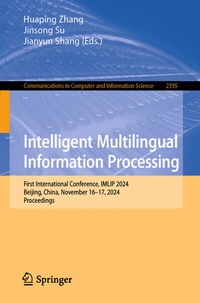
Intelligent Multilingual Information Processing
Description

This CCIS post conference volume constitutes the proceedings of the First International Conference on Intelligent Multilingual Information Processing, IMLIP 2024, in Beijing, China, during November 2024.
The 30 full papers presented at IMLIP 2024 were carefully reviewed and selected from 144 submissions. The papers contained in these proceedings address challenging issues in Cross-lingual processing, Large language models, Computational linguistics theory, Resource and corpus construction, Evaluation, Multilingual language understanding, Machine translation, as well as the fundamentals and applications of Multimodal intelligent information processing.
More details
Other editions
Additional editions
Persons
Content
.- Oral.
.- Does AI Write More Accurately in Japanese Than Humans?A Comparison of Human and AI Speech Levels and Speech-Level Shifts in Japanese Compositions.
.- Empirical Study on Translating Toxic Sentences with Large Language Model vs. Machine Translation.
.- Leveraging Pre-trained Language Models for Mongolian Intent Classiffcation and Slot Filling.
.- MIPS: Multilingual Inference Paradigm in Zero-Shot Cross-Lingual Stance Detection with
Contrastive Learning.
.- TibInkTrans: A Top-k Integrated Transformer for Enhancing Tibetan Document Images Affected by Ink Bleed.
.- Poster.
.- A Multi-Dialect Tibetan-Chinese Speech Translation Dataset Based on Speech Synthesis.
.- A Study of Central Nodes in the Interlanguage Syntactic Dependency Networks of Japanese CFL Learners.
.- Addressing Syntactic Divergence in Low-Resource Neural Machine Translation via Language Independent Word Reordering.
.- Character-level Generative Network for Vietnamese Spelling Error Correction .
.- Cognitive Mechanism of Focus and Pauses in the Mandarin Declaratives.
.- Dataset construction for learner-based Chinese answering questions scoring.
.- Domain-Oriented Chinese Named Entity Recognition Based on Enhanced Word-Word Relation Classiffcation.
.- Emotion in Real-Scene Transformerfor Speech Emotion Recognition.
.- EmpLLM: Enhancing Empathy in LLMs through Psychologist Simulation.
.- Enhancing Chinese-Turkish Neural Machine Translation through Bilingual Dictionary and Contrastive Learning .
.- Evaluating Large Language Models on Twitter Based on Hashtag Dynamics and Scaling Properties.
.- Face-threatening Contexts on the Understanding of Sometimes.
.- From Bytes to Words: Enhancing Multilingual NMT through Explicit Byte Integration .
.- Instruction Fine-tuning Guidance: How PEFT Methods Impact the Generation of Language Model via Different Attributions.
.- Japanese Author Attribution using BERT ffnetuning with Stylometric Features .
.- Leveraging Domain Expertise: The Impact of Media Experts in Developing Large Language Models.
.- Mining Positive Examples from Negatives for Enhanced Knowledge Graph Completion.
.- Research on Optimizing Speaker Diarization Tasks Based on the Semantic Capabilities of Large Language Models.
.- MM-Eval: A Hierarchical Benchmark for Modern Mongolian Evaluation in LLMs.
.- Research on Small Object Segmentation of Tibetan Newspapers using DeepLabV3+ at High Resolution.
.- The formation and application of the contradictory meanings of several words.
.- The Research of Commonly Used Modern Chinese Characters from Glossary of Media Words in the Year in the Green Book 2011-2022.
.- Ti-MSUM: Tibetan Image and Text Summarization Dataset.
.- TPL-NER Three-Stage Prompt-based Low-Resource Named Entity Recognition.
.- Uyghur Punctuation Restoration Model based on Position Awareness and Label Attention.
