
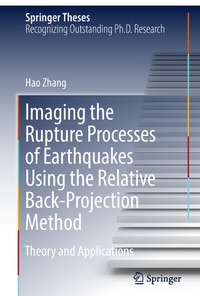
Imaging the Rupture Processes of Earthquakes Using the Relative Back-Projection Method
Description
Alles über E-Books | Antworten auf Fragen rund um E-Books, Kopierschutz und Dateiformate finden Sie in unserem Info- & Hilfebereich.
This thesis adopts the relative back-projection method to dramatically reduce "swimming" artifacts by identifying the rupture fronts in the time window of a reference station; this led to a faster and more accurate image of the rupture processes of earthquakes. Mitigating the damage caused by earthquakes is one of the primary goals of seismology, and includes saving more people's lives by devising seismological approaches to rapidly analyze an earthquake's rupture process. The back-projection method described in this thesis can make that a reality.
More details
Other editions
Additional editions
Person
Ph.D. 09/2007-07/2013, Department of Geophysics, School of Earth and Space Sciences, Dissertation Title: Imaging the Rupture Processes of Earthquakes Using the Relative Back-projection Method. Advisers: Jieyuan Ning B.S. 09/2003-07/2007, Department of Geophysics, School of Earth and Space Sciences, Peking Thesis Title: Simulating the Seismic Responses of 2-D Constant-Gradient Models Using the Boundary Element Method. Adviser: Zengxi Ge (Associate Professor)
Awards 2012-2013 Outstanding Graduates of 2012-2013 Outstanding Graduates of Peking 2012-2013 2011-2012 2010-2011 Founder Scholarship, Peking University

Content
System requirements
File format: PDF
Copy protection: Watermark-DRM (Digital Rights Management)
System requirements:
- Computer (Windows; MacOS X; Linux): Use the free software Adobe Reader, Adobe Digital Editions, or any other PDF viewer of your choice (see eBook Help).
- Tablet/Smartphone (Android; iOS): Install the free app Adobe Digital Editions or another reading app for eBooks, e.g., PocketBook (see eBook Help).
- E-reader: Bookeen, Kobo, Pocketbook, Sony, Tolino and many more (only limited: Kindle).
The file format PDF always displays a book page identically on any hardware. This makes PDF suitable for complex layouts such as those used in textbooks and reference books (images, tables, columns, footnotes). Unfortunately, on the small screens of e-readers or smartphones, PDFs are rather annoying, requiring too much scrolling.
This eBook uses Watermark-DRM, a „soft” copy protection. This means that there are no technical restrictions to prevent illegal distribution. However, there is a personalised watermark embedded in the eBook that can be used to identify the purchaser of the eBook in the event of misuse and to provide evidence for legal purposes.
For more information, see our eBook Help page.