

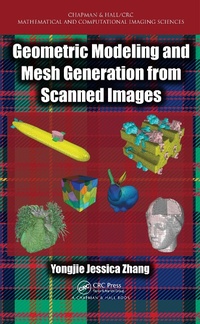
Geometric Modeling and Mesh Generation from Scanned Images
1st Edition
Published on 3. September 2018
364 pages
978-1-315-36022-5 (ISBN)
Description

Cutting-Edge Techniques to Better Analyze and Predict Complex Physical Phenomena
Geometric Modeling and Mesh Generation from Scanned Images shows how to integrate image processing, geometric modeling, and mesh generation with the finite element method (FEM) to solve problems in computational biology, medicine, materials science, and engineering. Based on the author's recent research and course at Carnegie Mellon University, the text explains the fundamentals of medical imaging, image processing, computational geometry, mesh generation, visualization, and finite element analysis. It also explores novel and advanced applications in computational biology, medicine, materials science, and other engineering areas.
One of the first to cover this emerging interdisciplinary field, the book addresses biomedical/material imaging, image processing, geometric modeling and visualization, FEM, and biomedical and engineering applications. It introduces image-mesh-simulation pipelines, reviews numerical methods used in various modules of the pipelines, and discusses several scanning techniques, including ones to probe polycrystalline materials.
The book next presents the fundamentals of geometric modeling and computer graphics, geometric objects and transformations, and curves and surfaces as well as two isocontouring methods: marching cubes and dual contouring. It then describes various triangular/tetrahedral and quadrilateral/hexahedral mesh generation techniques. The book also discusses volumetric T-spline modeling for isogeometric analysis (IGA) and introduces some new developments of FEM in recent years with applications.
Geometric Modeling and Mesh Generation from Scanned Images shows how to integrate image processing, geometric modeling, and mesh generation with the finite element method (FEM) to solve problems in computational biology, medicine, materials science, and engineering. Based on the author's recent research and course at Carnegie Mellon University, the text explains the fundamentals of medical imaging, image processing, computational geometry, mesh generation, visualization, and finite element analysis. It also explores novel and advanced applications in computational biology, medicine, materials science, and other engineering areas.
One of the first to cover this emerging interdisciplinary field, the book addresses biomedical/material imaging, image processing, geometric modeling and visualization, FEM, and biomedical and engineering applications. It introduces image-mesh-simulation pipelines, reviews numerical methods used in various modules of the pipelines, and discusses several scanning techniques, including ones to probe polycrystalline materials.
The book next presents the fundamentals of geometric modeling and computer graphics, geometric objects and transformations, and curves and surfaces as well as two isocontouring methods: marching cubes and dual contouring. It then describes various triangular/tetrahedral and quadrilateral/hexahedral mesh generation techniques. The book also discusses volumetric T-spline modeling for isogeometric analysis (IGA) and introduces some new developments of FEM in recent years with applications.
Reviews / Votes
"Congratulations to the first reference and textbook for a new interdisciplinary approach to image-based engineering and science. The book covers all topics ranging from imaging, image processing, geometric modeling, and mesh generation, to simulation and applications. It is an excellent textbook for both senior undergraduate and graduate students, researchers, and engineers in aerospace, biomedical, civil, materials science, and mechanical engineering."-Wing Kam Liu, PhD, PE, Walter P. Murphy Professor of Mechanical and Civil Engineering, Northwestern University
"Professor Zhang's book on image-derived geometric modeling and meshing will be an indispensable resource for researchers in computational biology and medicine where mesh-generation is a critical bottle neck. The author covers state-of-the-art methods such as isogeometric analysis and T-splines while providing a thorough background and ample practical examples for interdisciplinary readership."
-Andrew D. McCulloch, Distinguished Professor of Bioengineering and Medicine, University of California, San Diego
"This is a wide-ranging book, bringing together a set of topics not yet covered in a single book. It will give a graduate student or advanced undergraduate a solid foundation to understand a modern pipeline, which collects data from the real world and performs an engineering analysis of it, particularly biomedical data. Topics covered include numerical methods and basic geometric computations, various different 2D and 3D image capture techniques, image preprocessing, surface and volume mesh extraction, T-splines for geometric modeling, and various finite element methods for engineering analysis. The book is to be commended in its cross-discipline approach, including topics from math, computer science, and engineering. Students often just consider each topic in isolation but are not shown how the pieces fit together to make a whole. This book will give them the big picture."
-Ralph Martin, Cardiff University
More details
Series
Edition
1. Auflage
Language
English
Place of publication
London
United Kingdom
Publishing group
Taylor & Francis Ltd
Target group
College/higher education
Product notice
Reflowable
Illustrations
4 Tables, color; 156 Illustrations, color
File size
14,02 MB
ISBN-13
978-1-315-36022-5 (9781315360225)
Copyright in bibliographic data and cover images is held by Nielsen Book Services Limited or by the publishers or by their respective licensors: all rights reserved.
Schweitzer Classification
Other editions
Additional editions
Yongjie Jessica Zhang
Geometric Modeling and Mesh Generation from Scanned Images
Book
09/2020
1st Edition
Chapman & Hall/CRC
€103.60
Shipment within 15-20 days
Yongjie Jessica Zhang
Geometric Modeling and Mesh Generation from Scanned Images
Book
04/2016
1st Edition
Chapman & Hall/CRC
€202.50
Article not available for order
Person
Yongjie Jessica Zhang is an associate professor in the Department of Mechanical Engineering at Carnegie Mellon University with a courtesy appointment in the Department of Biomedical Engineering. She is the co-author of more than 130 publications in peer-reviewed international journals and conference proceedings. She has been a recipient of the Presidential Early Career Award for Scientists and Engineers, NSF CAREER Award, Office of Naval Research Young Investigator Award, USACM Gallagher Young Investigator Award, Clarence H. Adamson Career Faculty Fellow in Mechanical Engineering, George Tallman Ladd Research Award, and Donald L. and Rhonda Struminger Faculty Fellow. Her research interests include computational geometry, mesh generation, computer graphics, visualization, finite element method, isogeometric analysis, and their application in computational biomedicine and engineering. She earned a PhD in computational engineering and sciences from the Institute for Computational Engineering and Sciences (ICES) at the University of Texas at Austin.
Content
Introduction and Pipelines. Review of Numerical Methods. Scanning Techniques and Image Processing. Fundamentals to Geometric Modeling and Meshing. Image-Based Triangular and Tetrahedral Mesh Generation. Image-Based Quadrilateral and Hexahedral Mesh Generation. Volumetric T-Spline Modeling. Finite Element and Isogeometric Analysis Applications.
