

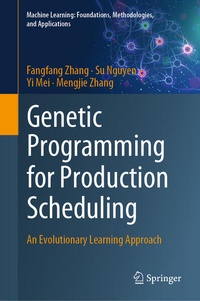
Genetic Programming for Production Scheduling
Description

This book introduces readers to an evolutionary learning approach, specifically genetic programming (GP), for production scheduling. The book is divided into six parts. In Part I, it provides an introduction to production scheduling, existing solution methods, and the GP approach to production scheduling. Characteristics of production environments, problem formulations, an abstract GP framework for production scheduling, and evaluation criteria are also presented. Part II shows various ways that GP can be employed to solve static production scheduling problems and their connections with conventional operation research methods. In turn, Part III shows how to design GP algorithms for dynamic production scheduling problems and describes advanced techniques for enhancing GP's performance, including feature selection, surrogate modeling, and specialized genetic operators. In Part IV, the book addresses how to use heuristics to deal with multiple, potentially conflicting objectives in production scheduling problems, and presents an advanced multi-objective approach with cooperative coevolution techniques or multi-tree representations. Part V demonstrates how to use multitask learning techniques in the hyper-heuristics space for production scheduling. It also shows how surrogate techniques and assisted task selection strategies can benefit multitask learning with GP for learning heuristics in the context of production scheduling. Part VI rounds out the text with an outlook on the future.
Given its scope, the book benefits scientists, engineers, researchers, practitioners, postgraduates, and undergraduates in the areas of machine learning, artificial intelligence, evolutionary computation, operations research, and industrial engineering.
More details
Other editions
Additional editions
Persons
Su Nguyen is a Senior Research Fellow and Algorithm Lead at the Centre for Data Analytics and Cognition, La Trobe University, Melbourne, Australia. His expertise includes evolutionary computation, simulation optimization, automated algorithm design, interfaces of artificial intelligence/operations research, and their applications in logistics, energy, and transportation. Dr. Nguyen chaired the IEEE Task Force on Evolutionary Scheduling and Combinatorial Optimisation from 2014 to 2018. He gave technical tutorials on evolutionary computation and artificial intelligence-based visualization at the Parallel Problem Solving from Nature Conference in 2018 and the IEEE World Congress on Computational Intelligence in 2020.
Yi Mei is a Senior Lecturer at the School of Engineering and Computer Science, Victoria University of Wellington, New Zealand. He has published more than 100 articles in prominent journals for Evolutionary Computation and Operations Research, including IEEE Transactions on Evolutionary Computation, IEEE Transactions on Cybernetics, Evolutionary Computation, European Journal of Operational Research, and ACM Transactions on Mathematical Software. His research interests include evolutionary scheduling and combinatorial optimization, machine learning, genetic programming, and hyper-heuristics.
Mengjie Zhang is a Professor of Computer Science, Head of the Evolutionary Computation Research Group, and Associate Dean (Research and Innovation) of the Faculty of Engineering, Victoria University of Wellington, New Zealand. His current research interests include artificial intelligence and machine learning, particularly genetic programming, image analysis, feature selection and reduction, job shop scheduling, and transfer learning. He has published over 600 research papers in international journals and conference proceedings. Prof. Zhang is a Fellow of the Royal Society of New Zealand, Fellow of the IEEE, and an IEEE Distinguished Lecturer. He has previously chaired the IEEE CIS Intelligent Systems and Applications Technical Committee, the IEEE CIS Emergent Technologies Technical Committee, and the Evolutionary Computation Technical Committee, and served on the IEEE CIS Award Committee. He is a Vice-Chair of the Task Force on Evolutionary Computer Vision and Image Processing, and the Founding Chair of the IEEE Computational Intelligence Chapter in New Zealand. He is a Fellow of the Royal Society of New Zealand, a Fellow of the IEEE, and an IEEE Distinguished Lecturer.