

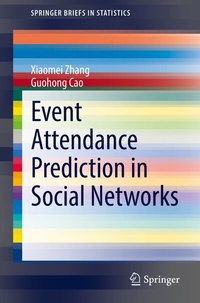
Event Attendance Prediction in Social Networks
Description

This volume focuses on predicting users' attendance at a future event at specific time and location based on their common interests. Event attendance prediction has attracted considerable attention because of its wide range of potential applications. By predicting event attendance, events that better fit users' interests can be recommended, and personalized location-based or topic-based services related to the events can be provided to users. Moreover, it can help event organizers estimating the event scale, identifying conflicts, and help manage resources. This book first surveys existing techniques on event attendance prediction and other related topics in event-based social networks. It then introduces a context-aware data mining approach to predict the event attendance by learning how users are likely to attend future events. Specifically, three sets of context-aware attributes are identified by analyzing users' past activities, including semantic, temporal, and spatial attributes. This book illustrates how these attributes can be applied for event attendance prediction by incorporating them into supervised learning models, and demonstrates their effectiveness through a real-world dataset collected from event-based social networks.
More details
Other editions
Additional editions
Persons
Xiaomei Zhang received the BE degree from University of Science and Technology of China in 2010 and the PhD degree in computer science and engineering from the Pennsylvania State University in 2016. Science then, she has been with the Department of Computer Science at the University of South Carolina Beaufort, where she is currently an assistant professor. Her research interests include data science, machine learning, mobile computing, mobile social networks, and wireless communications.
Guohong Cao is a Distinguished Professor in the Department of Computer Science and Engineering at the Pennsylvania State University. He received his Ph.D. in computer science from the Ohio State University in 1999. He has published more than 200 papers in the areas of mobile computing, machine learning, wireless networks, wireless security, and privacy, which have been cited over 20000 times. He has served on the editorial board of IEEE Transactions on Mobile Computing, IEEE Transactions onWireless Communications, and IEEE Transactions on Vehicular Technology, and has served on the organizing and technical program committees of many conferences, including the TPC Chair/Co-Chair of IEEE SRDS, MASS, and INFOCOM. He has received several best paper awards, the IEEE INFOCOM Test of Time award, and the NSF CAREER award. He is a Fellow of the AAAS and a Fellow of the IEEE.
