

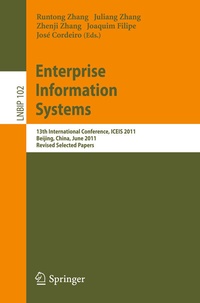
Enterprise Information Systems
13th International Conference, ICEIS 2011, Beijing, China, June 8-11, 2011, Revised Selected Papers
Published on 20. May 2012
XV, 436 pages
978-3-642-29958-2 (ISBN)
Description

This book contains substantially extended and revised versions of the best papers from the 13th International Conference on Enterprise Information Systems (ICEIS 2011), held in Beijing, China, June 8-11, 2011.
The 27 papers included (plus one invited paper) in this volume were carefully reviewed and selected from 57 full papers presented at the conference (out of 402 submissions). They reflect state-of-the-art research that is often driven by real-world applications, thus successfully relating the academic with the industrial community. The topics covered are: databases and information systems integration, artificial intelligence and decision support systems, information systems analysis and specification, software agents and Internet computing, and human-computer interaction.
More details
Other editions
Additional editions
Runtong Zhang | Juliang Zhang | Zhenji Zhang
Enterprise Information Systems
13th International Conference, ICEIS 2011, Beijing, China, June 8-11, 2011, Revised Selected Papers
Book
05/2012
1st Edition
Springer
€53.49
Shipment within 7-9 days
Content
- Title
- Preface
- Organization
- Table of Contents
- Invited Paper
- A System-of-Systems Approach to the Analysis and Conservation of Biodiversity
- Introduction
- System of Systems
- Description
- Adaptive Policies
- Biodiversity
- Biodiversity as SoS
- a-Level Simulation
- Level Simulation
- Dynamic Allocation of Conservation Funding between Two Regions
- Higher-Level Simulations
- Conclusions
- References
- PART I: Databases and InformationSystems Integration
- Clustering Documents with Maximal Substrings
- Introduction
- Previous Works
- Clustering Documents with Maximal Substrings
- Maximal Substrings
- Bayesian Document Clustering
- Evaluation Experiment
- Document Sets
- Extraction and Reduction
- EvaluationMeasure
- Analysis
- Conclusions
- References
- Imbalanced Classification Problems: Systematic Study, Issues and Best Practices
- Introduction
- Metrics
- The Effect of Class Imbalance on Different Classifiers: Empirical Study
- Approaches for Dealing with Class Imbalance
- Limitations of Traditional Learning Techniques
- Data-Oriented Techniques
- Adapting Learning Techniques
- Conclusions
- References
- Adaptive Information Integration: Bridging the Semantic Gap between Numerical Simulations
- Introduction
- State of the Art
- Use Case
- Architecture of the Framework
- System Architecture
- Software Architecture
- Adaptive Information Integration
- Concept
- Ontology
- Components
- Application of the Framework
- Conclusions
- References
- PAR-COM: A New Methodologyfor Post-processing Association Rules
- Introduction
- Related Works
- PAR-COM Methodology
- Experiments
- Results and Discussion
- Case Study
- Conclusions
- References
- Ubiquitous Resource-Aware Clustering of Data Streams
- Introduction
- Related Work
- RA-HCluster
- Online Maintenance
- Offline Clustering
- Performance Evaluation
- Experimental Environment and Data
- Comparison and A nalysis
- Conclusions
- References
- UF-Evolve: Uncertain Frequent Pattern Mining
- Introduction
- Literature Review
- Problem Statement
- mUF-Tree: Design and Construction
- Discovering New Uncertain Frequent Patterns
- Preliminary Definitions
- The UF-Evolve Algorithm
- Performance Study
- Experimental Environment and Data Preparation
- Experiments
- Conclusions
- References
- Formal Fact-Oriented Model Transformations for Cooperative Information Systems Semantic Conceptualisation
- Introduction
- Cooperative Information Systems
- Our Approach for Semantics Enactment in Conceptual Models
- Step 1: Reverse Engineering
- Step 2: Expert Knowledge Injection
- Step 3: Fact-Oriented Transformation
- Patterns Represent ted in FOL
- Case Study
- Specific Analysed E Enterprise Information System: Sage X3 ERP
- Conclusions
- References
- Incorporating Data Concerns into Query Languages for Data Services
- Introduction
- Data Services: Roles and Data Concerns
- Roles of the Data Service
- Data Concerns for Data Services
- DaaS Architecture with Data Concerns
- Models of Data Concern Aware Querying
- Concern Aware Querying
- Data Concerns Collection
- Query Processing
- Concern Aware XQuery
- Implementation and Evaluation
- Implementation
- Experimental Application: Distributed Extended XQuery for Data Integration (DeXIN)
- Evaluation
- Conclusions and Future Work
- References
- PART II: Artificial Intelligence andDecision Support Systems
- A Study on Noisy Typing Stream Analysis Using Machine Learning Approach
- Introduction
- Time Gap Modeling
- Prediction Using Time Gap
- Probabilistic Neural Network Modeling
- Conclusions
- References
- Intelligent Information Acquisition and Utilization in Safety Evaluation Decision Making Process of Power Generation Enterprises
- Introduction
- The Framework
- Related Concepts and Statistics
- The Case-Based Evaluation Process
- Evaluation Indexes
- IDSS-MSSATPP Functional Structure
- Methodology
- Decision Information Acquiring Method
- Weight Derivation of MSSATPP Cases
- Data Set
- Experiments
- Comparison Tests with KNN
- Comparison with Other Methods
- Conclusions
- References
- Outperforming Mutation Operator with Random Building Block Operator in Genetic Algorithms
- Introduction
- Genetic Algorithms
- Genetic Operators
- The Random Building Block Operator
- Experimentation
- Conclusions
- Future Research
- References
- Automating Texas Hold'em Poker with PLICAS
- Introduction
- A Short Overview of Automated Poker Play
- Essential Techniques for Automated Poker Play
- System Architecture and Playing Algorithms
- The PreflopModel
- The Postflop Model
- Experiments
- Pretests with the 'dpp' Poker Bot
- 2010 Computer Poker Competition
- Conclusions
- References
- An Event-Based Service Framework for Learning, Querying and Monitoring Multivariate Time Series
- Introduction
- An Event-Based Service Framework for Multivariate Time Series Analytics (MTSA)
- Expert Query Parametric Estimation (EQPE) Model
- Checkpoint Algorithm and Experimental Evaluation
- MTSA Data Model and Query Language
- Data Model
- Querying Service
- Monitoring and Recommendation Service
- Parameter Learning Service
- Conclusions and Future Work
- References
- From Natural Language Software Specifications to UML Class Models
- Introduction
- SBVR Based Controlled Natural Language
- Conceptual Formalization
- Semantic Formulation
- Generating Class Models from NL Specification via SBVR
- Parsing NL Software
- SBVR Vocabulary Extraction
- SBVR Rules Generation
- Object-Oriented Analysis
- Drawing UML Class Model
- A Case Study
- Evaluation
- Evaluation Methodology
- Evaluation Results
- Conclusions
- References
- PART III: Information Systems Analysisand Specification
- On the Use of Software Visualization to Analyze Software Evolution: An Interactive Differential Approach
- Introduction
- Background
- Software Evolution
- Software Visualization
- A Differential Approach to Understand Software Evolution
- Using Colors to Represent Evolution Attributes
- A Differential Approach to Visualize Software Evolution
- Using Multiple Perspectives
- SourceMiner in Action
- Related Works
- Final Remarks
- References
- Temporal Management of WS-BPEL Processes
- Introduction
- Model Description
- Interval-Based Approach
- Probabilistic Approach
- Temporal Management of WS-BPEL Executable and Abstract Processes
- Prototypical Implementation
- Design Time Component
- Run Time Component
- Conclusions
- References
- Model Based Testing in Software Product Lines
- Introduction
- Related Work
- Proposed Approach
- SPL Metamodels
- The Process
- A Short Overview of PralínTool
- Transformation Algorithm Implementation
- Conclusions and Future Work
- References
- A Set of Well-Formedness Rules to Checking the Consistency of the Software Processes Based on SPEM 2.0
- Introduction
- Related Work
- SPEM 2.0
- Process Definition
- Process Structure in the SPEM 2.0
- Errors in a Software Process
- Process Checking
- Well-Formedness Rules
- Evaluation of the Well-Formedness Rules
- Process Checking Example
- Evaluation of the Well-Formedness Rules
- Conclusions
- References
- A Multiobjective Optimization Approach to the Software Release Planning with Undefined Number of Releases and Interdependent Requirements
- Introduction
- Related Work
- Problem Definition
- Requirements
- Stakeholders
- Releases
- Project
- Requirements versus Stakeholders
- Requirements Interdependencies
- Mathematical Formulation
- Release Planning with Undefined Number of Releases
- Release Planning with Expected Number of Releases
- Multiobjective Optimization
- Pareto Front
- NSGA-II - Non-dominated Sorting Genetic Algorithm II
- MOCell
- Metrics for Comparison
- Representation of Results
- Experiments, Results and Analysis
- Experiments
- Results
- Analysis
- Conclusions
- References
- Cost Estimation of Web Applications through Knowledge Elicitation
- Introduction
- General Process Used to Build BNs
- Process Used to Build the Expert-Based BNs
- Conclusions
- References
- PART IV: Software Agentsand Internet Computing
- Applying Conflict Management Process to Wiki Communities
- Introduction
- Conflict Management Process for Wiki Communities
- Identification of Conflicts and Causes
- Analysis of Conflicts
- Conflict Response Planning
- Monitoring and Control of Conflicts
- Application of the Conflict Management Process to Wikipedia
- Identification of Conflicts and Causes in Wikipedia
- Analysis of Conflicts in Wikipedia
- Conflict Response Planning in Wikipedia
- Monitoring and Control of Conflicts in Wikipedia
- Conflict Management Process Applied to Wikipedia: An Evaluation
- Conclusions
- References
- Research on Grid-Based Mobile Business Process and Analysis on Process Simulation
- Introduction
- Theory
- Grid Management
- Theory of Mobile Grid
- Arena Simulation Software
- Current Mobile Business Process Analysis
- Current Mobile Business Process
- The Drawbacks of Current Mobile Business Process
- Feasibility Analysis
- Modeling of Grid-Based Mobile Business Process
- Basic Ideas of Modeling of Grid-Based Mobile Business Process
- Basic Model of Grid-Based Mobile Business Process
- Simulation Comparison of Grid-Based and Non-grid Mobile Business Process
- Model I of Non-grid Process Simulation
- Model II of Grid-Based Process Simulation
- Simulation Results Analysis of Grid-Based Process and Non-grid Process
- Conclusions
- References
- PART V: Human-Computer Interaction
- Understanding User's Acceptance of Social Shopping Websites: Effects of Social Comparison and Trust
- Introduction
- Conceptual Background
- Research Model and Hypotheses
- Data Collection
- Data Analysis and Results
- Demographic Statistics
- Hypotheses Testing
- Discussions
- Contributions and Future Research
- References
- Seeing Social Software Analysis and Evaluation through the Lenses of Culture
- Introduction
- Methodological and Theoretical Bases
- Valuation Framing
- Valuation Framing for Social Software
- The Case Study
- Activity Main Findings
- Conclusions
- References
- Electronic Government in Brazil: Evaluating Brazilian Initiative and How to Improve It
- Introduction
- Related Work
- Accessibility and Usability
- The Transparency Portal in Brazil
- Difficulties
- NGOs Evaluations
- Evaluations by Common Users
- Proposed Improvements
- Proposed Architecture
- Comparison with Other Sites
- Comparison of Accessibility by ASES and DaSilva
- Comparing Accessibility with TotalValidator
- Conclusions
- References
- PART VI: Enterprise Architecture
- A Service-Oriented Framework for Distributed Collaborative Knowledge Work
- Introduction
- Knowledge Spaces
- DataModel of Knowledge Spaces
- Multiple Views on a Data Collection
- Architectural Concept
- Main Service Methods
- Transactions
- Events
- AAI-Infrastructure
- The Seven Access Rights in WasabiBeans
- User Access Rights
- Group Access Rights
- Inherited Access Rights
- Time-Based Access Rights
- WasabiPipes: A Pipeline Editor forWasabiBeans
- Concrete Filter Implementations
- A Graphical User Interface to Connect Repositories
- Conclusions and Outlook
- References
- IS/IT Resources and Business Value: Operationalization of an Information Oriented Framework
- Introduction
- Literature Review
- Resources and IS/IT Capabilities
- IS/IT Utilization
- Process and Decision Impact
- IS/IT Performance and Impact Measurement
- Summary
- An Information Oriented Framework
- Operationalization of the Framework
- Information Management Maturity Assessment
- Information Quality Assessment
- Information Risk Assessment
- Operationalization in Case Studies
- Discussion
- Concluding Remarks
- References
- Author Index
