

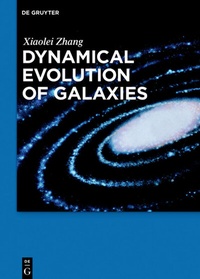
Dynamical Evolution of Galaxies
Description

This research monograph presents a new dynamical framework for the study of secular morphological evolution of galaxies along the Hubble sequence. Classical approaches based on Boltzmann's kinetic equation, as well as on its moment-equation descendants the Euler and Navier-Stokes fluid equations, are inadequate for treating the maintenance and long-term evolution of systems containing self-organized structures such as galactic density-wave modes. A global and synthetic approach, incorporating correlated fluctuations of the constituent particles during a nonequilibrium phase transition, is adopted to supplement the continuum treatment. The cutting-edge research combining analytical, N-body simulational, and observational aspects, as well as the fundamental-physics connections it provides, make this work a valuable reference for researchers and graduate students in astronomy, astrophysics, cosmology, many-body physics, complexity theory, and other related fields.
Contents
Dynamical Drivers of Galaxy Evolution
N-Body Simulations of Galaxy Evolution
Astrophysical Implications of the Dynamical Theory
Putting It All Together
Concluding Remarks
Appendix: Relation to Kinetics and Fluid Mechanics
More details
Other editions
Additional editions
Person
Content
Preface page
1 Introduction
1.1 Observational Background
1.2 Theoretical Background
1.3 Organization of the Material
2 Drivers of Secular Morphological Evolution of Galaxies
2.1 Motivations for the Theoretical Approach
2.2 Density Wave Crest as the Site of Gravitational Instability
2.3 Potential-Density Phase Shifts for Density Wave Modes
2.4 Linear Regime and Quasi-Steady State of the Wave Modes
2.5 Torque Coupling and Angular Momentum Transport
2.6 Rates of Secular Evolution
2.7 Relation to "Broadening of Resonances"
2.8 In a Nutshell
3 Verification of Analytical Results through N-Body Simulations
3.1 Overview of the N-Body Simulations of Disk Galaxies
3.2 Simulation Codes and Basic State Specifications
3.3 Signature of Collisionless Shock in N-Body Spirals
3.4 Modal Nature of a Spontaneously-Formed Pattern
3.5 Qualitative Signature of Secular Mass Redistribution
3.6 Longevity of the Spiral Modes
3.7 Role of Gas
3.8 Implication on Orbits as "Building Blocks"
3.9 Second Generation Tests
4 Astrophysical Implications of the New Dynamical Theory
4.1 Motivations and General Outline
4.2 Potential-Density Phase Shift (PDPS) Method for CR Determination
4.3 Secular Mass Migration and Bulge Building
4.4 Secular Heating and The Age-Velocity-Dispersion Relation
4.5 Secular Heating and the Size-Linewidth Relation
4.6 Other Characteristics of the Milky Way Galaxy and External Galaxies
4.7 Universal Rotation Curve
4.8 Secular Evolution and the Maintenance of Galaxy Scaling Relations
4.9 Butcher-Oemler Effect and Evolution of Cluster Galaxies
4.10 Secular Evolution and the Origin of Color-Magnitude Relation
4.11 An Example of Secular Evolution in Interacting Galaxies
4.12 Black-Hole-Mass and Bulge-Mass Correlation
5 Putting in All Together: What We Have Learned So Far
5.1 Reexamine the Foundations
5.2 Role of Basic State Specification
5.3 Broader Implications
5.4 Implications on the Cosmological Evolution of Galaxies
6 Concluding Remarks
7 Appendix. Nonequilibrium Phase Transition and Classical Mechanics
7.1 Foundation of Kinetic Theory: the Boltzmann Equation
7.2 From Kinetic Theory to Fluid Mechanics
7.3 Nonequilibrium Phase Transition and Galaxy Evolution
7.4 The Proper Choice of Hierarchies
8 References
