

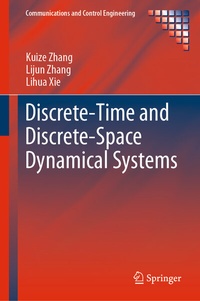
Discrete-Time and Discrete-Space Dynamical Systems
Description

- Boolean control networks;
- nondeterministic finite-transition systems;
- finite automata;
- labelled Petri nets; and
- cellular automata.
Academic researchers with backgrounds in applied mathematics, engineering or computer science and practising engineers working with discrete-time and discrete-space systems will find this book a helpful source of new understanding for this increasingly important class of systems. The basic results to be found within are of fundamental importance for further study of related problems such as automated synthesis and safety control in cyber-physical systems using formal methods.
More details
Other editions
Additional editions
Persons
Lijun Zhang received the Ph.D. degree in Systems Theory from Chinese Academy of Sciences, China, in 2003. From August 2003 to July 2005, he held a postdoc position at Tsinghua University, China. From March 2004 to November 2004, he worked as a visiting scholar at National University of Singapore. From October 2006 to January 2007, he worked as a visiting scholar at City University of Hong Kong. From August 2005 to November 2011, he was a professor of Harbin Engineering University. Since 2012, he has been with the College of Marine Science and Technology of Northwestern Polytechnical University, where he is currently a professor. He has been a reviewer of Mathematical Reviews since 2008. His research interests include nonlinear systems control and identification, logic dynamic systems theory, adaptive signal processing, etc. He was a recipient of New Century Excellent Talents in University of Ministry of Education of China. Currently he serves as Associate Editor of the Journal of Systems Sciences and Mathematics (in Chinese). He was also an author or coauthor of more than 60 journal or conference papers.
Lihua Xie received the B.E. and M.E. degrees in electrical engineering from Nanjing University of Science and Technology in 1983 and 1986, respectively, and the Ph.D. degree in electrical engineering from the University of Newcastle, Australia, in 1992. Since 1992, he has been with the School of Electrical and Electronic Engineering, Nanyang Technological University, Singapore, where he is currently a professor and Director, Delta-NTU Corporate Laboratory for Cyber-Physical Systems. He served as the Head of Division of Control and Instrumentation from July 2011 to June 2014. He held teaching appointments in the Department of Automatic Control, Nanjing University of Science and Technology from 1986 to 1989. Dr. Xie's research interests include robust control and estimation, networked control systems, multi-agent networks, localization and unmanned systems. He is an Editor-in-Chief for Unmanned Systems and an Associate Editor for IEEE Transactions on Network Control Systems. He has served as an editor of IET Book Series in Control and an Associate Editor of a number of journals including IEEE Transactions on Automatic Control, Automatica, IEEE Transactions on Control Systems Technology, and IEEE Transactions on Circuits and Systems-II. He is an elected member of Board of Governors, IEEE Control System Society (January 2016-December 2018). Dr. Xie is a Fellow of the IEEE and Fellow of the IFAC.