

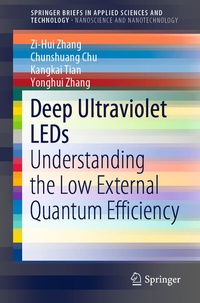
Deep Ultraviolet LEDs
Description

This book highlights the origin of low external quantum efficiency for deep ultraviolet light-emitting diodes (DUV LEDs). In addition, it puts forward solutions for increasing the internal quantum efficiency and the light extraction efficiency of DUV LEDs. The book chiefly concentrates on approaches that can be used to improve the crystalline quality, increase carrier injection, reduce the polarization-induced electric field within multiple quantum wells, suppress the TM polarization emission, and enhance the light escape from the semiconductor layer. It also demonstrates insightful device physics for DUV LEDs, which will greatly benefit the optoelectronic community.
More details
Other editions
Additional editions
Persons
Ms. Chunshuang Chu received her B.S. from the Department of Physics at Hebei North University in 2016. She is currently pursuing her Ph.D. at the School of Electronics and Information Engineering, Hebei University of Technology. Her research interests include device fabrication, characterization, simulation and design for III-nitride based semiconductor devices.
Mr. Kangkai Tian received his B.E. degree from the School of Electronics and Information of Nantong University in 2016. He is currently pursuing his Ph.D. degree at the School of Electronics and Information, Hebei University of Technology. His major focus is on the design and fabrication of III-nitride based light-emitting diodes and electronic devices.
Dr. Yonghui Zhang received his Bachelor's and Master's degrees from Hebei University of Technology in 2007 and Beijing University of Technology, respectively. After earning his Ph.D. from the Institution of Semiconductors, Chinese Academy of Sciences in 2015, he began teaching and research work at Hebei University of Technology. His main research interest is in GaN-based light emitting diodes (LEDs) with micro- or nano-structure. In this regard he is employing a range of nanotechnologies, including nano-patterned sapphire substrate, photonic crystal and core-shell technology, to improve the quantum efficiency of LED. He has published more than 20 papers related to these fields in international mainstream journals, and holds six patents.
Content
1.Introduction.- 2.Increase the IQE by improving the crystalline quality for DUV LEDs.- 3.Improve the current spreading for DUV LEDs.- 4.Improve the hole injection to enhance the IQE for DUV LEDs.- 5.Enhance the electron injection efficiency for DUV LEDs.- 6.Screen the polarization induce electric field within the MQWs for DUV LEDs.- 7.Thermal management for DUV LEDs.- 8.The light extraction efficiency for DUV LEDs.- 9. Conclusions and outlook.
