

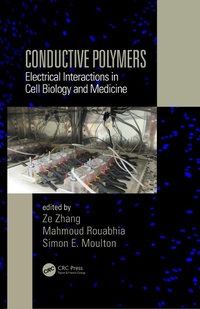
Conductive Polymers
Electrical Interactions in Cell Biology and Medicine
1st Edition
Published on 3. September 2018
440 pages
978-1-351-64529-4 (ISBN)
Description

This book is dedicated to the field of conductive polymers, focusing on electrical interactions with biological systems. It addresses the use of conductive polymers as the conducting interface for electrical communications with the biological system, both in vitro and in vivo. It provides an overview on the chemistry and physics of conductive polymers, their useful characteristics as well as limitations, and technologies that apply conductive polymers for medical purposes. This groundbreaking resource addresses cytotoxicity and tissue compatibility of conductive polymers, the basics on electromagnetic fields, and commonly used experimental methods. Readers will also learn how cells are cultured in vitro with conductive polymers, and how conductive polymers and living tissues interact electrically. Throughout the contents, chapter authors emphasize the importance of conductive polymers in biomedical engineering and their potential applications in medicine.
Reviews / Votes
"Profs. Zhang, Rouabhia, and Moulton have assembled a group of investigators that are working on issues ranging from materials synthesis, device characterization, and analytical measurements of performance. Of particular interest and value are several reports from clinically-inclined investigators that describe recent studies of electrically-mediated cell response. These areas represent opportunities for future developments and collaborations between chemists, materials scientists, biomedical engineers, and physicians. Taken together, these chapters provide a comprehensive overview of issues related to the interface between active devices and biological systems"-David C. Martin, Karl W. and Renate Boeer Professor of Materials Science & Engineering, University of Delaware (from the Foreword)
More details
Series
Edition
1. Auflage
Language
English
Place of publication
London
United Kingdom
Publishing group
Taylor & Francis Ltd
Target group
College/higher education
Product notice
Reflowable
Illustrations
118 Illustrations, black and white
ISBN-13
978-1-351-64529-4 (9781351645294)
Copyright in bibliographic data and cover images is held by Nielsen Book Services Limited or by the publishers or by their respective licensors: all rights reserved.
Schweitzer Classification
Other editions
Additional editions
Ze Zhang | Mahmoud Rouabhia | Simon E. Moulton
Conductive Polymers
Electrical Interactions in Cell Biology and Medicine
Book
03/2021
1st Edition
CRC Press
€63.13
Shipment within 15-20 days
Ze Zhang | Mahmoud Rouabhia | Simon E. Moulton
Conductive Polymers
Electrical Interactions in Cell Biology and Medicine
Book
04/2017
1st Edition
CRC Press
€349.12
Article not available for order
Persons
Dr. Ze Zhang is a full professor of the Department of Surgery at Laval University and a senior researcher in the Division of Regenerative Medicine of CHU in Quebec City. He received bachelor's and master's degrees in engineering from Chengdu University of Science & Technology (now Sichuan University) in 1982 and 1984, and then a PhD degree in experimental medicine from Laval University in 1993. After a postdoctoral training in Japan he returned to Laval University in 1995. Dr. Ze Zhang's main research focuses are cardiovascular implants and tissue repair using synthetic polymers and electrical stimulation. He has published more than 100 peer-reviewed papers and 4 book chapters.
Dr. Mahmoud Rouabhia is a full professor at the Faculty of Dentistry of Laval University. He is a senior scientist in the field of Immunologyimmunology, cell biology, and tissue engineering. He got his PhD in France, followed by a postdoctoral training for four years in Canada. Dr. Rouabhia research interest includes studying the interaction between human cells biomaterials and electrical stimulation for better wound healing. Dr. Rouabhia has more than 130 peer-reviewed scientific publications. He also published over 15 book chapters/review articles, and two patents. He is the editor/coeditor of two books in the field of tissue engineering and wound healing.
Dr. Simon E. Moulton is a full professor of Biomedical Electromaterials Science in the Faculty of Science, Engineering and Technology at Swinburne University of Technology. He completed his PhD at the University of Wollongong in 2002 and has developed a substantial research track record in the synthesis and fabrication of organic conducting materials for use in a variety of biomedical applications. He has a strong focus in materials chemistry research with an emphasis in developing composite biomaterials through the integration of electroactive materials with conventional biomaterials. He has published 1 book, 4 book chapters and 95 journal papers with an h-index of 27.
Dr. Mahmoud Rouabhia is a full professor at the Faculty of Dentistry of Laval University. He is a senior scientist in the field of Immunologyimmunology, cell biology, and tissue engineering. He got his PhD in France, followed by a postdoctoral training for four years in Canada. Dr. Rouabhia research interest includes studying the interaction between human cells biomaterials and electrical stimulation for better wound healing. Dr. Rouabhia has more than 130 peer-reviewed scientific publications. He also published over 15 book chapters/review articles, and two patents. He is the editor/coeditor of two books in the field of tissue engineering and wound healing.
Dr. Simon E. Moulton is a full professor of Biomedical Electromaterials Science in the Faculty of Science, Engineering and Technology at Swinburne University of Technology. He completed his PhD at the University of Wollongong in 2002 and has developed a substantial research track record in the synthesis and fabrication of organic conducting materials for use in a variety of biomedical applications. He has a strong focus in materials chemistry research with an emphasis in developing composite biomaterials through the integration of electroactive materials with conventional biomaterials. He has published 1 book, 4 book chapters and 95 journal papers with an h-index of 27.
Content
Early History of Conductive Organic Polymers
Synthesis of Biomedically Relevant Conducting Polymers
Properties and Characterization of Conductive Polymers
Mechanism in Charge Transfer and Electrical Stability
Industry Viable Metal Anti-corrosion Application of Polyaniline
Medical Device Implants for Neuromodulation. The Electromagnetic Nature of Protein-Protein Interactions
The Impact of Electric Fields on Cell Processes, Membrane Proteins and Intracellular Signaling Cascades
Lipid-Protein Electrostatic Interactions in the Regulation of Membrane-Protein Activities
Experimental Methods to Manipulate Cultured Cells with Electrical and Electromagnetic Fields
The Neurotrophic Factor Rationale for Using Brief Electrical Stimulation to Promote Peripheral Nerve Regeneration in Animal Models and Human Patients
In vitro Modulatory Effects of Electrical Field on Fibroblasts
The Role of Electrical Field on Neurons: In vitro Studies
Modulation of Bone Cell Activities in vitro by Electrical and Electromagnetic Stimulations
Electrical Stimulation of Cells Derived from Muscle
The Response of Endothelial Cells to Endogenous Bioelectric Fields
The Role of Electrical Field on Stem Cells In Vitro
Effects of Electrical Stimulation on Cutaneous Wound Healing: Evidence from in vitro Studies and Clinical Trials
Effect of Electrical Stimulation on Bone Healing
Synthesis of Biomedically Relevant Conducting Polymers
Properties and Characterization of Conductive Polymers
Mechanism in Charge Transfer and Electrical Stability
Industry Viable Metal Anti-corrosion Application of Polyaniline
Medical Device Implants for Neuromodulation. The Electromagnetic Nature of Protein-Protein Interactions
The Impact of Electric Fields on Cell Processes, Membrane Proteins and Intracellular Signaling Cascades
Lipid-Protein Electrostatic Interactions in the Regulation of Membrane-Protein Activities
Experimental Methods to Manipulate Cultured Cells with Electrical and Electromagnetic Fields
The Neurotrophic Factor Rationale for Using Brief Electrical Stimulation to Promote Peripheral Nerve Regeneration in Animal Models and Human Patients
In vitro Modulatory Effects of Electrical Field on Fibroblasts
The Role of Electrical Field on Neurons: In vitro Studies
Modulation of Bone Cell Activities in vitro by Electrical and Electromagnetic Stimulations
Electrical Stimulation of Cells Derived from Muscle
The Response of Endothelial Cells to Endogenous Bioelectric Fields
The Role of Electrical Field on Stem Cells In Vitro
Effects of Electrical Stimulation on Cutaneous Wound Healing: Evidence from in vitro Studies and Clinical Trials
Effect of Electrical Stimulation on Bone Healing
