

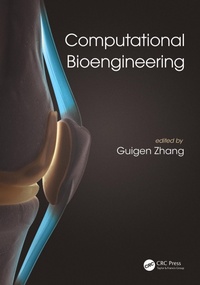
Computational Bioengineering
1st Edition
Published on 1. April 2015
508 pages
978-1-4665-1756-1 (ISBN)
Description

Arguably the first book of its kind, Computational Bioengineering explores the power of multidisciplinary computer modeling in bioengineering. Written by experts, the book examines the interplay of multiple governing principles underlying common biomedical devices and problems, bolstered by case studies. It shows you how to take advantage of the la
Reviews / Votes
"... an excellent overview of state-of-the-art methods developed to approach complex cardiovascular problems. It provides a way to model the integrative physiology aspects of the circulatory system - an aspect necessary when dealing with "patient specific" modeling."-Lakshmi Prasad Dasi, Colorado State University
"... very well written ... large range of computation modeling approaches discussed in the book and that have been developed to address a broad spectrum of problems in the field of bioengineering."
-Sundar Srinivasan, University of Washington
"... presents a timely and interactive compilation of work in the forefronts of computational bioengineering. ... ideal for the use in both research and training; it will benefit and bringer closer the scientific computation and bioengineering communities."-Hao Lin, Rutgers, The State University of New Jersey "... an excellent overview of state-of-the-art methods developed to approach complex cardiovascular problems. It provides a way to model the integrative physiology aspects of the circulatory system - an aspect necessary when dealing with "patient specific" modeling."
-Lakshmi Prasad Dasi, Colorado State University
"... very well written ... large range of computation modeling approaches discussed in the book and that have been developed to address a broad spectrum of problems in the field of bioengineering."
-Sundar Srinivasan, University of Washington
"... presents a timely and interactive compilation of work in the forefronts of computational bioengineering. ... ideal for the use in both research and training; it will benefit and bringer closer the scientific computation and bioengineering communities."-Hao Lin, Rutgers, The State University of New Jersey
Zhang (Clemson Univ.) has compiled writings from a long list of contributors in this 17-chapter volume. The book presents a range of examples of modern computational bioengineering topics in areas such as the cardiovascular and skeletomuscular systems, and transport phenomena and mechanics that lend themselves well to quantitative analysis. The work bridges multiple scales, from nanopores and matrix microstructure to whole organ systems. Each chapter starts with the biological background of the topic, followed by the theoretical underpinnings and then a description of a computational model, along with some representative results and often some comparison with experimental data. The chapters range in focus from basic physiology to more clinically applied biomedical topics, which will be particularly interesting to biomedical engineering students. Readers will not necessarily take away from this book the ability to implement any of these modern computational techniques, but they will gain an increased awareness of the breadth of computational bioengineering research, and a wealth of appropriate references are provided where readers can learn more. The data graphs and schematics in both gray scale and color are easy to read and informative. The book is appropriate for advanced students and postgraduate practitioners new to bioengineering.
-CHOICE, June 2016 Issue
More details
Edition
1. Auflage
Language
English
Place of publication
Baton Rouge
United States
Publishing group
Taylor & Francis Inc
Target group
College/higher education
Illustrations
202 s/w Abbildungen, 19 s/w Tabellen
202 b/w images, 19 tables and 284
File size
43,62 MB
ISBN-13
978-1-4665-1756-1 (9781466517561)
Copyright in bibliographic data and cover images is held by Nielsen Book Services Limited or by the publishers or by their respective licensors: all rights reserved.
Schweitzer Classification
Other editions
Additional editions
Guigen Zhang
Computational Bioengineering
Book
10/2017
1st Edition
CRC Press
€136.66
Shipment within 10-20 days
Guigen Zhang
Computational Bioengineering
Book
04/2015
1st Edition
CRC Press
€371.40
Shipment within 15-20 days
Person
Guigen Zhang, PhD, is a professor of bioengineering and of electrical and computer engineering at Clemson University. He is the executive director of the Institute for Biological Interfaces of Engineering, a research and education/training institute designated by the South Carolina Commission on Higher Education. Prof. Zhang is also a fellow of the American Institute for Medical and Biological Engineering (AIMBE). He has published extensively in the areas of biomechanics, biomaterials, and biosensors, and he holds numerous patents in nanotechnology-enhanced structures and biosensors.
Content
Preface 1. An Integrative Way of Solving Bioengineering Problems 2. Toward Predicting the Performance of Joint Arthroplasty 3. Mathematical Modelling of Basic Multicellular Units: The Functional Units of Bone Remodeling 4. Effect of Nonlinearity in Tensioned Wires of an External Fixation Device 5. Viscoelasticity of Load-Bearing Soft Tissues: Constitutive Formulation, Numerical Integration, and Computational Implementation 6. Physical Signals and Solute Transport in Human Intervertebral Disc: Multiphasic Mechano-Electrochemical Finite Element Analysis 7. Multiscale Modeling of Cardiovascular Flows 8. Computational Fluid Modeling of Heart Valves 9. Mathematical Modeling of Cancer Metastases 10. Dynamic Processes in Photodynamic Therapy 11. Computational Cell Phenotyping in the Lab, Plant, and Clinic 12. Molecular Simulation of Protein-Surface Interactions 13. Structure of the Electrical Double Layers: Insights from Continuum and Atomistic Simulations 14. A Solid-State Nanopore as Biosensor 15. DNA Electrokinetic Translocation through a Nanopore16. Dielectrophoresis for Bioengineering Applications and Some Associated Issues 17. Image-Based Modeling for Bioengineering Problems
