

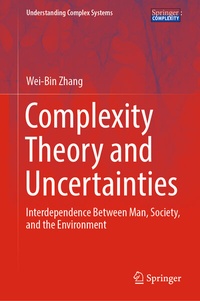
Complexity Theory and Uncertainties
Description

This book provides an overview of recent developments of complexity theory within the realm of social sciences. At a time when global and local social, political, cultural, and economic affairs are engulfed in chaos, this book sheds light on the mechanisms of uncertainties, offering new visions and frameworks for analyzing the nonlinear interactions between individuals, societies, and the environment.
From exploring the foundational elements that shape our understanding of humanity, such as worldviews, justice, and trust, to applying complexity theory in the realms of politics, economics, management, strategies, and wars, this monograph provides a comprehensive examination of its far-reaching implications. By examining historical bifurcations and structural changes in American history and China's modern development, it emphasizes how complexity theory can serve as a bridge for intellectual and cultural communication between Western (Newtonian) and East Asian (yin-yang-based) civilizations.
Moreover, the book elucidates that nonlinear phenomena, including bifurcations, catastrophes, structural changes, emergence of structures, and chaos, are integral aspects of human evolution. It unveils the positive potential within chaos, demonstrating that a comprehensive understanding of catastrophic mechanisms enables humanity to prevent global disasters by leading systems to chaotic attractors without destructive consequences. Through an exploration of the intricate interdependencies among individuals, societies, and the environment, this book offers a unique and comprehensive introduction to the application of complexity theory to the realm of humanity.
More details
Other editions
Additional editions
Person
Wei-Bin Zhang, Ph.D. (Umeå, Sweden), is Professor of Economics at Ritsumeikan Asia Pacific University, Japan. His main research fields are complexity theory (synergertic economics, chaos theory, or nonlinear economic dynamics), general economic theory, Confucianism and East Asian economic development, and ancient thought of China. He has published 240 academic articles in peer-review international journals and authorized 28 academic books. Prof. Zhang is Editorial Board Member of 12 international journals. He is Editor of Encyclopedia of Mathematical Models in Economics (in two volumes) as a part of the unprecedented global effort, The Encyclopedias of Life Support Systems, organized by UNESCO.
Content
Chapter 1. Complexity Theory and Broadened Rationality on Man and Society.- Chapter 2. Influential Linearized Theories on Man and Society.- Chapter 3. Bifurcations, Chaos, and Unpredictability.- Chapter 4. Self-Organization, Catastrophes, and Structural Changes.- Chapter 5 Uncertainties with Power, Wealth, and Sexuality.
