

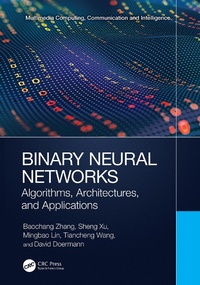
Binary Neural Networks
Algorithms, Architectures, and Applications
1st Edition
Published on 13. December 2023
215 pages
978-1-003-81679-9 (ISBN)
Description

Deep learning has achieved impressive results in image classification, computer vision, and natural language processing. To achieve better performance, deeper and wider networks have been designed, which increase the demand for computational resources. The number of floatingpoint operations (FLOPs) has increased dramatically with larger networks, and this has become an obstacle for convolutional neural networks (CNNs) being developed for mobile and embedded devices. In this context, Binary Neural Networks: Algorithms, Architectures, and Applications will focus on CNN compression and acceleration, which are important for the research community. We will describe numerous methods, including parameter quantization, network pruning, low-rank decomposition, and knowledge distillation. More recently, to reduce the burden of handcrafted architecture design, neural architecture search (NAS) has been used to automatically build neural networks by searching over a vast architecture space. Our book will also introduce NAS and binary NAS and its superiority and state-of-the-art performance in various applications, such as image classification and object detection. We also describe extensive applications of compressed deep models on image classification, speech recognition, object detection, and tracking. These topics can help researchers better understand the usefulness and the potential of network compression on practical applications. Moreover, interested readers should have basic knowledge of machine learning and deep learning to better understand the methods described in this book.
Key Features
Reviews recent advances in CNN compression and acceleration
Elaborates recent advances on binary neural network (BNN) technologies
Introduces applications of BNN in image classification, speech recognition, object detection, and more
Key Features
Reviews recent advances in CNN compression and acceleration
Elaborates recent advances on binary neural network (BNN) technologies
Introduces applications of BNN in image classification, speech recognition, object detection, and more
More details
Series
Edition
1. Auflage
Language
English
Place of publication
London
United Kingdom
Publishing group
Taylor & Francis Ebooks
Target group
College/higher education
Professional and scholarly
Illustrations
31 Tables, black and white; 85 Line drawings, black and white; 19 Halftones, black and white; 104 Illustrations, black and white
ISBN-13
978-1-003-81679-9 (9781003816799)
Copyright in bibliographic data and cover images is held by Nielsen Book Services Limited or by the publishers or by their respective licensors: all rights reserved.
Schweitzer Classification
Other editions
Additional editions
Baochang Zhang | Sheng Xu | Mingbao Lin
Binary Neural Networks
Algorithms, Architectures, and Applications
Book
05/2025
1st Edition
CRC Press
€74.60
Shipment within 10-20 days
Baochang Zhang | Sheng Xu | Mingbao Lin
Binary Neural Networks
Algorithms, Architectures, and Applications
Book
12/2023
1st Edition
CRC Press
€173.90
Shipment within 10-20 days
Persons
Baochang Zhang is a full Professor with Institute of Artificial Intelligence, Beihang University, Beijing, China. He was selected by the Program for New Century Excellent Talents in University of Ministry of Education of China, also selected as Academic Advisor of Deep Learning Lab of Baidu Inc., and a distinguished researcher of Beihang Hangzhou Institute in Zhejiang Province. His research interests include explainable deep learning, computer vision and patter recognition. His HGPP and LDP methods were state-of-the-art feature descriptors, with 1234 and 768 Google Scholar citations, respectively. Both are "Test-of-Time" works. Our 1-bit methods achieved the best performance on ImageNet. His group also won the ECCV 2020 tiny object detection, COCO object detection, and ICPR 2020 Pollen recognition challenges.
Sheng Xu received the B.E. degree in Automotive Engineering from Beihang University, Beijing, China. He is currently a Ph.D. with the school of Automation Science and Electrical Engineering, Beihang University, Beijing, China, specializing in computer vision, model quantization, and compression. He has made significant contributions to the field and has published about a dozen papers as the first author in top-tier conferences and journals such as CVPR, ECCV, NeurIPS, AAAI, BMVC, IJCV, and ACM TOMM. Notably, he has 4 papers selected as oral or highlighted presentations by these prestigious conferences. Furthermore, Sheng Xu actively participates in the academic community as a reviewer for various international journals and conferences, including CVPR, ICCV, ECCV, NeurIPS, ICML, and IEEE TCSVT. His expertise has also led to his group's victory in the ECCV 2020 tiny object detection challenge.
Mingbao Lin finished his M.S.-Ph.D. study and obtained the Ph.D. degree in intelligence science and technology from Xiamen University, Xiamen, China, in 2022. Earlier, he received the B.S. degree from Fuzhou University, Fuzhou, China, in 2016. He is currently a senior researcher with the Tencent Youtu Lab, Shanghai, China. His publications on top-tier conferences/journals include IEEE TPAMI, IJCV, IEEE TIP, IEEE TNNLS, CVPR, NeurIPS, AAAI, IJCAI, ACM MM and so on. His current research interest is to develop efficient vision model, as well as information retrieval.
Tiancheng Wang received the B.E. degree in Automation from Beihang University, Beijing, China. He is currently pursuing the Ph.D. degree with the school of Institute of Artificial Intelligence, Beihang University, Beijing, China. During undergraduate, he has been awarded the title of Merit Student for several consecutive years, and has received various scholarships including academic excellence scholarship and academic competitions scholarship, etc. He was involved in several AI projects, including behavior detection and intention understanding research and unmanned air-based vision platform, etc. Now, his current research interests include deep learning and network compression, his goal is to explore the highly energy-saving model and drive the deployment of neural networks in embedded devices.
Dr. David Doermann is a Professor of Empire Innovation at the University at Buffalo (UB) and the Director of the University at Buffalo Artificial Intelligence Institute. Prior to coming to UB, he was a program manager at the Defense Advanced Research Projects Agency (DARPA), where he developed, selected and oversaw approximately $150 million in research and transition funding in the areas of computer vision, human language technologies and voice analytics. He coordinated performers on all of the projects, orchestrating consensus, evaluating cross team management and overseeing fluid program objectives.
Sheng Xu received the B.E. degree in Automotive Engineering from Beihang University, Beijing, China. He is currently a Ph.D. with the school of Automation Science and Electrical Engineering, Beihang University, Beijing, China, specializing in computer vision, model quantization, and compression. He has made significant contributions to the field and has published about a dozen papers as the first author in top-tier conferences and journals such as CVPR, ECCV, NeurIPS, AAAI, BMVC, IJCV, and ACM TOMM. Notably, he has 4 papers selected as oral or highlighted presentations by these prestigious conferences. Furthermore, Sheng Xu actively participates in the academic community as a reviewer for various international journals and conferences, including CVPR, ICCV, ECCV, NeurIPS, ICML, and IEEE TCSVT. His expertise has also led to his group's victory in the ECCV 2020 tiny object detection challenge.
Mingbao Lin finished his M.S.-Ph.D. study and obtained the Ph.D. degree in intelligence science and technology from Xiamen University, Xiamen, China, in 2022. Earlier, he received the B.S. degree from Fuzhou University, Fuzhou, China, in 2016. He is currently a senior researcher with the Tencent Youtu Lab, Shanghai, China. His publications on top-tier conferences/journals include IEEE TPAMI, IJCV, IEEE TIP, IEEE TNNLS, CVPR, NeurIPS, AAAI, IJCAI, ACM MM and so on. His current research interest is to develop efficient vision model, as well as information retrieval.
Tiancheng Wang received the B.E. degree in Automation from Beihang University, Beijing, China. He is currently pursuing the Ph.D. degree with the school of Institute of Artificial Intelligence, Beihang University, Beijing, China. During undergraduate, he has been awarded the title of Merit Student for several consecutive years, and has received various scholarships including academic excellence scholarship and academic competitions scholarship, etc. He was involved in several AI projects, including behavior detection and intention understanding research and unmanned air-based vision platform, etc. Now, his current research interests include deep learning and network compression, his goal is to explore the highly energy-saving model and drive the deployment of neural networks in embedded devices.
Dr. David Doermann is a Professor of Empire Innovation at the University at Buffalo (UB) and the Director of the University at Buffalo Artificial Intelligence Institute. Prior to coming to UB, he was a program manager at the Defense Advanced Research Projects Agency (DARPA), where he developed, selected and oversaw approximately $150 million in research and transition funding in the areas of computer vision, human language technologies and voice analytics. He coordinated performers on all of the projects, orchestrating consensus, evaluating cross team management and overseeing fluid program objectives.
Content
Chapter 1: Introduction.
Chapter 2: Quantization of Neural Networks.
Chapter 3: Algorithms for Binary Neural Networks.
Chapter 4: Binary Neural Architecture Search.
Chapter 5: Applications in Natural Language Processing.
Chapter 6: Applications in Computer Vision.
Bibliography.
Chapter 2: Quantization of Neural Networks.
Chapter 3: Algorithms for Binary Neural Networks.
Chapter 4: Binary Neural Architecture Search.
Chapter 5: Applications in Natural Language Processing.
Chapter 6: Applications in Computer Vision.
Bibliography.
