

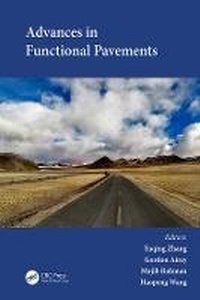
Advances in Functional Pavements
Proceedings of the 7th Chinese-European Workshop on Functional Pavement (CEW 2023), Birmingham, UK, 2-4 July 2023
1st Edition
Published on 15. November 2023
352 pages
978-1-003-85677-1 (ISBN)
Description

Advances in Functional Pavements is a collection of papers presented at the 7th Chinese-European Workshop (CEW) on Functional Pavement (Birmingham, UK, 2-4 July 2023).
The focus of the CEW series is on field tests, laboratory test methods and advanced analysis techniques, and covers analysis, material development and production, experimental characterization, design and construction of pavements. The main areas covered by the book include:
Green pavements for circular and low-carbon economy
Intelligent pavements for future and smart cities
Durable pavements for long-life infrastructures
Safe pavements for user-friendly build environments
Advances in Functional Pavements aims at contributing to the establishment of a new generation of pavement design methodologies in which rational mechanics principles, advanced constitutive models and advanced material characterization techniques shall constitute the backbone of the design process. The book will be much of interest to professionals, academics and practitioners in pavement engineering and related disciplines as it should assist them in providing improved road pavement infrastructure to their stakeholders.
The focus of the CEW series is on field tests, laboratory test methods and advanced analysis techniques, and covers analysis, material development and production, experimental characterization, design and construction of pavements. The main areas covered by the book include:
Green pavements for circular and low-carbon economy
Intelligent pavements for future and smart cities
Durable pavements for long-life infrastructures
Safe pavements for user-friendly build environments
Advances in Functional Pavements aims at contributing to the establishment of a new generation of pavement design methodologies in which rational mechanics principles, advanced constitutive models and advanced material characterization techniques shall constitute the backbone of the design process. The book will be much of interest to professionals, academics and practitioners in pavement engineering and related disciplines as it should assist them in providing improved road pavement infrastructure to their stakeholders.
More details
Edition
1. Auflage
Language
English
Place of publication
London
United Kingdom
Publishing group
Taylor & Francis Ebooks
Target group
College/higher education
Professional and scholarly
Product notice
Reflowable
ISBN-13
978-1-003-85677-1 (9781003856771)
Copyright in bibliographic data and cover images is held by Nielsen Book Services Limited or by the publishers or by their respective licensors: all rights reserved.
Schweitzer Classification
Other editions
Additional editions
Yuqing Zhang | Gordon Airey | Mujib Rahman
Advances in Functional Pavements
Proceedings of the 7th Chinese-European Workshop on Functional Pavement (CEW 2023), Birmingham, UK, 2-4 July 2023
Book
11/2023
1st Edition
CRC Press
€197.00
Shipment within 10-20 days
Persons
Yuqing Zhang is a Professor in Highway Engineering at Southeast University, China. Prior to that, Dr Zhang was a Senior Lecturer and the Director of the Aston Institute of Materials Research (AIMR) at Aston University in Birmingham, UK. He graduated from Texas A&M University, US. with a PhD degree in Civil Engineering. His research is focused on mechanics-based multiscale and multiphysics modelling of pavement materials and structures. He also works on renewable materials for sustainable roads and intelligent technologies for future city infrastructures. His research has been funded by the EU's Horizon 2020, UK's Engineering and Physical Sciences Research Council (EPSRC), Royal Society, Royal Academy of Engineering, British Academy, British Council and construction industries. Over 100 technical papers were published resulting from his research. Dr Zhang serves on the steering committee of the UK's National Asphalt Research Consortium (NARC) and he also serves as an associate editor of ASCE's Journal of Transportation Engineering, Part B: Pavements. Dr Zhang is the recipient of the 2020 Theodore von Karman Fellowship from RWTH Aachen University, Germany.
Gordon Airey is Professor of Pavement Engineering Materials and Director of the Nottingham Transportation Engineering Centre (NTEC) at the University of Nottingham. He currently serves as President of the European Asphalt Technology Association (EATA) and as a Director-at-Large on the Board of Directors of the International Society for Asphalt Pavements (ISAP). Professor Airey is also a Director of the Forum of European National Highway Research Laboratories (FEHRL) and an Associate Editor on the Editorial Board of Road Materials and Pavement Design. Professor Airey has been involved in pavement engineering research for over 30 years and has authored and co-authored over 400 journal and conference publications as well as contributing chapters to various pavement engineering and construction material textbooks. His research interests include rheological characterisation of bituminous binders; durability of asphalt materials; the use of secondary and recycled materials in pavement applications; the use of thermodynamic approaches to moisture damage characterisation and the development of aggregate and bitumen adhesion testing methodologies; and the multiscale modelling and testing of bitumen-mineral aggregate systems. Professor Airey is also an active member on numerous technical committees of both ISAP and the International Union of Laboratories and Experts in Construction Materials, Systems and Structures (RILEM) as well as Director of the National Asphalt Research Consortium (NARC) in the UK.
Mujib Rahman is Professor in Civil Engineering and Head of Department of Civil Engineering at Aston University. With over 20 years of experience in pavement engineering as a researcher and consultant, he has made significant contributions to more than 100 research and consultancy projects and has written many technical reports on pavement design and evaluation reports, published over 100 journal and conference articles and has also authored a book on the deterioration of pavement. His research interests primarily focus on the characterisation of asphalt materials, protection and durability of porous construction material, pavement maintenance and rehabilitation, with a special emphasis on utilising sensor technology for defect detection and quantification, as well as asset management. In addition to his research and academic contributions, Professor Rahman has served as the Chief Editor for the ICE Transport journal and currently serves as an editorial board member for various prominent journals.
Haopeng Wang is Lecturer in Civil Engineering at the University of Liverpool. Before joining the University of Liverpool, he was a Marie Sklodowska-Curie Individual Fellow sponsored by the European Union's flagship funding program Horizon 2020 at the University of Nottingham from 2021 to 2023. He received his Ph.D. degree from Delft University of Technology in 2021. His research interests include multiphysics modelling of pavement materials and structures, polymer physics and chemistry, micromechanics of infrastructure materials, damage mechanisms in asphalt mixture (fracture, fatigue and healing), and sustainable pavement materials and technologies. He has an internationally recognised track record of publications in the fields of sustainable asphalt materials and engineering mechanics. Dr. Wang is a member of several international academic associations, e.g., Transportation Research Board (TRB), RILEM, International Society for Asphalt Pavements (ISAP), Academy of Pavement Science and Engineering (APSE), and International Association of Chinese Infrastructure Professionals (IACIP). He is the recipient of several academic awards from prestigious international associations and conferences. He is also actively involved in organising academic conferences, e.g., Transportation Research Congress (TRC) and Chinese-European Workshop on functional pavements (CEW). He also participates in several industrial innovations.
Gordon Airey is Professor of Pavement Engineering Materials and Director of the Nottingham Transportation Engineering Centre (NTEC) at the University of Nottingham. He currently serves as President of the European Asphalt Technology Association (EATA) and as a Director-at-Large on the Board of Directors of the International Society for Asphalt Pavements (ISAP). Professor Airey is also a Director of the Forum of European National Highway Research Laboratories (FEHRL) and an Associate Editor on the Editorial Board of Road Materials and Pavement Design. Professor Airey has been involved in pavement engineering research for over 30 years and has authored and co-authored over 400 journal and conference publications as well as contributing chapters to various pavement engineering and construction material textbooks. His research interests include rheological characterisation of bituminous binders; durability of asphalt materials; the use of secondary and recycled materials in pavement applications; the use of thermodynamic approaches to moisture damage characterisation and the development of aggregate and bitumen adhesion testing methodologies; and the multiscale modelling and testing of bitumen-mineral aggregate systems. Professor Airey is also an active member on numerous technical committees of both ISAP and the International Union of Laboratories and Experts in Construction Materials, Systems and Structures (RILEM) as well as Director of the National Asphalt Research Consortium (NARC) in the UK.
Mujib Rahman is Professor in Civil Engineering and Head of Department of Civil Engineering at Aston University. With over 20 years of experience in pavement engineering as a researcher and consultant, he has made significant contributions to more than 100 research and consultancy projects and has written many technical reports on pavement design and evaluation reports, published over 100 journal and conference articles and has also authored a book on the deterioration of pavement. His research interests primarily focus on the characterisation of asphalt materials, protection and durability of porous construction material, pavement maintenance and rehabilitation, with a special emphasis on utilising sensor technology for defect detection and quantification, as well as asset management. In addition to his research and academic contributions, Professor Rahman has served as the Chief Editor for the ICE Transport journal and currently serves as an editorial board member for various prominent journals.
Haopeng Wang is Lecturer in Civil Engineering at the University of Liverpool. Before joining the University of Liverpool, he was a Marie Sklodowska-Curie Individual Fellow sponsored by the European Union's flagship funding program Horizon 2020 at the University of Nottingham from 2021 to 2023. He received his Ph.D. degree from Delft University of Technology in 2021. His research interests include multiphysics modelling of pavement materials and structures, polymer physics and chemistry, micromechanics of infrastructure materials, damage mechanisms in asphalt mixture (fracture, fatigue and healing), and sustainable pavement materials and technologies. He has an internationally recognised track record of publications in the fields of sustainable asphalt materials and engineering mechanics. Dr. Wang is a member of several international academic associations, e.g., Transportation Research Board (TRB), RILEM, International Society for Asphalt Pavements (ISAP), Academy of Pavement Science and Engineering (APSE), and International Association of Chinese Infrastructure Professionals (IACIP). He is the recipient of several academic awards from prestigious international associations and conferences. He is also actively involved in organising academic conferences, e.g., Transportation Research Congress (TRC) and Chinese-European Workshop on functional pavements (CEW). He also participates in several industrial innovations.
Content
Green pavements for circular and low-carbon economy, Intelligent pavements for future and smart cities, Durable pavements for long-life infrastructures, Safe pavements for user-friendly build environments
