

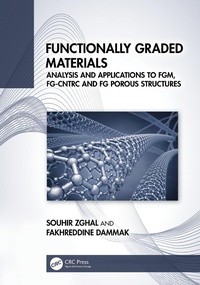
Functionally Graded Materials
Analysis and Applications to FGM, FG-CNTRC and FG Porous Structures
1st Edition
Published on 27. August 2024
428 pages
978-1-040-10324-1 (ISBN)
Description

Functionally Graded Materials: Analysis and Applications to FGM, FG-CNTRC and FG Porous Structures aims to disseminates knowledge between users, manufacturers, designers, and researchers involved in structures or structural components manufactured using functionally graded materials.
Despite a number of existing texts on the theory and analysis of plates and/or shells, there is not a single book that is devoted entirely to the analysis of functionally graded-based materials including FGMs, FG-CNTRCs and FG porous plates and shells. Functionally Graded Materials provides the reader with current research conducted in the field of composite materials, numerical simulations, computer methods and mechanical responses of structural components under different scenarios.
This book is a valuable reference source for postgraduate students, engineers, scientists, professors, researchers, and applied mathematicians in this field.
Despite a number of existing texts on the theory and analysis of plates and/or shells, there is not a single book that is devoted entirely to the analysis of functionally graded-based materials including FGMs, FG-CNTRCs and FG porous plates and shells. Functionally Graded Materials provides the reader with current research conducted in the field of composite materials, numerical simulations, computer methods and mechanical responses of structural components under different scenarios.
This book is a valuable reference source for postgraduate students, engineers, scientists, professors, researchers, and applied mathematicians in this field.
More details
Edition
1. Auflage
Language
English
Place of publication
London
United Kingdom
Publishing group
Taylor & Francis Ltd
Target group
College/higher education
Professional and scholarly
Illustrations
114 Tables, black and white; 309 Line drawings, black and white; 17 Halftones, black and white; 326 Illustrations, black and white
ISBN-13
978-1-040-10324-1 (9781040103241)
Copyright in bibliographic data and cover images is held by Nielsen Book Services Limited or by the publishers or by their respective licensors: all rights reserved.
Schweitzer Classification
Other editions
Additional editions
Souhir Zghal | Fakhreddine Dammak
Functionally Graded Materials
Analysis and Applications to FGM, FG-CNTRC and FG Porous Structures
Book
05/2026
1st Edition
CRC Press
€84.50
Shipment within 10-20 days
Souhir Zghal | Fakhreddine Dammak
Functionally Graded Materials
Analysis and Applications to FGM, FG-CNTRC and FG Porous Structures
Book
08/2024
1st Edition
CRC Press
€240.70
Shipment within 10-20 days

Souhir Zghal | Fakhreddine Dammak
Functionally Graded Materials
Analysis and Applications to Fgm, Fg-Cntrc and FG Porous Structures
Book
08/2024
CRC Press
Unfortunately, price unknown
Available (delivery time upon request)
Persons
Dr. Souhir ZGHAL, Associate professor at high Institute of Applied Science and Technology of
University of Gabes, Gabes, Tunisia. She was born on 01 June 1985 in Sfax where she received the
high school degree at Majida Boulila lyceum, in 2004. In 2009, she has received her mechanical engineering
degree from National Engineering School of Tunis (ENIT). She has received her P.h.d in
mechanical engineering in 2015 from National Engineering School of Tunis (ENIT) and FEMTOST
Institute, University of Franche-Comt?e, Besancon-France. Her research interests include finite
element analysis, composite structures, computers methods and simulations, advanced materials like
functionally graded materials (FGM), Carbon nanotubes, porosity, and graphene platelets, Structural
dynamics, vibrations, viscoelasticity, sandwich structures, Nonlinear dynamics, computational
structural mechanics, Stress analysis, Algorithms. Her group is particularly interested in research
problems related to structural advanced materials by developing finite element codes and computers
methods that able to investigate various geometries with different shapes and with a vast areas
of analysis like bending, vibrations, dynamics, mechanical and thermal buckling and post-buckling
responses of FGM, FG-CNTRC, porous-FGM based beams, plates and shells. An ambitious group
with a creative master head has published more than 200 scientific articles and communications
in the most recognized mechanical engineering journals and conferences proceedings. As a young
researcher in mechanical engineering field, she has received over 1500 citations and an h-index
of 17 (Data from Scopus January 2024). She is also a recognized reviewer in the most impactful
international journals through Elsevier, Springer, Taylor and Francis, Sages publishing CO.
Prof. Fakhreddine DAMMAK, Full professor at National School of Engineers of Sfax (ENIS),
Sfax, Tunisia. He was born on 16 November 1962 in Sfax and he has obtained his Ph.D. degree
in mechanical engineering from Laval university, Quebec, Canada in 1997. During the period of
1998 to 2004 he was assistant at National Institute of Applied Science and technologies of Tunis,
Tunisia. Then, he was joined the National School of Engineers of Sfax (ENIS), in 2005 as an
associate professor in mechanical engineering. He has taught over twenty different graduate and undergraduate courses in mechanical engineering and has conducted four courses covering the finite
element and plate/shell modeling codes for engineer students. He has over 250 technical/scientific
papers published in the international journals and conferences with an h-index of 36 (Data from
Scopus January 2024) He is expert in finite element modeling, structural analysis, materials science
covering new materials like functionally graded materials, carbon-nanotubes reinforced composite
(FG-CNTRC), FG porous structures, smart materials, nanocomposite, sheet forming and more on.
He is also a member of the scientific communities of Design and Modeling of Mechanical Systems
international conference with its all editions and a reviewer of over 40 different international journals.
He is the distinguished professor of finite element codes of Ministry of Higher Education and
Research in Tunisia.
University of Gabes, Gabes, Tunisia. She was born on 01 June 1985 in Sfax where she received the
high school degree at Majida Boulila lyceum, in 2004. In 2009, she has received her mechanical engineering
degree from National Engineering School of Tunis (ENIT). She has received her P.h.d in
mechanical engineering in 2015 from National Engineering School of Tunis (ENIT) and FEMTOST
Institute, University of Franche-Comt?e, Besancon-France. Her research interests include finite
element analysis, composite structures, computers methods and simulations, advanced materials like
functionally graded materials (FGM), Carbon nanotubes, porosity, and graphene platelets, Structural
dynamics, vibrations, viscoelasticity, sandwich structures, Nonlinear dynamics, computational
structural mechanics, Stress analysis, Algorithms. Her group is particularly interested in research
problems related to structural advanced materials by developing finite element codes and computers
methods that able to investigate various geometries with different shapes and with a vast areas
of analysis like bending, vibrations, dynamics, mechanical and thermal buckling and post-buckling
responses of FGM, FG-CNTRC, porous-FGM based beams, plates and shells. An ambitious group
with a creative master head has published more than 200 scientific articles and communications
in the most recognized mechanical engineering journals and conferences proceedings. As a young
researcher in mechanical engineering field, she has received over 1500 citations and an h-index
of 17 (Data from Scopus January 2024). She is also a recognized reviewer in the most impactful
international journals through Elsevier, Springer, Taylor and Francis, Sages publishing CO.
Prof. Fakhreddine DAMMAK, Full professor at National School of Engineers of Sfax (ENIS),
Sfax, Tunisia. He was born on 16 November 1962 in Sfax and he has obtained his Ph.D. degree
in mechanical engineering from Laval university, Quebec, Canada in 1997. During the period of
1998 to 2004 he was assistant at National Institute of Applied Science and technologies of Tunis,
Tunisia. Then, he was joined the National School of Engineers of Sfax (ENIS), in 2005 as an
associate professor in mechanical engineering. He has taught over twenty different graduate and undergraduate courses in mechanical engineering and has conducted four courses covering the finite
element and plate/shell modeling codes for engineer students. He has over 250 technical/scientific
papers published in the international journals and conferences with an h-index of 36 (Data from
Scopus January 2024) He is expert in finite element modeling, structural analysis, materials science
covering new materials like functionally graded materials, carbon-nanotubes reinforced composite
(FG-CNTRC), FG porous structures, smart materials, nanocomposite, sheet forming and more on.
He is also a member of the scientific communities of Design and Modeling of Mechanical Systems
international conference with its all editions and a reviewer of over 40 different international journals.
He is the distinguished professor of finite element codes of Ministry of Higher Education and
Research in Tunisia.
Content
Table of Contents
Chapter 1. Kinematic models of functionally gradient-based shells
Chapter 2. Thermal analysis of FGM structures using (I-FSDT)
Chapter 3. Buckling and post-buckling of FGM plates and shells
Chapter 4. Mechanical analysis of FG-CNTRC structures
Chapter 5. Nonlinear analysis of FG-CNTRC plates and shells
Chapter 6. Buckling and post-buckling of FG-CNTRC plates and shells
Chapter 7. Bending and free vibration analysis of FG porous beams
Chapter 8. Mechanical analysis of FG porous structures
Appendices
Chapter 1. Kinematic models of functionally gradient-based shells
Chapter 2. Thermal analysis of FGM structures using (I-FSDT)
Chapter 3. Buckling and post-buckling of FGM plates and shells
Chapter 4. Mechanical analysis of FG-CNTRC structures
Chapter 5. Nonlinear analysis of FG-CNTRC plates and shells
Chapter 6. Buckling and post-buckling of FG-CNTRC plates and shells
Chapter 7. Bending and free vibration analysis of FG porous beams
Chapter 8. Mechanical analysis of FG porous structures
Appendices
