

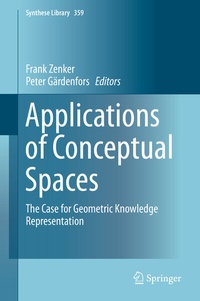
Applications of Conceptual Spaces
Description

This volume provides an overview of applications of conceptual spaces theory, beginning with an introduction to the modeling tool that unifies the chapters. The first section explores issues of linguistic semantics, including speakers' negotiation of meaning. Further sections address computational and ontological aspects of constructing conceptual spaces, while the final section looks at philosophical applications. Domains include artificial intelligence and robotics, epistemology and philosophy of science, lexical semantics and pragmatics, agent-based simulation, perspectivism, framing, contrast, sensory modalities, and music, among others.
This collection provides evidence of the wide application range of this theory of knowledge representation. The papers in this volume derive from international experts across different fields including philosophy, cognitive science, linguistics, robotics, computer science and geography. Each contributor has successfully applied conceptual spaces theory as a modeling tool in their respective areas of expertise. Graduates as well as researchers in the areas of epistemology, linguistics, geometric knowledge representation, and the mathematical modeling of cognitive processes should find this book of particular interest.
More details
Other editions
Additional editions
Persons
Peter Gärdenfors is a professor of cognitive science at Lund University, Sweden. He is a member of the Royal Swedish Academy of Letters, History and Antiquities and recipient of the Gad Rausing Prize. Internationally, he is one of Sweden's most notable philosophers. In 2009, he was elected a member of the Royal Swedish Academy of Sciences.
Frank Zenker is a researcher in philosophy at Lund University, Sweden, funded by the Swedish Research Council. Having obtained his doctorate in philosophy of science at the University of Hamburg, Germany, he has worked with Peter Gärdenfors on applying conceptual spaces to theory-dynamical processes in the empirical sciences. He is the editor of "Bayesian Argumentation" (Synthese Library Vol 362, 2013).
Content
Part I. Introduction.- Editors' introduction: Conceptual spaces at work; Peter Gärdenfors and Frank Zenker.- Part II. Semantic Spaces.- From conceptual spaces to predicates; Jean-Louis Dessalles.- Conceptual spaces at work in sensory cognition: Domains, dimensions and distances; Carita Paradis.- Conceptual spaces, features and word meanings: The case of Dutch shirts; Joost Zwarts.- Meaning negotiation; Massimo Warglien and Peter Gärdenfors.- Part III. Computing Meanings.- How to talk to each other via computers: Semantic interoperability as conceptual imitation; Simon Scheider and Werner Kuhn.- Self-organization of conceptual spaces from quality dimensions; Paul Vogt.- Conceptual spaces and computing with words; Janet Aisbett, John Rickard and Greg Gibbon.- Logical, Ontological and cognitive aspects of objects types and trans-world identity with applications to the theory of conceptual spaces; Giancarlo Guizzardi.- A cognitive architecture for music perception exploiting conceptual spaces; Antonio Chella.- Part IV. Philosophical Perspectives.- Conceptual spaces as philosophers' tools; Lieven Decock and Igor Douven.- Specification of the unified conceptual space, for purposes of empirical investigation; Joel Parthemore.- A perspectivist approach to conceptual spaces; Mauri Kaipanen and Antti Hautamäki.- Communication, rationality, and conceptual changes in scientific theories; Frank Zenker and Peter Gärdenfors.
