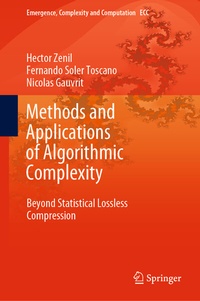
Methods and Applications of Algorithmic Complexity
Description

This book explores a different pragmatic approach to algorithmic complexity rooted or motivated by the theoretical foundations of algorithmic probability and explores the relaxation of necessary and sufficient conditions in the pursuit of numerical applicability, with some of these approaches entailing greater risks than others in exchange for greater relevance and applicability.
Some established and also novel techniques in the field of applications of algorithmic (Kolmogorov) complexity currently coexist for the first time, ranging from the dominant ones based upon popular statistical lossless compression algorithms (such as LZW) to newer approaches that advance, complement, and also pose their own limitations. Evidence suggesting that these different methods complement each other for different regimes is presented, and despite their many challenges, some of these methods are better grounded in or motivated by the principles of algorithmic information.
The authors propose that the field can make greater contributions to science, causation, scientific discovery, networks, and cognition, to mention a few among many fields, instead of remaining either as a technical curiosity of mathematical interest only or as a statistical tool when collapsed into an application of popular lossless compression algorithms. This book goes, thus, beyond popular statistical lossless compression and introduces a different methodological approach to dealing with algorithmic complexity.
For example, graph theory and network science are classic subjects in mathematics widely investigated in the twentieth century, transforming research in many fields of science from economy to medicine. However, it has become increasingly clear that the challenge of analyzing these networks cannot be addressed by tools relying solely on statistical methods. Therefore, model-driven approaches are needed. Recent advances in network science suggest that algorithmic informationtheory could play an increasingly important role in breaking those limits imposed by traditional statistical analysis (entropy or statistical compression) in modeling evolving complex networks or interacting networks. Further progress on this front calls for new techniques for an improved mechanistic understanding of complex systems, thereby calling out for increased interaction between systems science, network theory, and algorithmic information theory, to which this book contributes.
Reviews / Votes
"The book starts practically from scratch: It defines Turing machines, Kolmogorov complexity, etc. So this book can be recommended not only to researchers in this area, but also to students and to researchers from other areas interested in complexity issues." (Vladik Ya. Kreinovich, zbMATH 1497.68008, 2022)More details
Other editions
Additional editions