

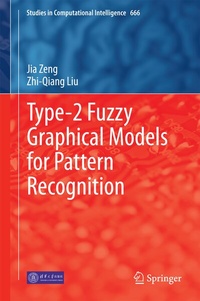
Type-2 Fuzzy Graphical Models for Pattern Recognition
Description

This book discusses how to combine type-2 fuzzy sets and graphical models to solve a range of real-world pattern recognition problems such as speech recognition, handwritten Chinese character recognition, topic modeling as well as human action recognition. It covers these recent developments while also providing a comprehensive introduction to the fields of type-2 fuzzy sets and graphical models. Though primarily intended for graduate students, researchers and practitioners in fuzzy logic and pattern recognition, the book can also serve as a valuable reference work for researchers without any previous knowledge of these fields. Dr. Jia Zeng is a Professor at the School of Computer Science and Technology, Soochow University, China. Dr. Zhi-Qiang Liu is a Professor at the School of Creative Media, City University of Hong Kong, China.
More details
Other editions
Additional editions
Persons
Prof. Jia ZENG is currently working at the School of Computer Science and Technology, Soochow University, Suzhou 215006, China. Before that, he was a Visiting Research Scholar with the Department of Computer Science, Hong Kong Baptist University from 2009 to 2010 and a Research Fellow in the Department of Electronic Engineering, City University of Hong Kong from 2006 to 2008. He obtained Ph.D. from School of Creative Media, City University of Hong Kong in October 2006, and B.Eng. with excellent academic honors at Wuhan University of Technology, China in 2002. His research interests have been mainly in the areas of type-2 fuzzy systems, probabilistic graphical models, pattern recognition and computational biology. He has authored and co-authored a number of publications appearing in high-profile journals and leading conferences. He won the 2006 Postgraduate Student Paper Contest, Second Prize, IEEE Region 10 and 2005 Postgraduate Student Paper Contest, First Prize, IEEE Region 10, respectively. He has also been invited to serve in a number of journals and conferences as the reviewer.
Prof Zhi-Qiang LIU received the M.A.Sc. degree in Aerospace Engineering from the Institute for Aerospace Studies, the University of Toronto, and the Ph.D. degree in Electrical Engineering from The University of Alberta, Canada. He is currently at the School of Creative Media, City University of Hong Kong. He has taught computer architecture, computer networks, artificial intelligence, programming languages, machine learning, pattern recognition, computer graphics, and art & technology. His interests are neural-fuzzy systems, machine learning, media computing and computer vision.
