

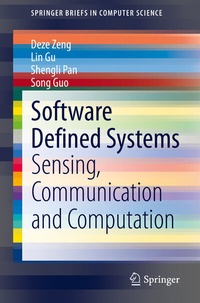
Software Defined Systems
Sensing, Communication and Computation
1st Edition
Published on 25. November 2019
XVI, 111 pages
978-3-030-32942-6 (ISBN)
Description

This book introduces the software defined system concept, architecture, and its enabling technologies such as software defined sensor networks (SDSN), software defined radio, cloud/fog radio access networks (C/F-RAN), software defined networking (SDN), network function virtualization (NFV), software defined storage, virtualization and docker. The authors also discuss the resource allocation and task scheduling in software defined system, mainly focusing on sensing, communication, networking and computation.
Related case studies on SDSN, C/F-RAN, SDN, NFV are included in this book, and the authors discuss how these technologies cooperate with each other to enable cross resource management and task scheduling in software defined system. Novel resource allocation and task scheduling algorithms are introduced and evaluated.
This book targets researchers, computer scientists and engineers who are interested in the information system softwarization technologies, resource allocation and optimization algorithm design, performance evaluation and analysis, next-generation communication and networking technologies, edge computing, cloud computing and IoT. Advanced level students studying these topics will benefit from this book as well.
Related case studies on SDSN, C/F-RAN, SDN, NFV are included in this book, and the authors discuss how these technologies cooperate with each other to enable cross resource management and task scheduling in software defined system. Novel resource allocation and task scheduling algorithms are introduced and evaluated.
This book targets researchers, computer scientists and engineers who are interested in the information system softwarization technologies, resource allocation and optimization algorithm design, performance evaluation and analysis, next-generation communication and networking technologies, edge computing, cloud computing and IoT. Advanced level students studying these topics will benefit from this book as well.
More details
Series
Language
English
Place of publication
Cham
Switzerland
Publishing group
Springer International Publishing
Target group
Professional and scholarly
Product notice
Reflowable
Illustrations
XVI, 111 p. 40 illus., 38 illus. in color.
File size
2,95 MB
ISBN-13
978-3-030-32942-6 (9783030329426)
DOI
10.1007/978-3-030-32942-6
Schweitzer Classification
Other editions
Additional editions
Book
12/2019
Springer
€53.49
Shipment within 7-9 days
Persons
Deze Zeng
is currently a Full Professor in School of Computer Science, China University of Geosciences, Wuhan, China. He received his Ph.D. and M.S. degrees in computer science from University of Aizu, Aizu-Wakamatsu, Japan, in 2013 and 2009, respectively. He received his B.S. degree from School of Computer Science and Technology, Huazhong University of Science and Technology, China in 2007. His current research interests include: network function virtualization, software-defined networking, cloud computing and edge computing. He has authored 1 book and over 80 papers in refereed journals and conferences in these areas. He also received 3 best paper awards from IEEE/ACM conferences and the IEEE Systems Journal Annual Best Paper Award of 2017. He serves in editorial boards of Journal of Network and Computer Applications, Frontiers of Computer Science, and guest editors of many prestigious journals. He has been the in organization or program committees of many international conferences including ICPADS, ICA3PP, CollaberateCom, MobiQuitous, ICC, Globecom. He is a member of IEEE.
Lin Gu received her Ph.D. and M.S. degrees in computer science from the University of Aizu in 2015 and 2011, respectively. She received her B.S. degree from the School of Computer Science and Technology, Huangzhou University of Science and Technology (HUST), in 2009. She is now with the Services Computing Technology and System Lab, Cluster and Grid Computing Lab in the School of Computer Science and Technology, HUST. Her current research interests include cloud computing, big data, and software-defined networking.
Shengli Pan received his B.E. and Ph.D. degrees from University of Electronic Science and Technology of China in 2011 and 2016, respectively. From Nov. 2014 to Nov. 2015, he was a visiting Ph.D. student in Swiss Federal Institute of Technology in Lausanne (EPFL), supervised by Prof. Katerina Argyraki. He has become an assistant professor in the School of Computer Science, China University of Geosciences since 2017. Currently, he is also an on-the-job post-doc in Prof. Ying-chang Liang's (IEEE, Fellow, Thomson Reuters Highly Cited Researchers) lab at University of Electronic Science and Technology of China. His main research interests include computer networks, network measurements, and network security.
Song Guo is a Full Professor at Department of Computing, The Hong Kong Polytechnic University. He received his Ph.D. in computer science from University of Ottawa and was a professor with the University of Aizu from 2007 to 2016. His research interests are mainly in the areas of big data, cloud computing and networking, and distributed systems with over 400 papers published in major conferences and journals. His work was recognized by the 2016 Annual Best of Computing: Notable Books and Articles in Computing in ACM Computing Reviews. He is the recipient of the 2017IEEE Systems Journal Annual Best Paper Award and other five Best Paper Awards from IEEE/ACM conferences. His research has been sponsored by JSPS, JST, MIC, NSF, NSFC, and industrial companies. Prof. Guo was an Associate Editor of IEEE Transactions on Parallel and Distributed Systems 2011-2015 and an IEEE Communications Society Distinguished Lecturer 2016-2017. He is now on the editorial boards of IEEE Transactions on Cloud Computing, IEEE Transactions on Emerging Topics in Computing, IEEE Transactions on Sustainable Computing, IEEE Transactions on Green Communications and Networking, and IEEE Communications. Prof. Guo also served as General, TPC and Symposium Chair for numerous IEEE conferences. He currently is the Member of Board of Governors and Director of Membership Services of IEEE Communications Society.
Lin Gu received her Ph.D. and M.S. degrees in computer science from the University of Aizu in 2015 and 2011, respectively. She received her B.S. degree from the School of Computer Science and Technology, Huangzhou University of Science and Technology (HUST), in 2009. She is now with the Services Computing Technology and System Lab, Cluster and Grid Computing Lab in the School of Computer Science and Technology, HUST. Her current research interests include cloud computing, big data, and software-defined networking.
Shengli Pan received his B.E. and Ph.D. degrees from University of Electronic Science and Technology of China in 2011 and 2016, respectively. From Nov. 2014 to Nov. 2015, he was a visiting Ph.D. student in Swiss Federal Institute of Technology in Lausanne (EPFL), supervised by Prof. Katerina Argyraki. He has become an assistant professor in the School of Computer Science, China University of Geosciences since 2017. Currently, he is also an on-the-job post-doc in Prof. Ying-chang Liang's (IEEE, Fellow, Thomson Reuters Highly Cited Researchers) lab at University of Electronic Science and Technology of China. His main research interests include computer networks, network measurements, and network security.
Song Guo is a Full Professor at Department of Computing, The Hong Kong Polytechnic University. He received his Ph.D. in computer science from University of Ottawa and was a professor with the University of Aizu from 2007 to 2016. His research interests are mainly in the areas of big data, cloud computing and networking, and distributed systems with over 400 papers published in major conferences and journals. His work was recognized by the 2016 Annual Best of Computing: Notable Books and Articles in Computing in ACM Computing Reviews. He is the recipient of the 2017IEEE Systems Journal Annual Best Paper Award and other five Best Paper Awards from IEEE/ACM conferences. His research has been sponsored by JSPS, JST, MIC, NSF, NSFC, and industrial companies. Prof. Guo was an Associate Editor of IEEE Transactions on Parallel and Distributed Systems 2011-2015 and an IEEE Communications Society Distinguished Lecturer 2016-2017. He is now on the editorial boards of IEEE Transactions on Cloud Computing, IEEE Transactions on Emerging Topics in Computing, IEEE Transactions on Sustainable Computing, IEEE Transactions on Green Communications and Networking, and IEEE Communications. Prof. Guo also served as General, TPC and Symposium Chair for numerous IEEE conferences. He currently is the Member of Board of Governors and Director of Membership Services of IEEE Communications Society.
Content
1 Introduction.- 2 Software Defined Sensing.- 3 Software Defined Communication.- 4 Software Defined Networking I: SDN.- 5 Software Defined Networking II: NFV.- 6 Conclusion and Future Research Directions.- References.
