

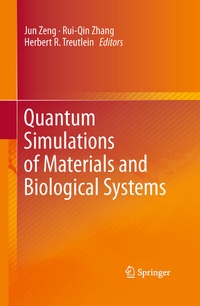
Quantum Simulations of Materials and Biological Systems
Description

Quantum Simulations of Materials and Biological Systems features contributions from leading world experts in the fields of density functional theory (DFT) and its applications to material and biological systems.
The recent developments of correlation functionals, implementations of Time-dependent algorithm into DFTB+ method are presented. The applications of DFT method to large materials and biological systems such as understanding of optical and electronic properties of nanoparticles, X-ray structure refinement of proteins, the catalytic process of enzymes and photochemistry of phytochromes are detailed. In addition, the book reviews the recent developments of methods for protein design and engineering, as well as ligand-based drug design. Some insightful information about the 2011 International Symposium on Computational Sciences is also provided.
Quantum Simulations of Materials and Biological Systems
is aimed at faculties and researchers in the fields of computational physics, chemistry and biology, as well as at the biotech and pharmaceutical industries.
More details
Other editions
Additional editions
Content
Towards a greater accuracy in DFT calculations: from GGA to hybrid functionals ( Jessica Hermet, Carlo Adamo, and Pietro Cortona ).- Quantum transport simulations based on time dependent density functional theory ( Thomas A. Niehaus and GuanHua Chen ).- Modelling Silicon Nanostructure Surface Functionalization for Biological Detections ( R.Q. Zhang and Abir De Sarkar ).- QM/MD Simulations of High-Temperature SWCNT Self-Capping ( Hironori Hara, Yoshio Kato, Genki Ichinose, and Stephan Irle ).- Graphene Oxide: Theoretical Perspectives ( Ning Lu and Zhenyu Li ).- First steps towards quantum refinement of protein X-ray structures ( Lars Goerigk, Olle Falköf, Charles A. Collyer, and Jeffrey R. Reimers ).- The inverse protein folding problem: protein design and structure prediction in the genomic era ( Marcel Schmidt am Busch, Anne Lopes, David Mignon, Thomas Gaillard, and Thomas Simonson ).- Integration of Ligand-Based and Structure-Based Approaches for Virtual Screening of Factor Xa Inhibitors ( Xue-Gang Yang, Duan Chen, Ying Xue ).- Principles and Applications of Hybrid Quantum Mechanical and Molecular Mechanical Methods ( Dingguo Xu, Min Zheng and Shanshan Wu ).- A computational perspective on the photochemistry of photosensory proteins: Phytochromes and Anabaena sensory rhodopsin ( Bo Durbeej ).
