

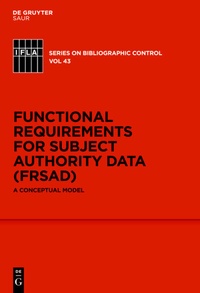
Functional Requirements for Subject Authority Data (FRSAD)
A Conceptual Model
1st Edition
Published on 14. July 2011
VI, 74 pages
978-3-11-026378-7 (ISBN)
Description

The purpose of authority control is to ensure consistency in representing a value - a name of a person, a place name, or a term or code representing a subject - in the elements used as access points in information retrieval. The primary purpose of this study is to produce a framework that will provide a clearly stated and commonly shared understanding of what the subject authority data/record/file aims to provide information about, and the expectation of what such data should achieve in terms of answering user needs.
More details
Other editions
Additional editions
Marcia Lei Zeng | Maja Zumer | Athena Salaba
Functional Requirements for Subject Authority Data (FRSAD)
A Conceptual Model
Book
05/2011
1st Edition
De Gruyter Saur
€99.95
Shipment within 7-9 days
Persons
Athena Salaba and Marcia Lei Zeng, Kent State University, Kent, USA and Maja Zumer, University of Ljubljana, Ljubljana, Slovenia
Content
1 - Contents [Seite 6]
2 - Members of the IFLA Working Group on the Functional Requirements for Subject Authority Records (FRSAR) [Seite 8]
3 - 1. Background [Seite 10]
4 - 2. Purpose and Scope [Seite 12]
4.1 - 2.1 Purpose [Seite 12]
4.2 - 2.2 Scope [Seite 13]
4.3 - 2.3 Aboutness and Ofness [Seite 14]
4.4 - 2.4 Method [Seite 15]
4.5 - 2.5 Components of the Study [Seite 16]
5 - 3. Entities [Seite 18]
5.1 - 3.1 Diagramming Conventions [Seite 18]
5.2 - 3.2 General Framework [Seite 18]
5.3 - 3.3 Choice of Terms for FRSAD Entities [Seite 20]
5.4 - 3.4 THEMA [Seite 20]
5.5 - 3.5 NOMEN [Seite 22]
6 - 4. Attributes [Seite 24]
6.1 - 4.1 Attributes of a THEMA [Seite 24]
6.2 - 4.2 Attributes of a NOMEN [Seite 26]
7 - 5. Relationships [Seite 30]
7.1 - 5.1 WORK-to-THEMA Relationship [Seite 30]
7.2 - 5.2 THEMA-to-NOMEN Relationship [Seite 30]
7.3 - 5.3 THEMA-to-THEMA Relationships [Seite 31]
7.4 - 5.4 NOMEN-to-NOMEN Relationships [Seite 35]
8 - 6. User Tasks [Seite 38]
8.1 - 6.1 Users and Use [Seite 38]
8.2 - 6.2 User Tasks [Seite 39]
8.3 - 6.3 Assessing Values Relative to User Tasks [Seite 40]
8.4 - 6.4 Mapping of Attributes, Relationships, and User Tasks [Seite 42]
9 - 7. Conclusion [Seite 44]
10 - Appendix A. Modeling Aboutness [Seite 46]
10.1 - A.1 Subject Relationship and Group 3 Entities Introduced in FRBR [Seite 46]
10.2 - A.2 Possible Approaches to the Model of Aboutness [Seite 47]
11 - Appendix B. Relationship of FRSAD with FRBR and FRAD [Seite 52]
11.1 - B.1 Relationship of FRSAD with FRBR [Seite 52]
11.2 - B.2 Relationship of FRSAD with FRAD [Seite 53]
12 - Appendix C. FRSAD Model and Other Models [Seite 56]
12.1 - C.1 The Importance of the THEMA-NOMEN Model [Seite 56]
12.2 - C.2 Mapping the FRSAD Model to Other Models [Seite 57]
12.3 - C.3 Conclusion [Seite 58]
13 - Appendix D. Examples from Subject Authority Systems [Seite 60]
13.1 - D.1 Existing Models of THEMA Types [Seite 60]
13.2 - D.2 THEMA-THEMA Relationships presented in Subject Authority Data [Seite 64]
13.3 - D.3 Same THEMA Represented by NOMENs from Different Schemes [Seite 73]
13.4 - D.4 Examples of Display Records from Controlled Vocabularies or Subject Authority Files [Seite 74]
14 - References [Seite 80]
2 - Members of the IFLA Working Group on the Functional Requirements for Subject Authority Records (FRSAR) [Seite 8]
3 - 1. Background [Seite 10]
4 - 2. Purpose and Scope [Seite 12]
4.1 - 2.1 Purpose [Seite 12]
4.2 - 2.2 Scope [Seite 13]
4.3 - 2.3 Aboutness and Ofness [Seite 14]
4.4 - 2.4 Method [Seite 15]
4.5 - 2.5 Components of the Study [Seite 16]
5 - 3. Entities [Seite 18]
5.1 - 3.1 Diagramming Conventions [Seite 18]
5.2 - 3.2 General Framework [Seite 18]
5.3 - 3.3 Choice of Terms for FRSAD Entities [Seite 20]
5.4 - 3.4 THEMA [Seite 20]
5.5 - 3.5 NOMEN [Seite 22]
6 - 4. Attributes [Seite 24]
6.1 - 4.1 Attributes of a THEMA [Seite 24]
6.2 - 4.2 Attributes of a NOMEN [Seite 26]
7 - 5. Relationships [Seite 30]
7.1 - 5.1 WORK-to-THEMA Relationship [Seite 30]
7.2 - 5.2 THEMA-to-NOMEN Relationship [Seite 30]
7.3 - 5.3 THEMA-to-THEMA Relationships [Seite 31]
7.4 - 5.4 NOMEN-to-NOMEN Relationships [Seite 35]
8 - 6. User Tasks [Seite 38]
8.1 - 6.1 Users and Use [Seite 38]
8.2 - 6.2 User Tasks [Seite 39]
8.3 - 6.3 Assessing Values Relative to User Tasks [Seite 40]
8.4 - 6.4 Mapping of Attributes, Relationships, and User Tasks [Seite 42]
9 - 7. Conclusion [Seite 44]
10 - Appendix A. Modeling Aboutness [Seite 46]
10.1 - A.1 Subject Relationship and Group 3 Entities Introduced in FRBR [Seite 46]
10.2 - A.2 Possible Approaches to the Model of Aboutness [Seite 47]
11 - Appendix B. Relationship of FRSAD with FRBR and FRAD [Seite 52]
11.1 - B.1 Relationship of FRSAD with FRBR [Seite 52]
11.2 - B.2 Relationship of FRSAD with FRAD [Seite 53]
12 - Appendix C. FRSAD Model and Other Models [Seite 56]
12.1 - C.1 The Importance of the THEMA-NOMEN Model [Seite 56]
12.2 - C.2 Mapping the FRSAD Model to Other Models [Seite 57]
12.3 - C.3 Conclusion [Seite 58]
13 - Appendix D. Examples from Subject Authority Systems [Seite 60]
13.1 - D.1 Existing Models of THEMA Types [Seite 60]
13.2 - D.2 THEMA-THEMA Relationships presented in Subject Authority Data [Seite 64]
13.3 - D.3 Same THEMA Represented by NOMENs from Different Schemes [Seite 73]
13.4 - D.4 Examples of Display Records from Controlled Vocabularies or Subject Authority Files [Seite 74]
14 - References [Seite 80]
